Intermediate Risk Management and Capital Growth / Module 4: Expectancy and Survival Lesson 12 of 16
Course Outline — Lesson 12 of 16
M1 Position Sizing Mechanics
1 L1.1 — Risk Percentage: The Only Variable You Fully Control 2 L1.2 — Calculating Position Size from Stop Distance 3 L1.3 — Why Consistent Sizing Matters More Than Sizing Big on Good Trades 4 L1.4 — Lot Size Tools and Broker-Specific Calculations
M2 Drawdown Control
1 L2.1 — Understanding Drawdown: Peak-to-Trough Equity Decline 2 L2.2 — Defining Your Maximum Drawdown and Reset Protocol 3 L2.3 — Losing Streaks Are Normal: Surviving Them Without Damage
M3 Risk-to-Reward Reality
1 L3.1 — What Risk-to-Reward Actually Measures 2 L3.2 — Setting Realistic Targets Based on Structure 3 L3.3 — Partial Exits and Trail Stops Without Destroying Expectancy
M4 Expectancy and Survival
1 L4.1 — Expectancy: The Only Number That Predicts Long-Term Performance 2 L4.2 — Tracking Performance: Building a Minimal Expectancy Log 3 L4.3 — When to Stop Trading: Protecting Survival Capital
M5 Capital Growth Without Overexposure
1 L5.1 — Compounding: How Capital Grows With Consistent Edge 2 L5.2 — Scaling Up: When and How to Increase Risk Parameters 3 L5.3 — Building a Multi-Year Capital Plan
Lesson 12 of 16

L4.2 — Tracking Performance: Building a Minimal Expectancy Log

A minimal performance log records: date, instrument, entry, stop, target, actual exit, R result (e.g. +2R, -1R, +0.5R), and a brief note on setup type. That is six fields. It takes two minutes per trade. From this log, you can calculate win rate, average R on winners and losers, and expectancy at any point with a simple spreadsheet.

The log must be maintained in real-time — not reconstructed from memory at the end of the month. Memory is biased toward remembering wins and minimising losses. The log is the antidote to this bias. It provides the objective data set that makes improvement measurable rather than subjective.
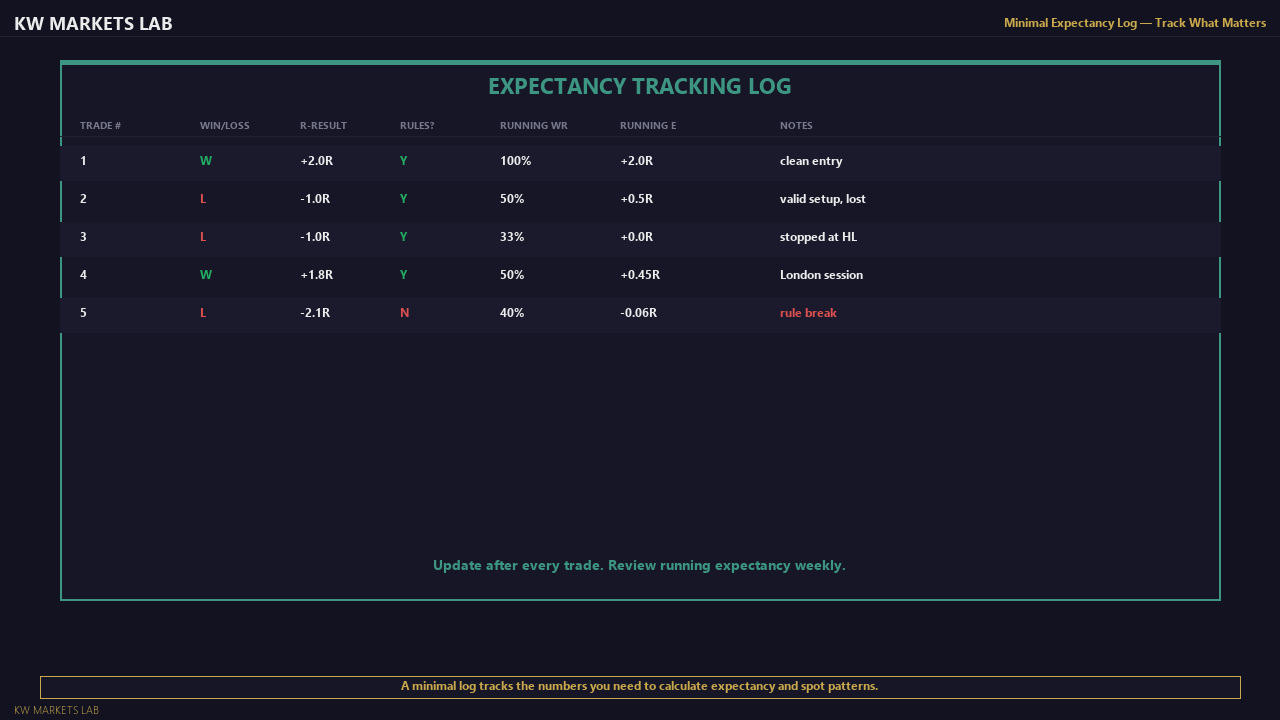
Minimal Expectancy Log
Minimal Expectancy LogA minimal log tracks the numbers you need for expectancy.

Review the log every 20 trades. Ask: is my average win larger than my average loss? Is my win rate approximately what my strategy should produce? Are there consistent patterns in the losses — specific session times, specific instruments, specific setup types that consistently underperform? The log answers these questions. Without it, you are guessing.

Continue Learning
L4.3 — When to Stop Trading: Protecting Survival Capital →
Stay Updated

Get notified when new lessons and content are published.