Intermediate Risk Management and Capital Growth / Module 5: Capital Growth Without Overexposure Lesson 15 of 16
Course Outline — Lesson 15 of 16
M1 Position Sizing Mechanics
1 L1.1 — Risk Percentage: The Only Variable You Fully Control 2 L1.2 — Calculating Position Size from Stop Distance 3 L1.3 — Why Consistent Sizing Matters More Than Sizing Big on Good Trades 4 L1.4 — Lot Size Tools and Broker-Specific Calculations
M2 Drawdown Control
1 L2.1 — Understanding Drawdown: Peak-to-Trough Equity Decline 2 L2.2 — Defining Your Maximum Drawdown and Reset Protocol 3 L2.3 — Losing Streaks Are Normal: Surviving Them Without Damage
M3 Risk-to-Reward Reality
1 L3.1 — What Risk-to-Reward Actually Measures 2 L3.2 — Setting Realistic Targets Based on Structure 3 L3.3 — Partial Exits and Trail Stops Without Destroying Expectancy
M4 Expectancy and Survival
1 L4.1 — Expectancy: The Only Number That Predicts Long-Term Performance 2 L4.2 — Tracking Performance: Building a Minimal Expectancy Log 3 L4.3 — When to Stop Trading: Protecting Survival Capital
M5 Capital Growth Without Overexposure
1 L5.1 — Compounding: How Capital Grows With Consistent Edge 2 L5.2 — Scaling Up: When and How to Increase Risk Parameters 3 L5.3 — Building a Multi-Year Capital Plan
Lesson 15 of 16

L5.2 — Scaling Up: When and How to Increase Risk Parameters

Scaling up means increasing either the risk percentage, the account size under management, or both. Each requires a specific prerequisite. Increasing risk percentage from 0.5% to 1% requires: at least 50 trades at the lower setting with documented positive expectancy, no current drawdown above 5%, and a written review confirming the edge is stable. Doubling risk percentage without these prerequisites doubles both growth and loss potential on an unproven edge.

Adding external capital (from others) requires a different threshold entirely: a minimum 6-month live track record, detailed performance data, and a clear understanding of the legal and compliance requirements for managing others' funds. This course does not cover managed accounts or investment services — this note is a guardrail, not a path forward.
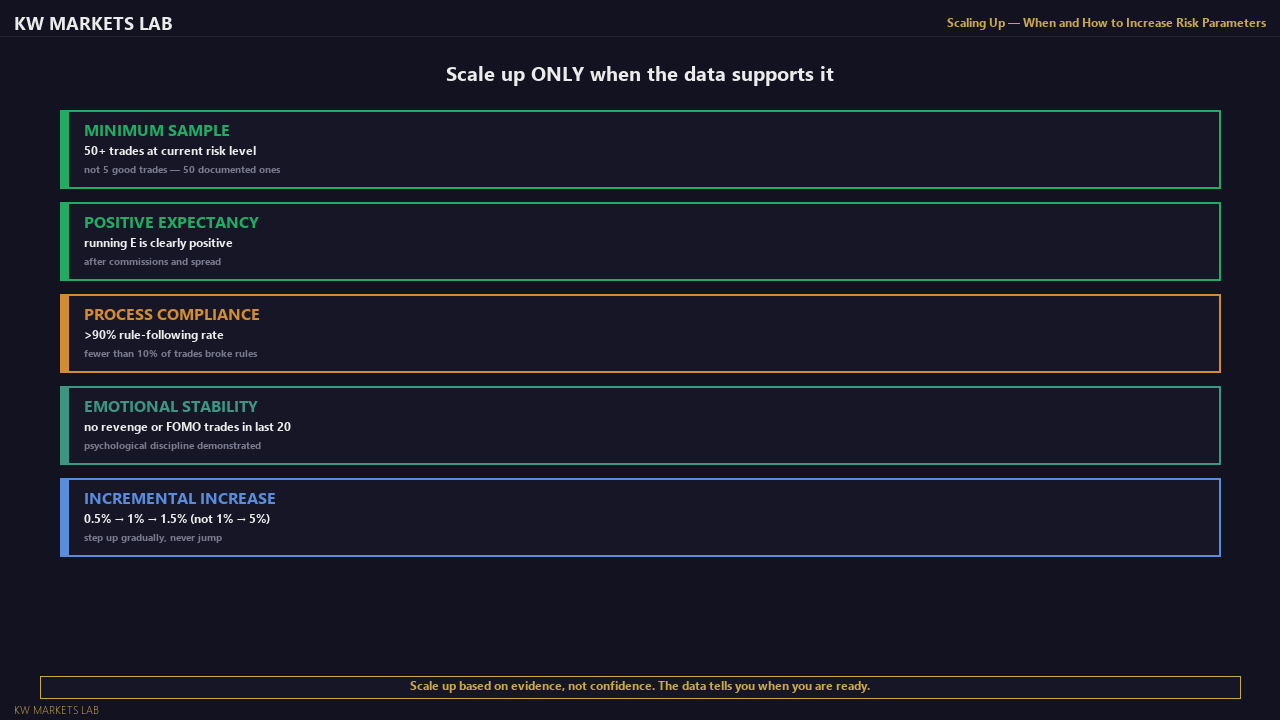
Scaling Up Criteria
Scaling Up CriteriaScale up based on evidence, not confidence.

The rule of thumb: every time you double your risk percentage, you need to requalify your edge at the new level before treating the increase as permanent. What works at 0.5% may feel very different at 2% because the emotional stakes are four times higher. The edge may be the same; your execution under increased pressure may not be.

Continue Learning
L5.3 — Building a Multi-Year Capital Plan →
Stay Updated

Get notified when new lessons and content are published.