Intermediate Risk Management and Capital Growth / Module 3: Risk-to-Reward Reality Lesson 9 of 16
Course Outline — Lesson 9 of 16
M1 Position Sizing Mechanics
1 L1.1 — Risk Percentage: The Only Variable You Fully Control 2 L1.2 — Calculating Position Size from Stop Distance 3 L1.3 — Why Consistent Sizing Matters More Than Sizing Big on Good Trades 4 L1.4 — Lot Size Tools and Broker-Specific Calculations
M2 Drawdown Control
1 L2.1 — Understanding Drawdown: Peak-to-Trough Equity Decline 2 L2.2 — Defining Your Maximum Drawdown and Reset Protocol 3 L2.3 — Losing Streaks Are Normal: Surviving Them Without Damage
M3 Risk-to-Reward Reality
1 L3.1 — What Risk-to-Reward Actually Measures 2 L3.2 — Setting Realistic Targets Based on Structure 3 L3.3 — Partial Exits and Trail Stops Without Destroying Expectancy
M4 Expectancy and Survival
1 L4.1 — Expectancy: The Only Number That Predicts Long-Term Performance 2 L4.2 — Tracking Performance: Building a Minimal Expectancy Log 3 L4.3 — When to Stop Trading: Protecting Survival Capital
M5 Capital Growth Without Overexposure
1 L5.1 — Compounding: How Capital Grows With Consistent Edge 2 L5.2 — Scaling Up: When and How to Increase Risk Parameters 3 L5.3 — Building a Multi-Year Capital Plan
Lesson 9 of 16

L3.2 — Setting Realistic Targets Based on Structure

A structurally valid target is the next significant level in the trade direction where price is likely to encounter resistance or consolidation. In a long trade from a support zone, the target is the next structural resistance — not an arbitrary number of pips, and not the "1:3 target zone" drawn from the entry regardless of what is between the entry and that level.

The honest process: after marking the entry and stop, look at what structural levels exist between the entry and the hypothetical target. If there is a major resistance level at 1:1 R:R that price is very likely to react at, your realistic target is that level — not the 1:3 target beyond it. Taking the partial exit at the 1:1 resistance and trailing the rest is a valid adjustment.
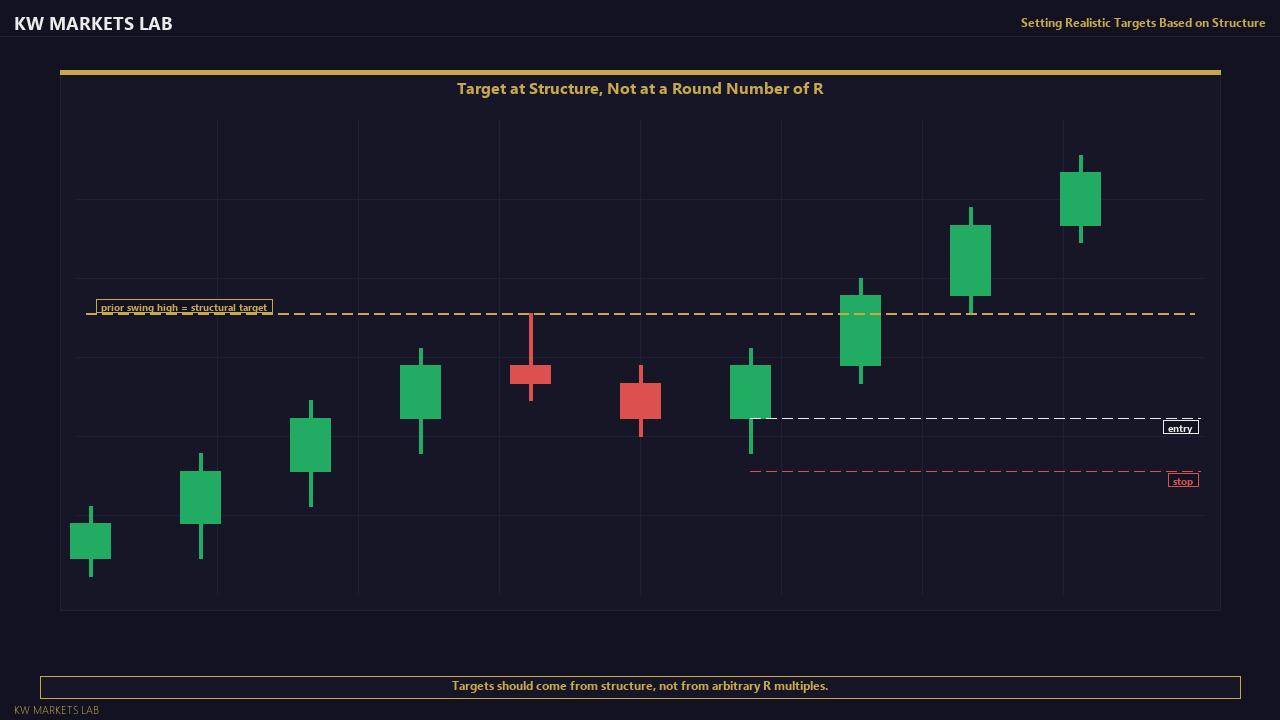
Setting Targets Based on Structure
Setting Targets Based on StructureTargets come from structure, not arbitrary R multiples.

Do not invent targets. Derive them from the chart. If no clear structural target exists at an acceptable R:R, the setup may not be worth taking. The minimum acceptable R:R you require is a personal rule — but it should be defined in advance and applied consistently, not relaxed when a setup looks otherwise attractive.

Continue Learning
L3.3 — Partial Exits and Trail Stops Without Destroying Expectancy →
Stay Updated

Get notified when new lessons and content are published.