Intermediate Risk Management and Capital Growth / Module 1: Position Sizing Mechanics Lesson 2 of 16
Course Outline — Lesson 2 of 16
M1 Position Sizing Mechanics
1 L1.1 — Risk Percentage: The Only Variable You Fully Control 2 L1.2 — Calculating Position Size from Stop Distance 3 L1.3 — Why Consistent Sizing Matters More Than Sizing Big on Good Trades 4 L1.4 — Lot Size Tools and Broker-Specific Calculations
M2 Drawdown Control
1 L2.1 — Understanding Drawdown: Peak-to-Trough Equity Decline 2 L2.2 — Defining Your Maximum Drawdown and Reset Protocol 3 L2.3 — Losing Streaks Are Normal: Surviving Them Without Damage
M3 Risk-to-Reward Reality
1 L3.1 — What Risk-to-Reward Actually Measures 2 L3.2 — Setting Realistic Targets Based on Structure 3 L3.3 — Partial Exits and Trail Stops Without Destroying Expectancy
M4 Expectancy and Survival
1 L4.1 — Expectancy: The Only Number That Predicts Long-Term Performance 2 L4.2 — Tracking Performance: Building a Minimal Expectancy Log 3 L4.3 — When to Stop Trading: Protecting Survival Capital
M5 Capital Growth Without Overexposure
1 L5.1 — Compounding: How Capital Grows With Consistent Edge 2 L5.2 — Scaling Up: When and How to Increase Risk Parameters 3 L5.3 — Building a Multi-Year Capital Plan
Lesson 2 of 16

L1.2 — Calculating Position Size from Stop Distance

Position sizing starts with the stop, not the entry. The sequence is: (1) identify the structurally correct stop level, (2) calculate the distance in pips or points from entry to stop, (3) determine the monetary value of one pip/point for the instrument, (4) divide your risk amount by the pip value times the stop distance. The result is your correct lot size.

For example: account equity $5,000, risk percentage 1%, stop distance 20 pips on EURUSD. Risk amount = $50. Value per pip on 1 standard lot = $10. Lots = $50 / (20 pips x $10) = 0.25 lots. This is the only correct position size for this trade at this risk level — not more, not less.
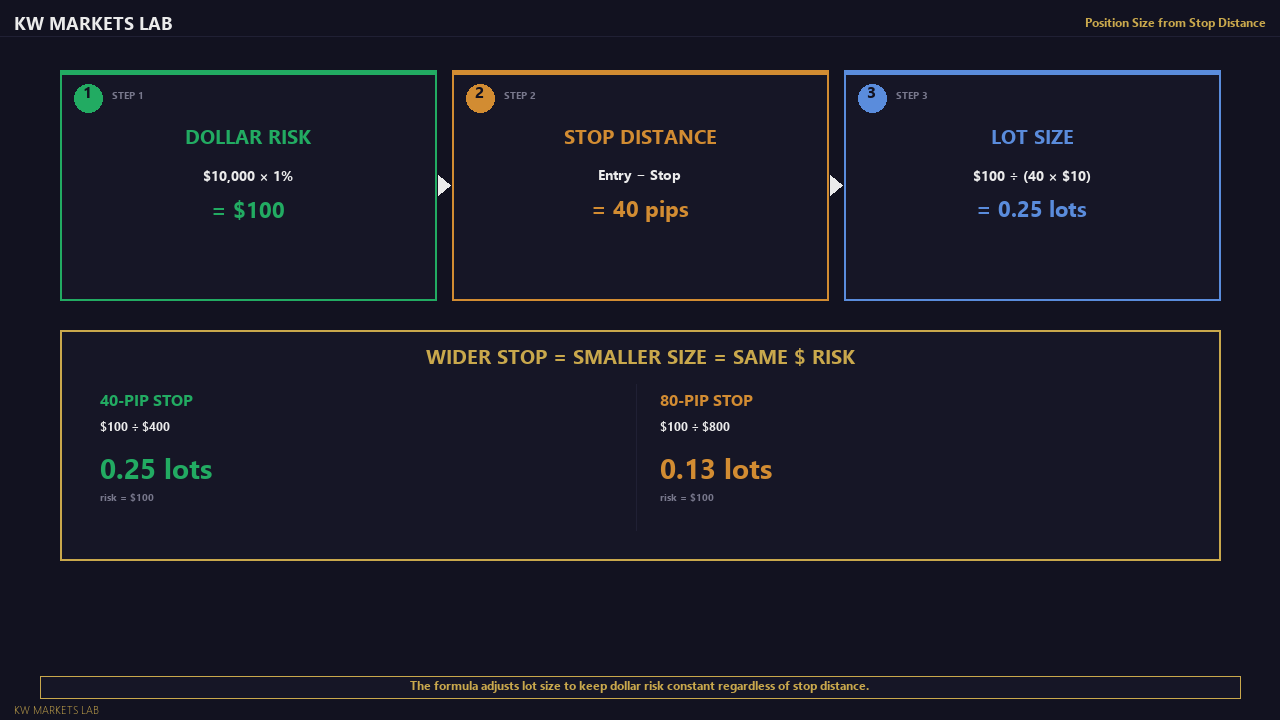
Position Size from Stop Distance
Position Size from Stop DistanceThe formula adjusts lot size to keep dollar risk constant.

The most common error is working backwards: deciding how many lots to trade first and then choosing a stop that fits. This approach decouples the stop from structure and produces stops that are either too tight (frequent stop-outs) or so wide they are never triggered until the loss is enormous. Always derive position size from the stop. Never derive the stop from the position size.

Continue Learning
L1.3 — Why Consistent Sizing Matters More Than Sizing Big on Good Trades →
Stay Updated

Get notified when new lessons and content are published.