Advanced Strategy Application Case Studies / Module 5: Mistake Analysis and Process Repair Lesson 15 of 16
Course Outline — Lesson 15 of 16
M1 Full Trade Breakdowns
1 L1.1 — How to Break Down a Trade: The Analysis Framework 2 L1.2 — Full Breakdown: A Winning BOS Continuation Trade 3 L1.3 — Full Breakdown: A Losing Trade That Was Correctly Executed 4 L1.4 — Full Breakdown: A Losing Trade With Execution Errors
M2 Winning vs Losing Trades
1 L2.1 — The Difference Between a Good Trade and a Winning Trade 2 L2.2 — Comparing Two Similar Setups With Opposite Outcomes 3 L2.3 — Win Rate vs Expectancy: Reading Your Own Performance Data
M3 Decision Frameworks
1 L3.1 — The Entry Decision Tree 2 L3.2 — The Exit Decision Tree 3 L3.3 — Applying the Decision Framework to a Novel Setup
M4 Context Comparison
1 L4.1 — How Context Changes Setup Probability 2 L4.2 — The Same Setup in Three Market Conditions 3 L4.3 — When Market Conditions Change Mid-Trade
M5 Mistake Analysis and Process Repair
1 L5.1 — Categorising Your Mistakes: A Taxonomy 2 L5.2 — Process Repair: Adjusting Rules After a Recurring Error 3 L5.3 — Building Your Personal Case Study Library
Lesson 15 of 16

L5.2 — Process Repair: Adjusting Rules After a Recurring Error

A recurring error is a mistake that appears three or more times in your trade log with the same cause. Recurring errors are not bad luck — they are system gaps. A rule that would have prevented the error does not yet exist in your process. The process repair procedure: identify the error, identify the condition that triggers it, write the specific rule that prevents it, add the rule to the relevant checklist, and monitor compliance with the new rule for the next 20 trades.

Process repair is not strategy change. It is adding precision to the rules that govern how you execute the strategy you already have. The strategy structure — the structural setups you trade, the markets you focus on, the basic entry model — should be stable across at least 50 trades before being evaluated for change.
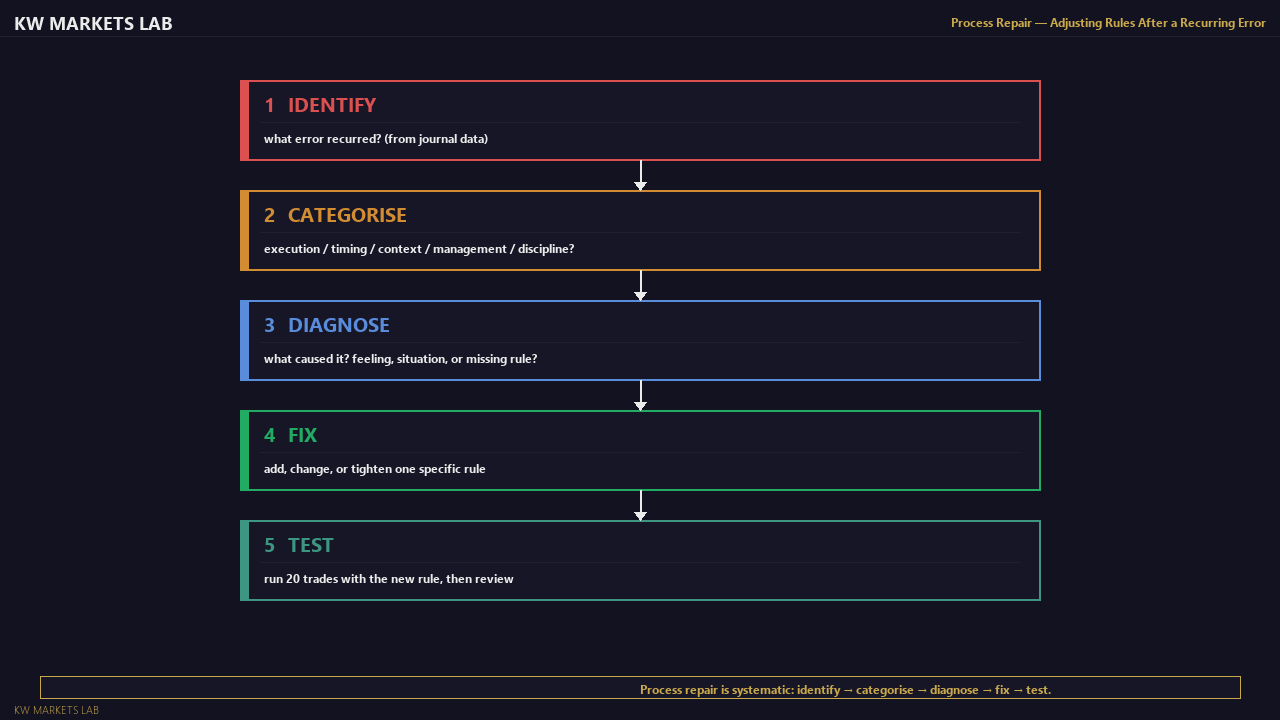
Process Repair Workflow
Process Repair WorkflowIdentify, categorise, diagnose, fix, test.

After adding a new rule, track whether it eliminates the recurring error. If the error disappears, the repair was successful. If it persists despite the rule, the rule is either too vague or not being applied consistently. Revisit the rule with more specificity or add an accountability mechanism to enforce it.

Continue Learning
L5.3 — Building Your Personal Case Study Library →
Stay Updated

Get notified when new lessons and content are published.