Advanced Strategy Application Case Studies / Module 2: Winning vs Losing Trades Lesson 6 of 16
Course Outline — Lesson 6 of 16
M1 Full Trade Breakdowns
1 L1.1 — How to Break Down a Trade: The Analysis Framework 2 L1.2 — Full Breakdown: A Winning BOS Continuation Trade 3 L1.3 — Full Breakdown: A Losing Trade That Was Correctly Executed 4 L1.4 — Full Breakdown: A Losing Trade With Execution Errors
M2 Winning vs Losing Trades
1 L2.1 — The Difference Between a Good Trade and a Winning Trade 2 L2.2 — Comparing Two Similar Setups With Opposite Outcomes 3 L2.3 — Win Rate vs Expectancy: Reading Your Own Performance Data
M3 Decision Frameworks
1 L3.1 — The Entry Decision Tree 2 L3.2 — The Exit Decision Tree 3 L3.3 — Applying the Decision Framework to a Novel Setup
M4 Context Comparison
1 L4.1 — How Context Changes Setup Probability 2 L4.2 — The Same Setup in Three Market Conditions 3 L4.3 — When Market Conditions Change Mid-Trade
M5 Mistake Analysis and Process Repair
1 L5.1 — Categorising Your Mistakes: A Taxonomy 2 L5.2 — Process Repair: Adjusting Rules After a Recurring Error 3 L5.3 — Building Your Personal Case Study Library
Lesson 6 of 16

L2.2 — Comparing Two Similar Setups With Opposite Outcomes

This lesson examines two structurally similar setups — both BOS continuation entries at H4 demand zones within daily bullish structures — where one produced a +2R win and the other a -1R loss. The comparison isolates what was different between the two and examines whether those differences were visible before entry or only apparent in retrospect.

Key differences identified: (1) the winning trade had a H1 rejection candle at the zone; the losing trade had no rejection candle — entry was taken on limit without waiting. (2) The winning trade occurred during London open; the losing trade occurred during Asian mid-session. (3) The winning trade had DXY structural support; the losing trade was entered against the DXY direction.
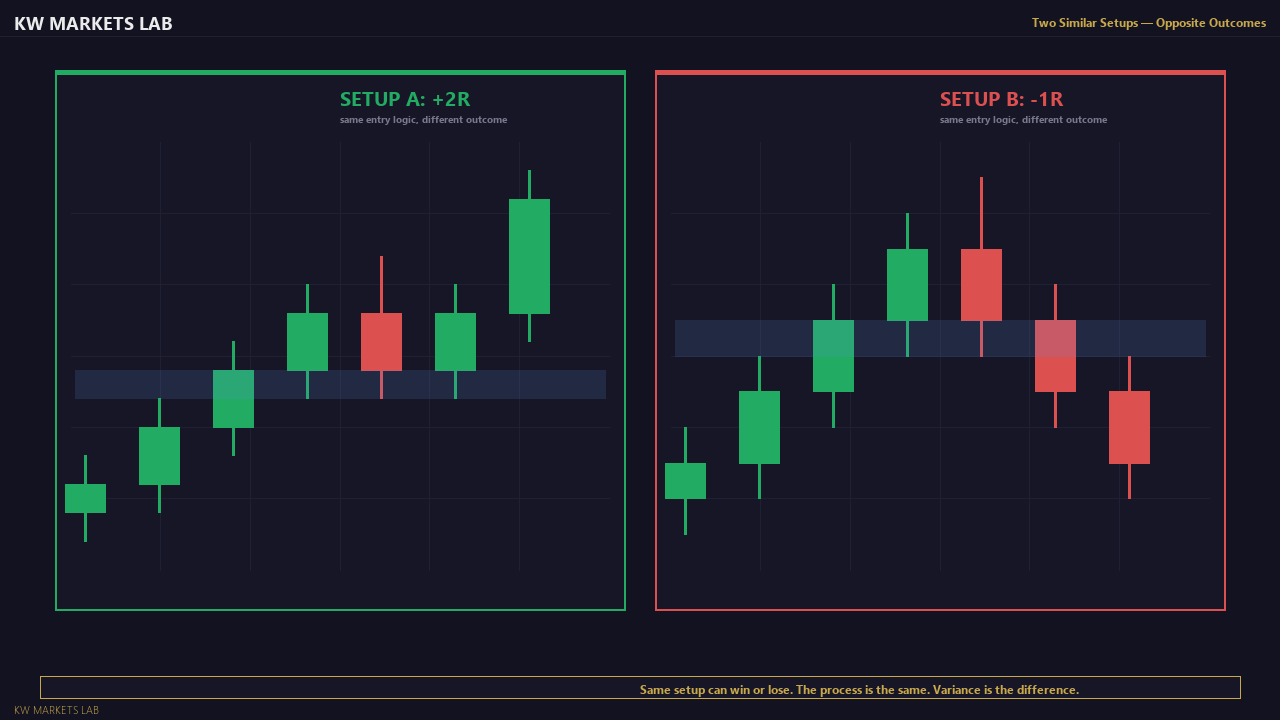
Similar Setups, Opposite Outcomes
Similar Setups, Opposite OutcomesVariance is the difference, not the process.

All three differences were observable before entry. The lesson is not "wait for better luck" — it is "apply the quality filters that were present in the winning trade and absent in the losing one." The quality filters become additions to the pre-entry checklist.

Continue Learning
L2.3 — Win Rate vs Expectancy: Reading Your Own Performance Data →
Stay Updated

Get notified when new lessons and content are published.