Advanced Strategy Application Case Studies / Module 2: Winning vs Losing Trades Lesson 5 of 16
Course Outline — Lesson 5 of 16
M1 Full Trade Breakdowns
1 L1.1 — How to Break Down a Trade: The Analysis Framework 2 L1.2 — Full Breakdown: A Winning BOS Continuation Trade 3 L1.3 — Full Breakdown: A Losing Trade That Was Correctly Executed 4 L1.4 — Full Breakdown: A Losing Trade With Execution Errors
M2 Winning vs Losing Trades
1 L2.1 — The Difference Between a Good Trade and a Winning Trade 2 L2.2 — Comparing Two Similar Setups With Opposite Outcomes 3 L2.3 — Win Rate vs Expectancy: Reading Your Own Performance Data
M3 Decision Frameworks
1 L3.1 — The Entry Decision Tree 2 L3.2 — The Exit Decision Tree 3 L3.3 — Applying the Decision Framework to a Novel Setup
M4 Context Comparison
1 L4.1 — How Context Changes Setup Probability 2 L4.2 — The Same Setup in Three Market Conditions 3 L4.3 — When Market Conditions Change Mid-Trade
M5 Mistake Analysis and Process Repair
1 L5.1 — Categorising Your Mistakes: A Taxonomy 2 L5.2 — Process Repair: Adjusting Rules After a Recurring Error 3 L5.3 — Building Your Personal Case Study Library
Lesson 5 of 16

L2.1 — The Difference Between a Good Trade and a Winning Trade

A good trade is one where every decision was correct given the information available at the time. A winning trade is one that produced a profit. These overlap frequently but not always. The most dangerous confusion in trading is treating winning trades as validation and losing trades as evidence of a problem. This confuses outcome with quality and leads to reinforcement of incorrect behaviours when they randomly produce profits.

The correct framework: evaluate every trade on process quality first, outcome second. A bad trade that won is still bad. A good trade that lost is still good. Over large samples, good trades produce better outcomes than bad trades — but the signal is in the process, not in each individual result.
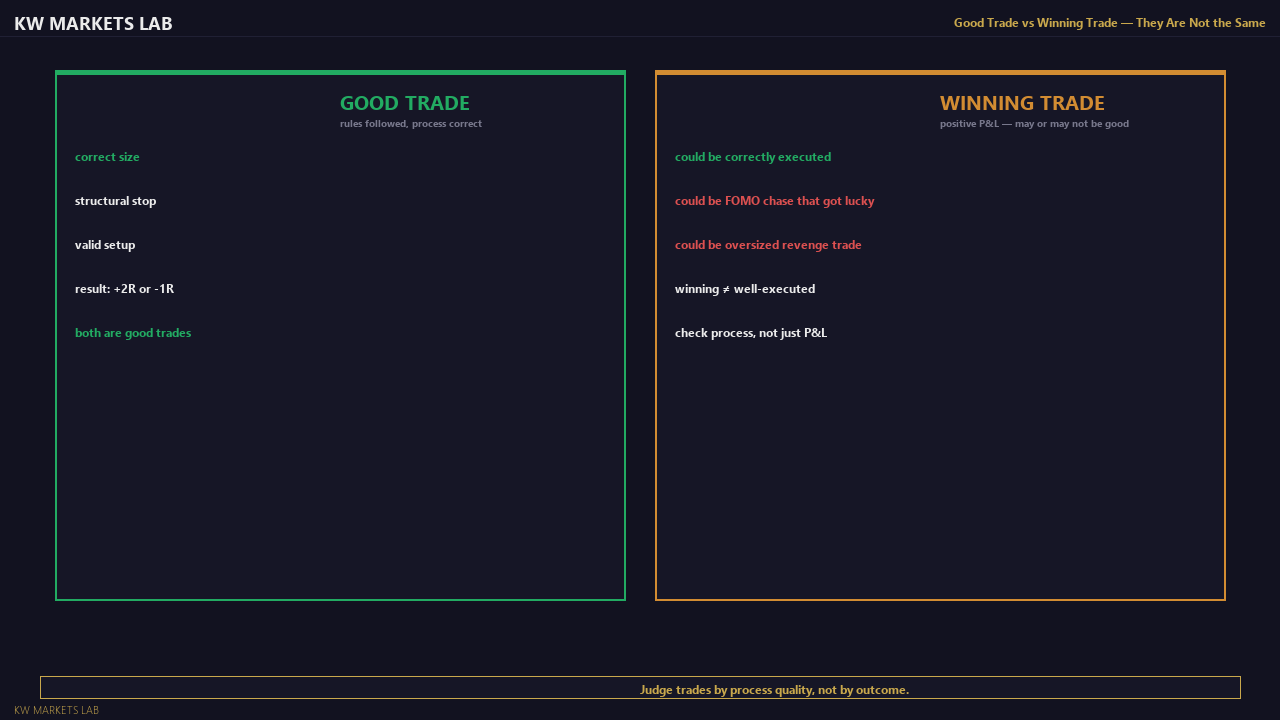
Good Trade vs Winning Trade
Good Trade vs Winning TradeJudge trades by process quality, not outcome.

Build a trade quality matrix for your last 30 trades: two axes — process quality (good/bad) and outcome (win/loss). Four quadrants: good process/win (reinforce), good process/loss (accept as variance), bad process/win (important — correct the process), bad process/loss (correct the process and accept the compound cost of two failures).

Continue Learning
L2.2 — Comparing Two Similar Setups With Opposite Outcomes →
Stay Updated

Get notified when new lessons and content are published.