Advanced Strategy Application Case Studies / Module 3: Decision Frameworks Lesson 10 of 16
Course Outline — Lesson 10 of 16
M1 Full Trade Breakdowns
1 L1.1 — How to Break Down a Trade: The Analysis Framework 2 L1.2 — Full Breakdown: A Winning BOS Continuation Trade 3 L1.3 — Full Breakdown: A Losing Trade That Was Correctly Executed 4 L1.4 — Full Breakdown: A Losing Trade With Execution Errors
M2 Winning vs Losing Trades
1 L2.1 — The Difference Between a Good Trade and a Winning Trade 2 L2.2 — Comparing Two Similar Setups With Opposite Outcomes 3 L2.3 — Win Rate vs Expectancy: Reading Your Own Performance Data
M3 Decision Frameworks
1 L3.1 — The Entry Decision Tree 2 L3.2 — The Exit Decision Tree 3 L3.3 — Applying the Decision Framework to a Novel Setup
M4 Context Comparison
1 L4.1 — How Context Changes Setup Probability 2 L4.2 — The Same Setup in Three Market Conditions 3 L4.3 — When Market Conditions Change Mid-Trade
M5 Mistake Analysis and Process Repair
1 L5.1 — Categorising Your Mistakes: A Taxonomy 2 L5.2 — Process Repair: Adjusting Rules After a Recurring Error 3 L5.3 — Building Your Personal Case Study Library
Lesson 10 of 16

L3.3 — Applying the Decision Framework to a Novel Setup

This lesson works through a live-context exercise: a setup appears on the chart that is structurally valid but has some features that are unfamiliar. The entry and exit decision trees are applied step by step to determine whether the setup qualifies, what the entry and management rules require, and what the skip criteria look like if any branch fails.

The exercise reveals three common outcomes: (1) the setup fully qualifies — all branches pass, execute per the entry tree; (2) the setup partially qualifies — most branches pass but one critical one fails (e.g. no confirmation signal yet) — defer to the next candle; (3) the setup does not qualify — a foundational branch fails (e.g. no clear higher-timeframe bias) — skip.
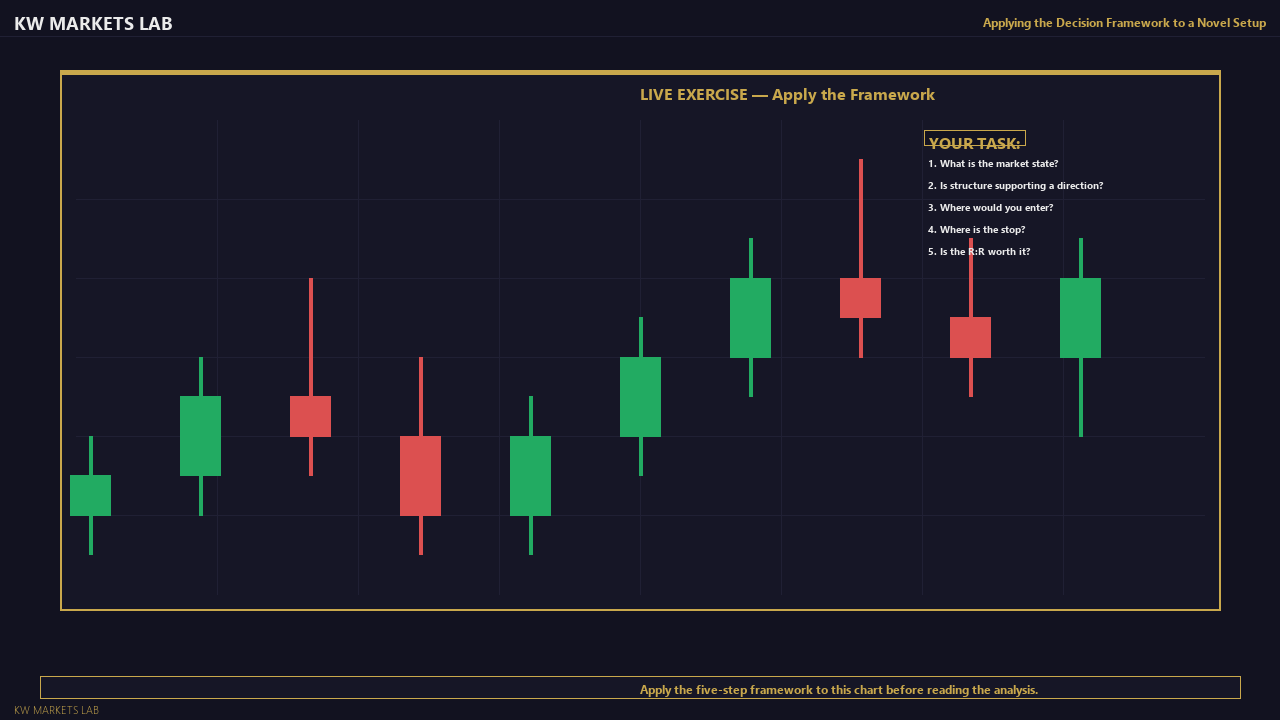
Decision Framework Live Exercise
Decision Framework Live ExerciseApply the framework to this chart before reading the analysis.

The skill being developed here is not chart-reading speed — it is structured decision-making under the time pressure of a live market. The decision trees do not slow you down: they replace panicked improvisation with a consistent 30-second process that applies the same quality filter to every setup regardless of its apparent attractiveness.

Continue Learning
L4.1 — How Context Changes Setup Probability →
Stay Updated

Get notified when new lessons and content are published.