Advanced Strategy Application Case Studies / Module 4: Context Comparison Lesson 12 of 16
Course Outline — Lesson 12 of 16
M1 Full Trade Breakdowns
1 L1.1 — How to Break Down a Trade: The Analysis Framework 2 L1.2 — Full Breakdown: A Winning BOS Continuation Trade 3 L1.3 — Full Breakdown: A Losing Trade That Was Correctly Executed 4 L1.4 — Full Breakdown: A Losing Trade With Execution Errors
M2 Winning vs Losing Trades
1 L2.1 — The Difference Between a Good Trade and a Winning Trade 2 L2.2 — Comparing Two Similar Setups With Opposite Outcomes 3 L2.3 — Win Rate vs Expectancy: Reading Your Own Performance Data
M3 Decision Frameworks
1 L3.1 — The Entry Decision Tree 2 L3.2 — The Exit Decision Tree 3 L3.3 — Applying the Decision Framework to a Novel Setup
M4 Context Comparison
1 L4.1 — How Context Changes Setup Probability 2 L4.2 — The Same Setup in Three Market Conditions 3 L4.3 — When Market Conditions Change Mid-Trade
M5 Mistake Analysis and Process Repair
1 L5.1 — Categorising Your Mistakes: A Taxonomy 2 L5.2 — Process Repair: Adjusting Rules After a Recurring Error 3 L5.3 — Building Your Personal Case Study Library
Lesson 12 of 16

L4.2 — The Same Setup in Three Market Conditions

This lesson presents one setup pattern — a BOS at a structural support zone — applied to three distinct market conditions: a clear uptrend, a ranging market, and a transitional/CHOCH market. The setup looks similar on the entry timeframe in all three cases. The structural context on the higher timeframe is dramatically different.

In the uptrend: the BOS is consistent with the higher-timeframe structure and produces a high-probability continuation. In the range: the BOS at the support zone is one of many support reactions that have historically reversed — valid but not high-probability for a directional continuation. In the transitional market: the structural context is unclear and the BOS may be a false signal of a new trend beginning.
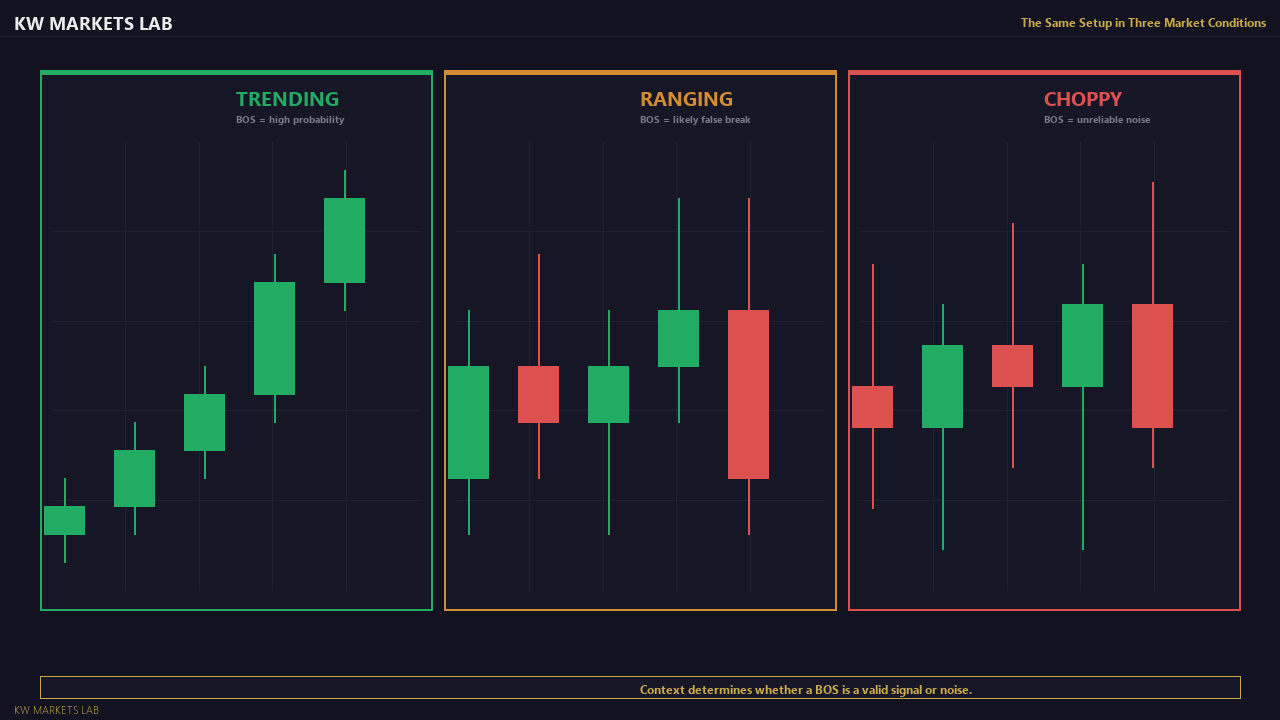
Same Setup in Three Contexts
Same Setup in Three ContextsContext determines whether a BOS is signal or noise.

The conclusion: the setup type is the same. The context assignment determines how much risk it receives and whether it is taken at all. Context is not a filter on top of the setup — it is the primary evaluation layer that the pattern is interpreted through.

Continue Learning
L4.3 — When Market Conditions Change Mid-Trade →
Stay Updated

Get notified when new lessons and content are published.