Advanced Strategy Application Case Studies / Module 1: Full Trade Breakdowns Lesson 3 of 16
Course Outline — Lesson 3 of 16
M1 Full Trade Breakdowns
1 L1.1 — How to Break Down a Trade: The Analysis Framework 2 L1.2 — Full Breakdown: A Winning BOS Continuation Trade 3 L1.3 — Full Breakdown: A Losing Trade That Was Correctly Executed 4 L1.4 — Full Breakdown: A Losing Trade With Execution Errors
M2 Winning vs Losing Trades
1 L2.1 — The Difference Between a Good Trade and a Winning Trade 2 L2.2 — Comparing Two Similar Setups With Opposite Outcomes 3 L2.3 — Win Rate vs Expectancy: Reading Your Own Performance Data
M3 Decision Frameworks
1 L3.1 — The Entry Decision Tree 2 L3.2 — The Exit Decision Tree 3 L3.3 — Applying the Decision Framework to a Novel Setup
M4 Context Comparison
1 L4.1 — How Context Changes Setup Probability 2 L4.2 — The Same Setup in Three Market Conditions 3 L4.3 — When Market Conditions Change Mid-Trade
M5 Mistake Analysis and Process Repair
1 L5.1 — Categorising Your Mistakes: A Taxonomy 2 L5.2 — Process Repair: Adjusting Rules After a Recurring Error 3 L5.3 — Building Your Personal Case Study Library
Lesson 3 of 16

L1.3 — Full Breakdown: A Losing Trade That Was Correctly Executed

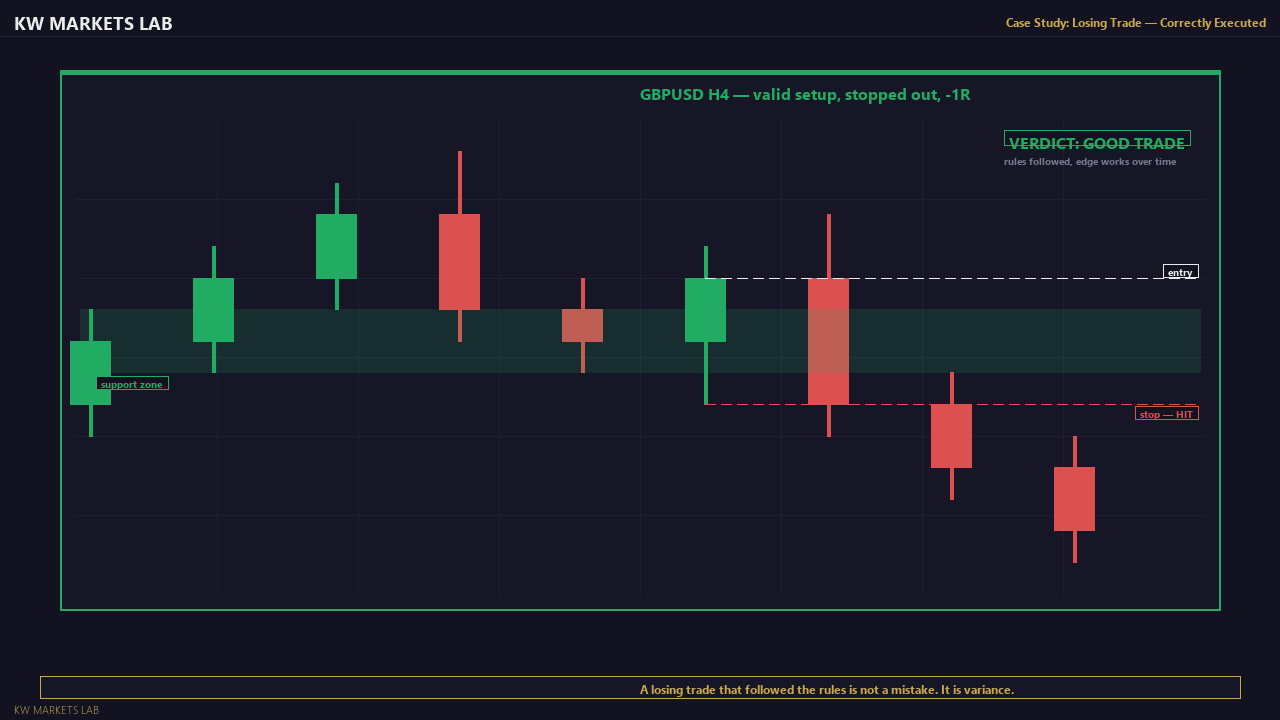
Case: GBPUSD, H4. Daily bias bearish — lower high confirmed. H4 price rallied into a pre-marked supply zone (previous structural resistance). H1 BOS of internal swing low confirmed re-engagement to the downside. Entry at 1.2650. Stop above the supply zone at 1.2680 (30 pips). Target at next structural support at 1.2590 (60 pips, 2R). Position size: 1% risk, 0.33 lots.

Trade outcome: price initially moved 15 pips in the direction of the trade then reversed, breaking above the supply zone and triggering the stop. Result: -1R. Post-trade structural review showed a higher-timeframe bullish catalyst (unexpected positive GBP data) that supported the reversal. The stop was correct; the structural logic was sound; the outcome was adverse variance.
Case Study: Correct Losing Trade
Case Study: Correct Losing TradeA losing trade that followed rules is not a mistake.

Decision audit: all six stages compliant. The trade lost. The process was correct. This is a critical case study: a -1R outcome from a fully compliant trade is not a failure — it is the expected cost of operating a probabilistic strategy. Adding this to your case study library reinforces the separation of process quality from outcome.

Continue Learning
L1.4 — Full Breakdown: A Losing Trade With Execution Errors →
Stay Updated

Get notified when new lessons and content are published.