Advanced Strategy Application Case Studies / Module 1: Full Trade Breakdowns Lesson 4 of 16
Course Outline — Lesson 4 of 16
M1 Full Trade Breakdowns
1 L1.1 — How to Break Down a Trade: The Analysis Framework 2 L1.2 — Full Breakdown: A Winning BOS Continuation Trade 3 L1.3 — Full Breakdown: A Losing Trade That Was Correctly Executed 4 L1.4 — Full Breakdown: A Losing Trade With Execution Errors
M2 Winning vs Losing Trades
1 L2.1 — The Difference Between a Good Trade and a Winning Trade 2 L2.2 — Comparing Two Similar Setups With Opposite Outcomes 3 L2.3 — Win Rate vs Expectancy: Reading Your Own Performance Data
M3 Decision Frameworks
1 L3.1 — The Entry Decision Tree 2 L3.2 — The Exit Decision Tree 3 L3.3 — Applying the Decision Framework to a Novel Setup
M4 Context Comparison
1 L4.1 — How Context Changes Setup Probability 2 L4.2 — The Same Setup in Three Market Conditions 3 L4.3 — When Market Conditions Change Mid-Trade
M5 Mistake Analysis and Process Repair
1 L5.1 — Categorising Your Mistakes: A Taxonomy 2 L5.2 — Process Repair: Adjusting Rules After a Recurring Error 3 L5.3 — Building Your Personal Case Study Library
Lesson 4 of 16

L1.4 — Full Breakdown: A Losing Trade With Execution Errors

Case: XAUUSD, H1. Daily bias neutral/transitional. H4 structure ranging between two key levels. A "setup" appeared on the H1 chart — an apparent BOS above a minor local swing high. Entry taken immediately on the break candle (no pullback waited for). Stop placed 15 pips below entry (arbitrary, not at a structural level). No H4 context check performed. No checklist completed before entry. Position: chased entry 25 pips above the original break candle.

Trade outcome: price reversed at the H4 resistance level (not marked because the H4 was not consulted). Stop triggered. Result: -1R, but with an incorrect position size because the stop was 15 pips instead of the structural 45-pip stop that would have been correct.
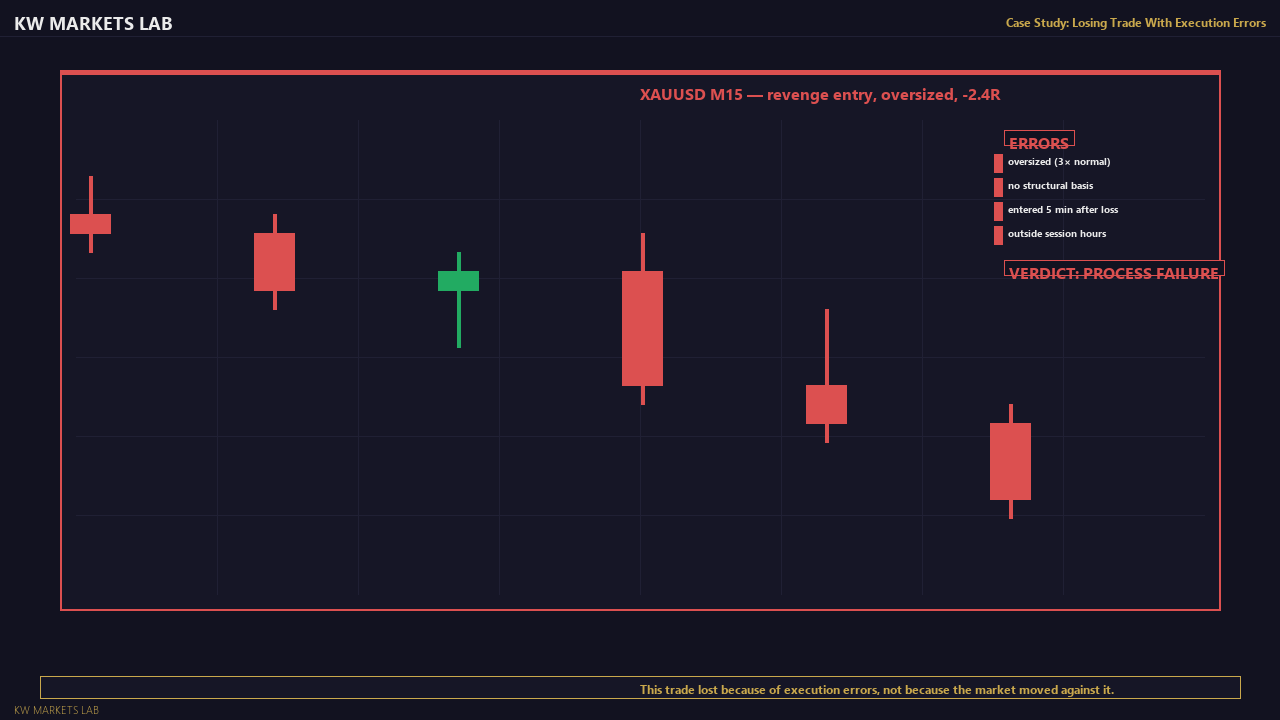
Case Study: Losing Trade With Errors
Case Study: Losing Trade With ErrorsThis trade lost because of execution errors.

Decision audit: five of six stages had errors. Bias not established, confirmation criteria not met (no pullback), entry chased, stop not structural, checklist not completed. This trade is an execution failure, not a variance event. The lesson: identify which emotional state produced each error — typically FOMO on the initial break — and write the specific rule that would have prevented it.

Continue Learning
L2.1 — The Difference Between a Good Trade and a Winning Trade →
Stay Updated

Get notified when new lessons and content are published.