L1.1 — How to Break Down a Trade: The Analysis Framework
A trade breakdown is a structured retrospective that examines every decision in a trade from pre-analysis through exit. The purpose is not to celebrate wins or explain away losses — it is to identify whether each decision was correct given the information available at the time it was made. This distinction — correct decisions based on available information, not based on outcome — is the foundation of process-based learning.
The breakdown framework covers six stages: (1) pre-session bias — what was the structural context and what was the directional hypothesis? (2) Setup identification — what triggered the consideration of this trade? (3) Confirmation evaluation — did the confirmation signal meet the defined criteria? (4) Entry execution — was the entry taken at the correct location at the right time? (5) Trade management — were the management rules followed? (6) Exit — was the exit at the defined target or triggered by the stop, and was it executed correctly?
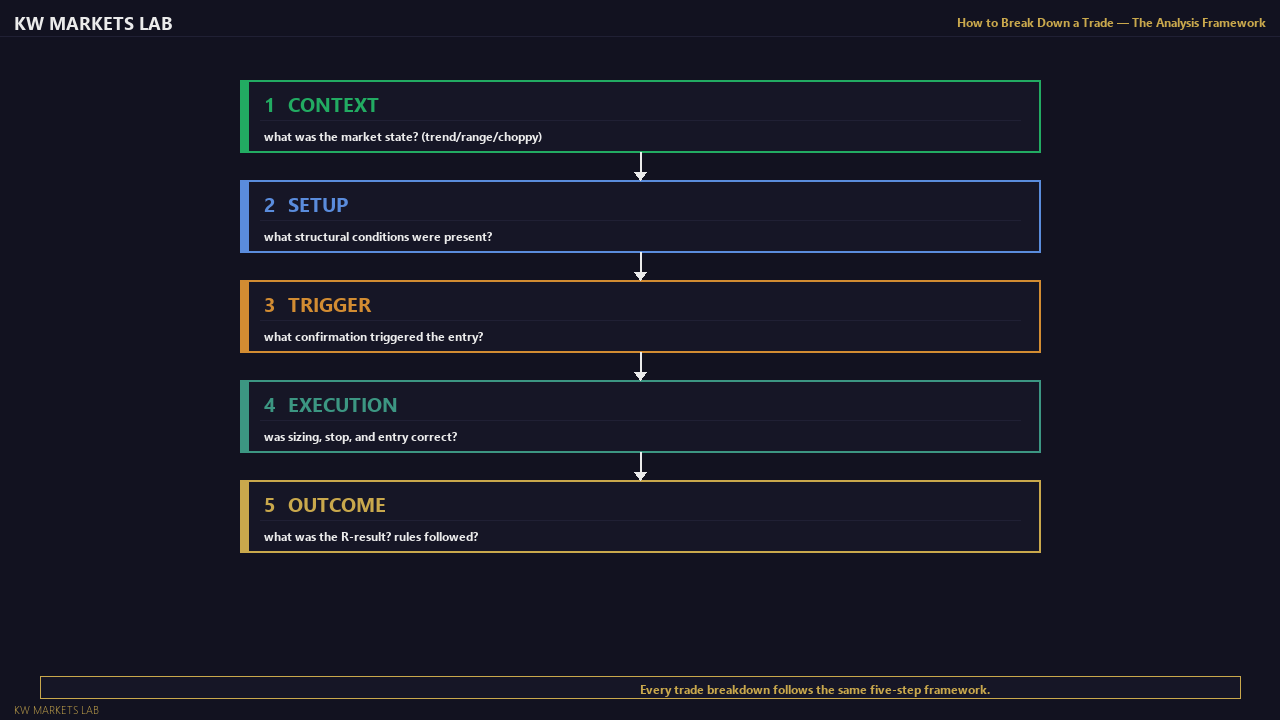
Apply this framework to your own recent trades before working through the case studies in this module. The framework forces a decision-level review rather than an outcome-level one, which is the only review that produces useful learning.
Get notified when new lessons and content are published.