Advanced Strategy Application Case Studies / Module 3: Decision Frameworks Lesson 8 of 16
Course Outline — Lesson 8 of 16
M1 Full Trade Breakdowns
1 L1.1 — How to Break Down a Trade: The Analysis Framework 2 L1.2 — Full Breakdown: A Winning BOS Continuation Trade 3 L1.3 — Full Breakdown: A Losing Trade That Was Correctly Executed 4 L1.4 — Full Breakdown: A Losing Trade With Execution Errors
M2 Winning vs Losing Trades
1 L2.1 — The Difference Between a Good Trade and a Winning Trade 2 L2.2 — Comparing Two Similar Setups With Opposite Outcomes 3 L2.3 — Win Rate vs Expectancy: Reading Your Own Performance Data
M3 Decision Frameworks
1 L3.1 — The Entry Decision Tree 2 L3.2 — The Exit Decision Tree 3 L3.3 — Applying the Decision Framework to a Novel Setup
M4 Context Comparison
1 L4.1 — How Context Changes Setup Probability 2 L4.2 — The Same Setup in Three Market Conditions 3 L4.3 — When Market Conditions Change Mid-Trade
M5 Mistake Analysis and Process Repair
1 L5.1 — Categorising Your Mistakes: A Taxonomy 2 L5.2 — Process Repair: Adjusting Rules After a Recurring Error 3 L5.3 — Building Your Personal Case Study Library
Lesson 8 of 16

L3.1 — The Entry Decision Tree

A decision tree is a structured series of binary questions that produces a defined action: Enter, Skip, or Defer. The tree is built from your checklist criteria in priority order. The first question is always the highest-authority filter: "Is higher-timeframe bias clear?" If no — Defer (return when bias is established). If yes — proceed to the next question.

Subsequent questions: "Is there a valid structural level in the bias direction?" → "Has price reached that level?" → "Is a confirmation signal present?" → "Is the current time within my entry window?" → "Is R:R above my minimum threshold?" → "Enter." Any "no" at any branch that cannot be resolved defers or skips the trade.
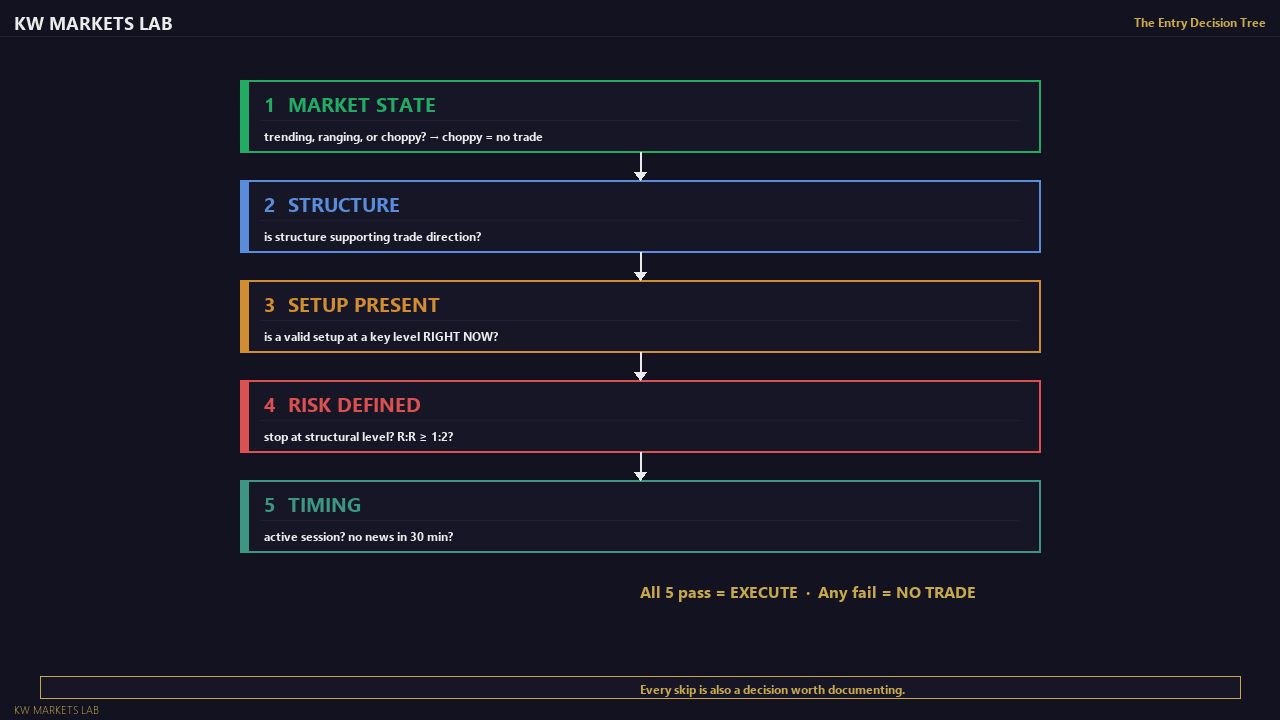
Entry Decision Tree
Entry Decision TreeAll 5 pass = EXECUTE. Any fail = NO TRADE.

The value of the tree is in its structure, not its exhaustiveness. A five-question tree that you actually use is more valuable than a twenty-question tree that you bypass when excited. Build the minimal version first. Add branches only when a recurring error reveals a missing filter.

Continue Learning
L3.2 — The Exit Decision Tree →
Stay Updated

Get notified when new lessons and content are published.