Advanced Strategy Application Case Studies / Module 3: Decision Frameworks Lesson 9 of 16
Course Outline — Lesson 9 of 16
M1 Full Trade Breakdowns
1 L1.1 — How to Break Down a Trade: The Analysis Framework 2 L1.2 — Full Breakdown: A Winning BOS Continuation Trade 3 L1.3 — Full Breakdown: A Losing Trade That Was Correctly Executed 4 L1.4 — Full Breakdown: A Losing Trade With Execution Errors
M2 Winning vs Losing Trades
1 L2.1 — The Difference Between a Good Trade and a Winning Trade 2 L2.2 — Comparing Two Similar Setups With Opposite Outcomes 3 L2.3 — Win Rate vs Expectancy: Reading Your Own Performance Data
M3 Decision Frameworks
1 L3.1 — The Entry Decision Tree 2 L3.2 — The Exit Decision Tree 3 L3.3 — Applying the Decision Framework to a Novel Setup
M4 Context Comparison
1 L4.1 — How Context Changes Setup Probability 2 L4.2 — The Same Setup in Three Market Conditions 3 L4.3 — When Market Conditions Change Mid-Trade
M5 Mistake Analysis and Process Repair
1 L5.1 — Categorising Your Mistakes: A Taxonomy 2 L5.2 — Process Repair: Adjusting Rules After a Recurring Error 3 L5.3 — Building Your Personal Case Study Library
Lesson 9 of 16

L3.2 — The Exit Decision Tree

The exit decision is as important as the entry decision, but most traders have less structure around it. An exit decision tree covers three scenarios: the trade reaches target (close at defined level, or apply partial/trail rules), the stop is triggered (close, no adjustment, move on), and an unexpected structural event occurs mid-trade (assess whether invalidation criteria are met — close, or hold if structure is still intact).

The unexpected event branch is the most commonly mishandled. When a trade is open and a significant candle moves against the position but does not trigger the stop, the emotional response is to adjust the stop to avoid the loss. The tree says: "Has my invalidation structural level been closed beyond?" If no — hold. If yes — close. The tree removes the in-the-moment judgement.
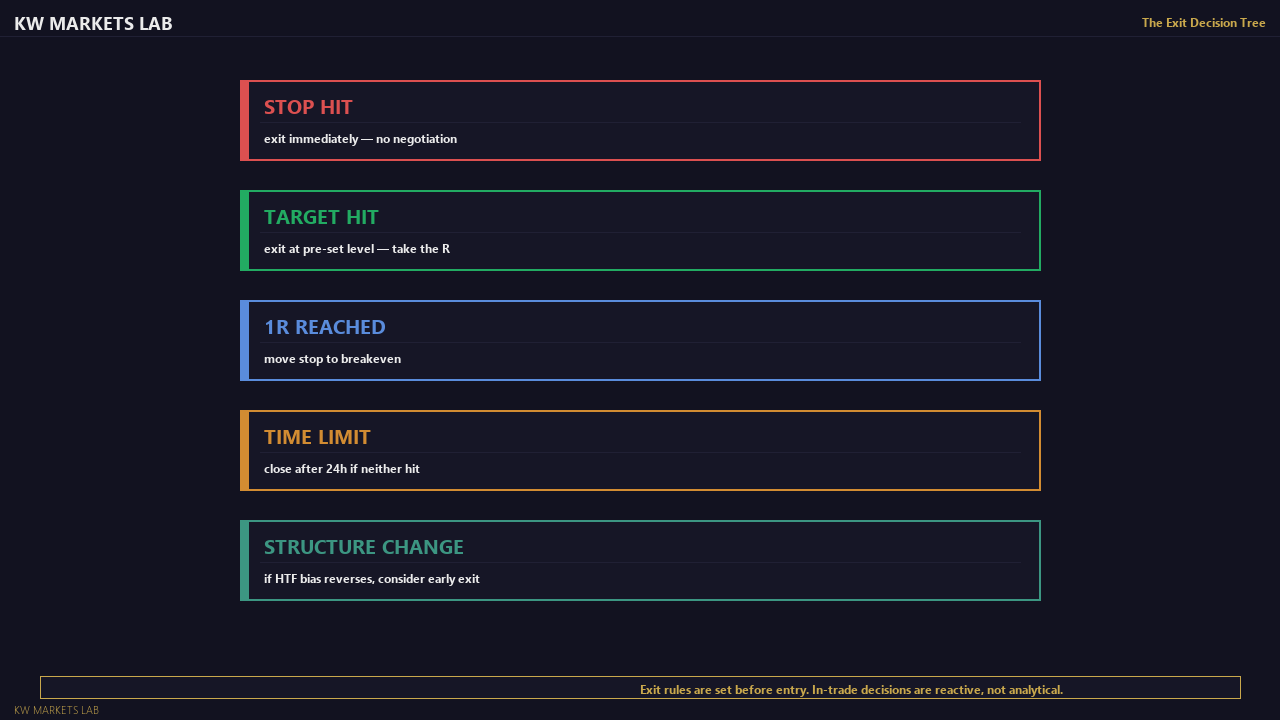
Exit Decision Tree
Exit Decision TreeExit rules are set before entry.

Write your exit tree on a card that sits next to your screen. When you feel the urge to manually close a trade that has not triggered its rule, check the tree. The action required by the tree is the correct action. The urge to close early is the emotion that the tree was designed to override.

Continue Learning
L3.3 — Applying the Decision Framework to a Novel Setup →
Stay Updated

Get notified when new lessons and content are published.