Advanced Strategy Application Case Studies / Module 2: Winning vs Losing Trades Lesson 7 of 16
Course Outline — Lesson 7 of 16
M1 Full Trade Breakdowns
1 L1.1 — How to Break Down a Trade: The Analysis Framework 2 L1.2 — Full Breakdown: A Winning BOS Continuation Trade 3 L1.3 — Full Breakdown: A Losing Trade That Was Correctly Executed 4 L1.4 — Full Breakdown: A Losing Trade With Execution Errors
M2 Winning vs Losing Trades
1 L2.1 — The Difference Between a Good Trade and a Winning Trade 2 L2.2 — Comparing Two Similar Setups With Opposite Outcomes 3 L2.3 — Win Rate vs Expectancy: Reading Your Own Performance Data
M3 Decision Frameworks
1 L3.1 — The Entry Decision Tree 2 L3.2 — The Exit Decision Tree 3 L3.3 — Applying the Decision Framework to a Novel Setup
M4 Context Comparison
1 L4.1 — How Context Changes Setup Probability 2 L4.2 — The Same Setup in Three Market Conditions 3 L4.3 — When Market Conditions Change Mid-Trade
M5 Mistake Analysis and Process Repair
1 L5.1 — Categorising Your Mistakes: A Taxonomy 2 L5.2 — Process Repair: Adjusting Rules After a Recurring Error 3 L5.3 — Building Your Personal Case Study Library
Lesson 7 of 16

L2.3 — Win Rate vs Expectancy: Reading Your Own Performance Data

Two traders with the same 45% win rate can have very different expectancy. Trader A: average win 2R, average loss 1R. Expectancy: (0.45 x 2) - (0.55 x 1) = +0.35R per trade. Profitable. Trader B: average win 0.8R, average loss 1.2R. Expectancy: (0.45 x 0.8) - (0.55 x 1.2) = -0.3R per trade. Unprofitable. Both have the same win rate. The difference is the size of wins versus losses — which is controlled by management, not by analysis.

The most actionable insight from this comparison: if your expectancy is negative despite a reasonable win rate, examine your average win versus average loss. Premature exits, moved targets, and partials taken too early are the mechanisms that compress average wins below average losses.
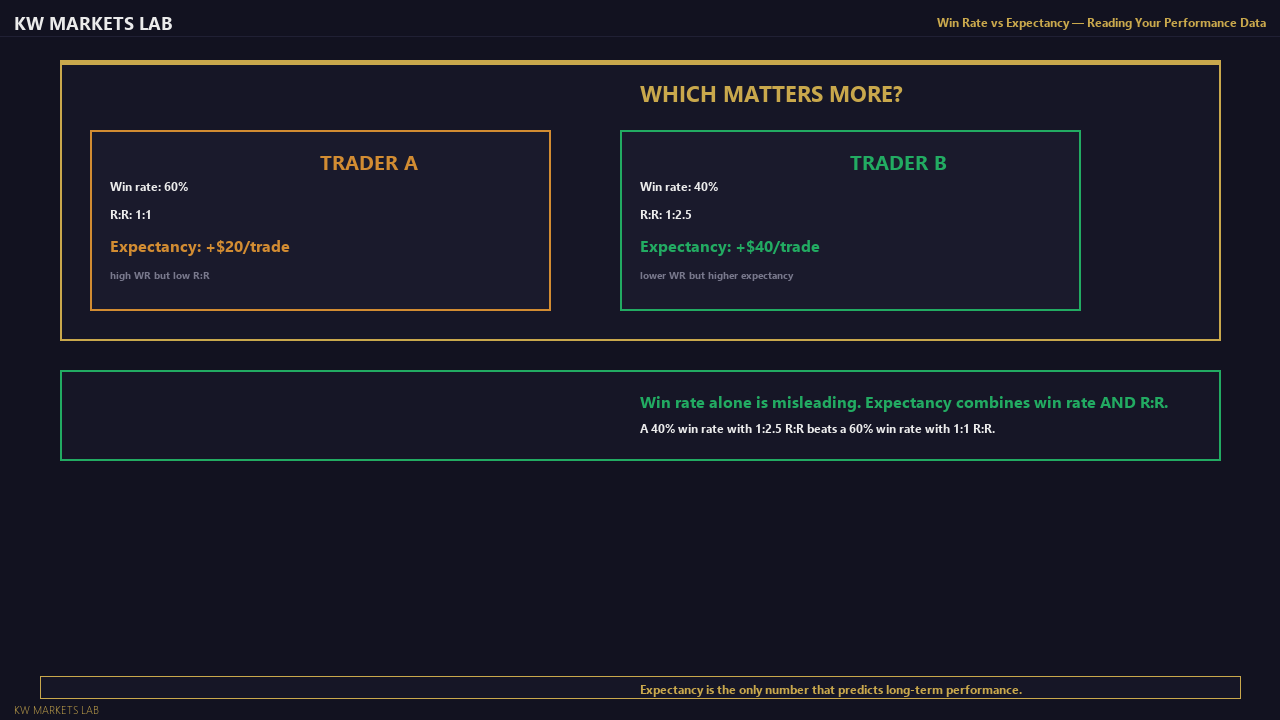
Win Rate vs Expectancy
Win Rate vs ExpectancyExpectancy is the only number that predicts long-term performance.

Calculate your own expectancy from your trade log. If it is positive, identify what produces your best winners and protect those conditions. If it is negative, identify whether the problem is win rate, reward quality, or both — and address the specific issue rather than changing the entire strategy.

Continue Learning
L3.1 — The Entry Decision Tree →
Stay Updated

Get notified when new lessons and content are published.