Advanced Strategy Application Case Studies / Module 5: Mistake Analysis and Process Repair Lesson 14 of 16
Course Outline — Lesson 14 of 16
M1 Full Trade Breakdowns
1 L1.1 — How to Break Down a Trade: The Analysis Framework 2 L1.2 — Full Breakdown: A Winning BOS Continuation Trade 3 L1.3 — Full Breakdown: A Losing Trade That Was Correctly Executed 4 L1.4 — Full Breakdown: A Losing Trade With Execution Errors
M2 Winning vs Losing Trades
1 L2.1 — The Difference Between a Good Trade and a Winning Trade 2 L2.2 — Comparing Two Similar Setups With Opposite Outcomes 3 L2.3 — Win Rate vs Expectancy: Reading Your Own Performance Data
M3 Decision Frameworks
1 L3.1 — The Entry Decision Tree 2 L3.2 — The Exit Decision Tree 3 L3.3 — Applying the Decision Framework to a Novel Setup
M4 Context Comparison
1 L4.1 — How Context Changes Setup Probability 2 L4.2 — The Same Setup in Three Market Conditions 3 L4.3 — When Market Conditions Change Mid-Trade
M5 Mistake Analysis and Process Repair
1 L5.1 — Categorising Your Mistakes: A Taxonomy 2 L5.2 — Process Repair: Adjusting Rules After a Recurring Error 3 L5.3 — Building Your Personal Case Study Library
Lesson 14 of 16

L5.1 — Categorising Your Mistakes: A Taxonomy

Trading mistakes fall into three categories: analysis errors (incorrect structural read), execution errors (correct analysis, incorrect trade action), and management errors (correct entry, incorrect exit or stop behaviour). Each category has different causes and different fixes. Conflating them — attributing an execution error to analysis, for example — produces the wrong remedy.

For each loss in your trade log, assign it to one of the three categories or to "variance" (correct everything, adverse outcome). After 30 trades, the distribution reveals where the largest improvement opportunity exists. Most traders find that execution and management errors significantly outnumber analysis errors — the problem is rarely the analysis.
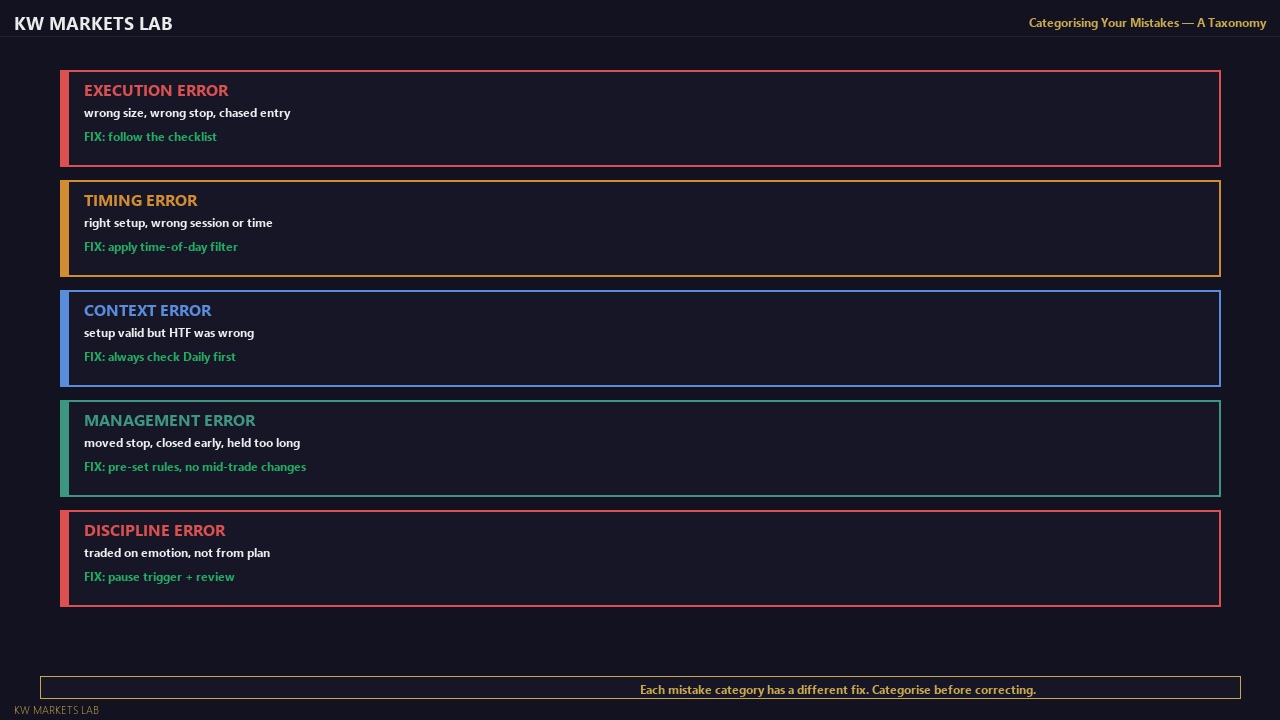
Mistake Taxonomy
Mistake TaxonomyEach mistake category has a different fix.

The three categories also map to different interventions: analysis errors require more study or a stricter structural filter; execution errors require a stronger pre-entry checklist; management errors require a stricter exit rule. Knowing the category drives the correct intervention. Generic "improve your trading" is not a fix. "Reduce premature stop movement by requiring a structural level change before moving the stop" is a fix.

Continue Learning
L5.2 — Process Repair: Adjusting Rules After a Recurring Error →
Stay Updated

Get notified when new lessons and content are published.