Advanced XAUUSD Gold Specialization / Module 4: Risk Management for Gold Lesson 12 of 16
Course Outline — Lesson 12 of 16
M1 Gold Behaviour and Volatility Profile
1 L1.1 — Why Gold Behaves Differently from Forex Pairs 2 L1.2 — What Drives Gold Price: Macro Context for Technical Traders 3 L1.3 — Gold Volatility Profile: ATR, Wicks, and Typical Session Ranges 4 L1.4 — Spread, Commission, and the True Cost of Trading Gold
M2 Key Gold Setups
1 L2.1 — The Top-Down Gold Setup: Daily Bias to H1 Entry 2 L2.2 — Asian Range Breakout Setups on Gold 3 L2.3 — Gold BOS Continuation: Adapting the Framework to Gold's Profile
M3 Session Behaviour on XAUUSD
1 L3.1 — Asian Session: Consolidation, Range Identification, and Patience 2 L3.2 — London Session: Expansion, Direction, and Entry Windows 3 L3.3 — New York Session: Continuation vs Reversal Decision Points
M4 Risk Management for Gold
1 L4.1 — Position Sizing for Gold: Accounting for Pip Value 2 L4.2 — Managing Around Gold-Specific Risk Events 3 L4.3 — Gold-Specific Stop Placement: Buffering for Wicks
M5 Gold-Specific Case Studies
1 L5.1 — Case Study: Clean Bullish BOS on H4 Gold 2 L5.2 — Case Study: Asian Range Sweep and London Reversal 3 L5.3 — Case Study: Gold During a High-Impact News Event
Lesson 12 of 16

L4.2 — Managing Around Gold-Specific Risk Events

Gold is highly sensitive to three categories of risk event: US economic data (particularly CPI, NFP, and FOMC decisions), US Treasury yield movements, and geopolitical escalations. Each can produce sudden, sharp moves that exceed any structural stop placed at a reasonable level. The management decision is binary: be out before the event, or accept that the stop may be blown through before it triggers.

The rule: check the economic calendar before every London session and identify any high-impact USD events scheduled for that day. If a trade is active and an NFP or FOMC is within two hours, the default is to close or significantly reduce the position. If the setup is strong enough that you want exposure through the event, be explicit about this decision — do not "forget" the calendar.
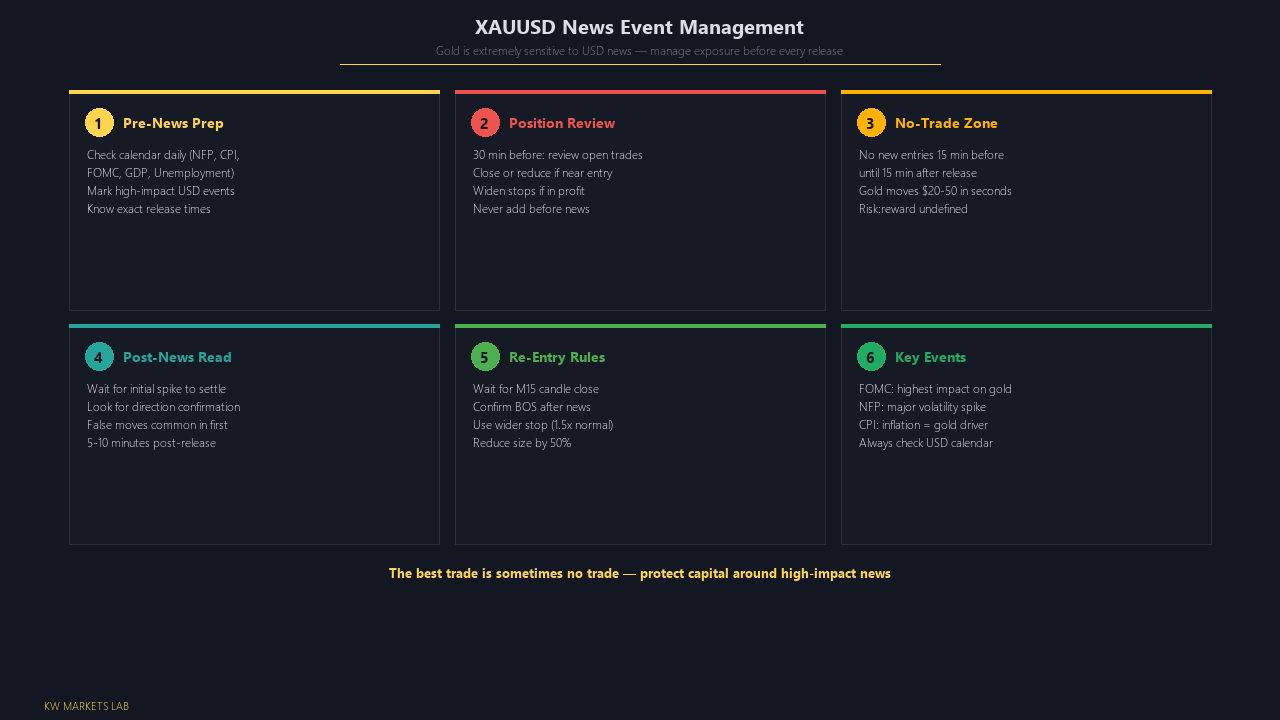
High-impact event list and gold news protocol rules.
Managing Around Gold-Specific Risk EventsHigh-impact events: US CPI, FOMC, NFP, Fed speeches, geopolitical events. Protocol: no new entries within 30 minutes before high-impact news. If in a trade: partial close before event, do not widen stop. Post-event: wait 15 minutes before reading new structure. Best post-news entries form 20–40 minutes after the initial spike.

The asymmetric risk of news events: a position that is 2R in profit before FOMC can be stopped out at -1R by the spike. The opportunity cost of closing at +1.5R before the event is much lower than the cost of a news spike that turns a winning trade into a loss. Take the partial exit, honour the risk management, and let the next post-news setup provide the continuation opportunity.

Continue Learning
L4.3 — Gold-Specific Stop Placement: Buffering for Wicks →
Stay Updated

Get notified when new lessons and content are published.