Advanced XAUUSD Gold Specialization / Module 3: Session Behaviour on XAUUSD Lesson 8 of 16
Course Outline — Lesson 8 of 16
M1 Gold Behaviour and Volatility Profile
1 L1.1 — Why Gold Behaves Differently from Forex Pairs 2 L1.2 — What Drives Gold Price: Macro Context for Technical Traders 3 L1.3 — Gold Volatility Profile: ATR, Wicks, and Typical Session Ranges 4 L1.4 — Spread, Commission, and the True Cost of Trading Gold
M2 Key Gold Setups
1 L2.1 — The Top-Down Gold Setup: Daily Bias to H1 Entry 2 L2.2 — Asian Range Breakout Setups on Gold 3 L2.3 — Gold BOS Continuation: Adapting the Framework to Gold's Profile
M3 Session Behaviour on XAUUSD
1 L3.1 — Asian Session: Consolidation, Range Identification, and Patience 2 L3.2 — London Session: Expansion, Direction, and Entry Windows 3 L3.3 — New York Session: Continuation vs Reversal Decision Points
M4 Risk Management for Gold
1 L4.1 — Position Sizing for Gold: Accounting for Pip Value 2 L4.2 — Managing Around Gold-Specific Risk Events 3 L4.3 — Gold-Specific Stop Placement: Buffering for Wicks
M5 Gold-Specific Case Studies
1 L5.1 — Case Study: Clean Bullish BOS on H4 Gold 2 L5.2 — Case Study: Asian Range Sweep and London Reversal 3 L5.3 — Case Study: Gold During a High-Impact News Event
Lesson 8 of 16

L3.1 — Asian Session: Consolidation, Range Identification, and Patience

The Asian session for gold (approximately 00:00-07:00 UTC) is characterised by lower volume, tighter ranges, and less directional conviction than the London or New York sessions. For most technical gold traders, the Asian session is an observation period — time to mark the consolidation range, review the daily structural bias, and prepare for the London expansion rather than a period to actively trade.

Setups taken during the Asian session on gold frequently fail to follow through or reverse at London open when volume returns. The spreads are also typically wider during Asian hours. Both factors — lower conviction and wider spreads — reduce the expected value of Asian-session gold entries significantly.
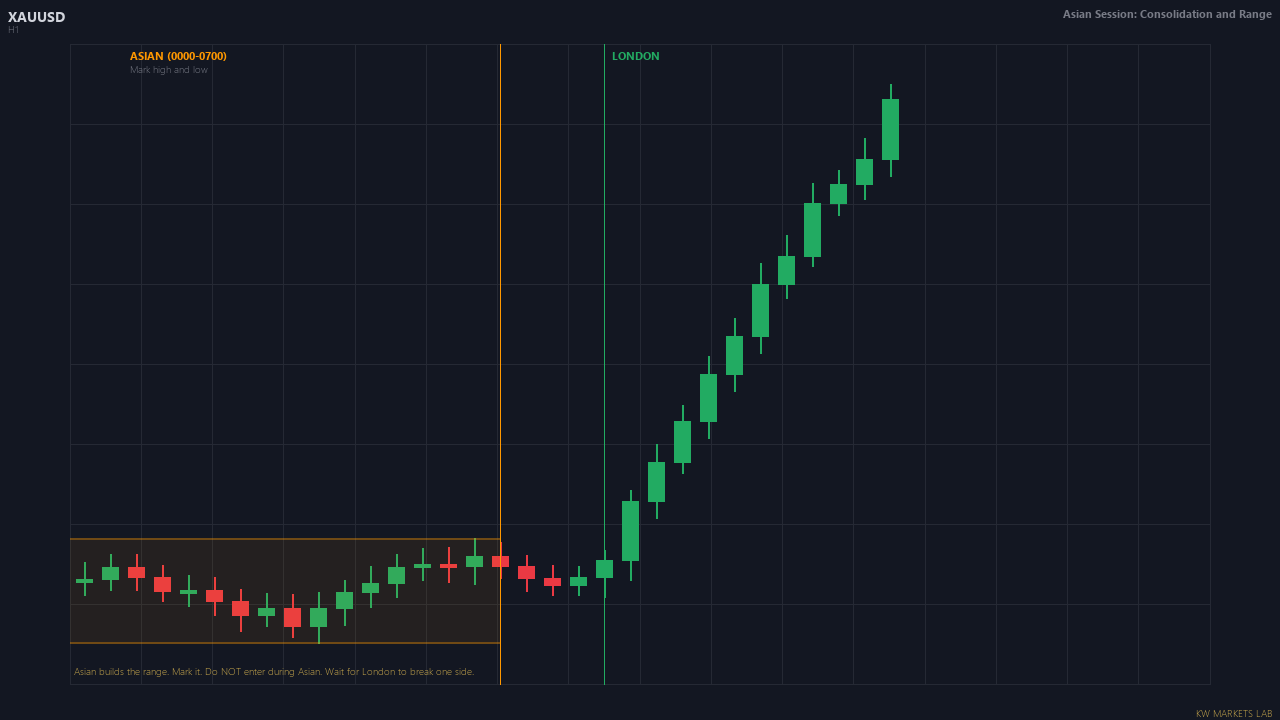
Four session windows with behaviour notes, plus do/do-not checklists for the Asian session.
Asian Session: Consolidation and RangeAsian builds the range. Mark high and low. Do NOT enter during Asian. Wait for London to break one side.

The productive use of Asian session time: mark the day's key levels on H4 and daily, update the structural bias, mark the Asian range high and low, and set price alerts at your anticipated London entry levels. This preparation makes the London session reactive and fast rather than analytical — which is the correct state for execution.

Continue Learning
L3.2 — London Session: Expansion, Direction, and Entry Windows →
Stay Updated

Get notified when new lessons and content are published.