L1.2 — What Drives Gold Price: Macro Context for Technical Traders
Gold has a well-documented negative correlation with the US dollar — when the dollar strengthens, gold typically weakens, and vice versa. It also has a strong correlation with US real interest rates (nominal rates minus inflation): rising real rates reduce the appeal of non-yielding gold, while negative or declining real rates support it. A technical trader does not need to be a macro economist, but they do need to know whether the macro wind is at their back or against their structural bias.
The practical application: before forming your gold structural bias for the week, check the DXY (US Dollar Index) trend and whether there are high-impact USD events (CPI, FOMC, NFP) on the calendar. A bullish structural bias on gold combined with a DXY that is pressing to new highs is a lower-probability bias than one where the DXY is in a confirmed downtrend.
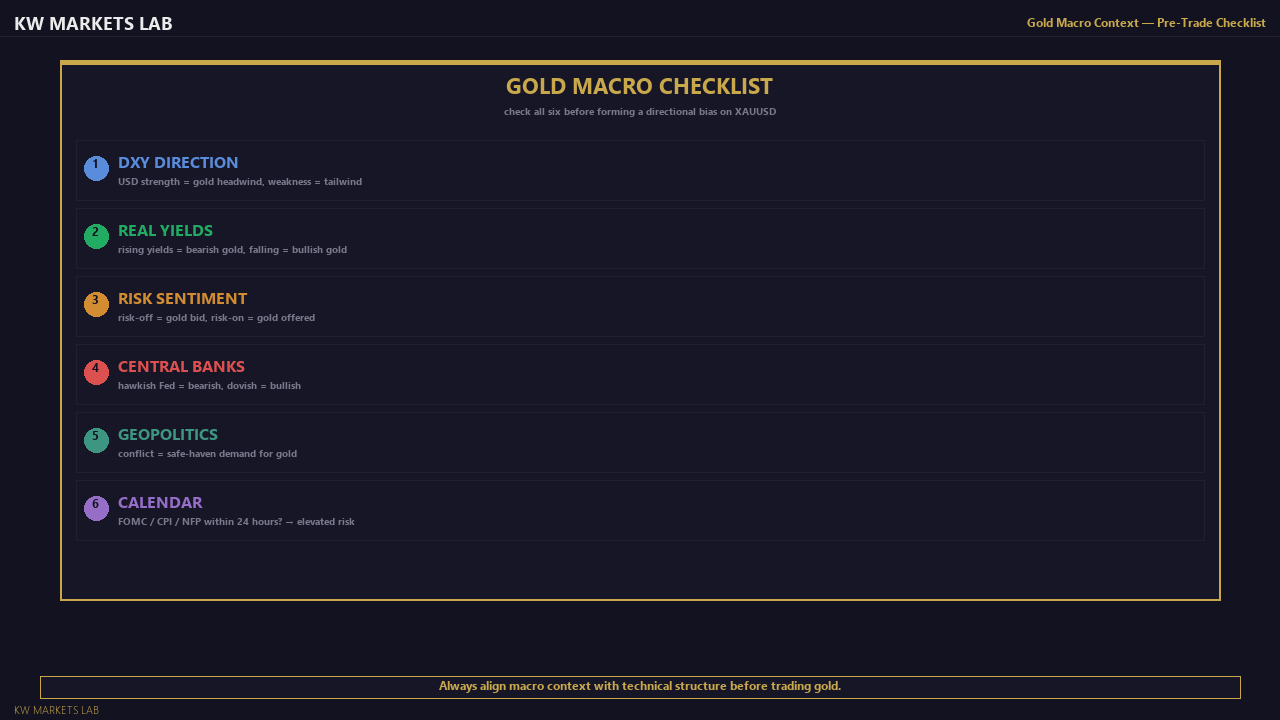
Geopolitical risk events also affect gold disproportionately compared to forex pairs. Escalating conflict, banking sector stress, or global uncertainty typically produce sharp gold rallies that reverse quickly once the immediate risk event subsides. These are not structural moves — they are event-driven spikes. Do not trade them with structural entry models.
Get notified when new lessons and content are published.