Overview
A session-based reversal framework that targets high-probability reversal points in XAUUSD during the London and New York kill zones. Uses HTF structure and supply/demand zones to define the context, then waits for a price action trigger during the kill zone window.
Before using this strategy:
When to Use This Strategy
- ✓London (0700-0830 GMT) or New York (1230-1400 GMT) kill zone is active
- ✓A clear level exists to be swept (Asian high/low, prior session extreme)
- ✓Asian range is well-defined (500+ pips on gold)
- ✓No high-impact news event within the kill zone window
When NOT to Use It
- ✗Gold has already moved 2000+ pips before the kill zone (trend day)
- ✗Asian range is very narrow (<500 pips) or not well-defined
- ✗High-impact news (CPI, FOMC, NFP) is scheduled during the window
- ✗Outside the kill zone timing windows
Framework Overview
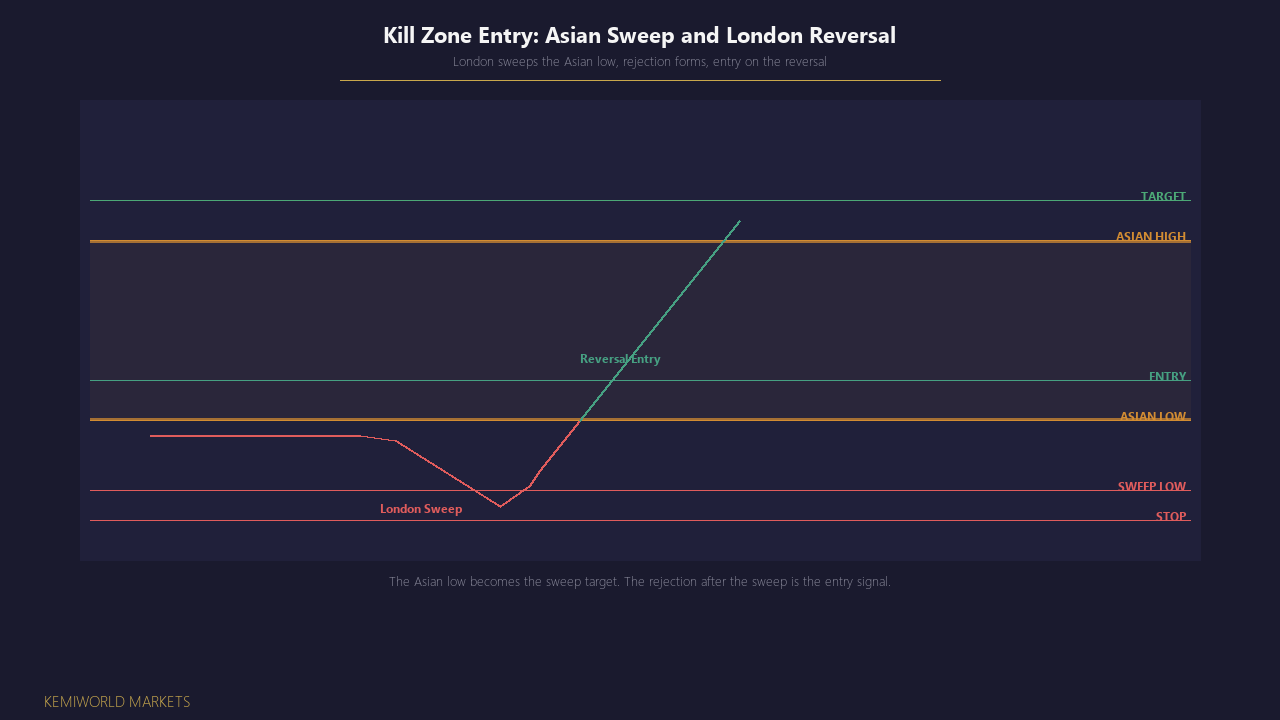
The XAUUSD Kill Zone Reversal is a session-specific strategy designed for gold's unique behavioural pattern during the London and New York kill zones. Unlike trend-following strategies that enter on continuation, this strategy enters on reversal — specifically, the reversal that occurs after a liquidity sweep during a kill zone opening.
Why Gold Reverses at Kill Zones
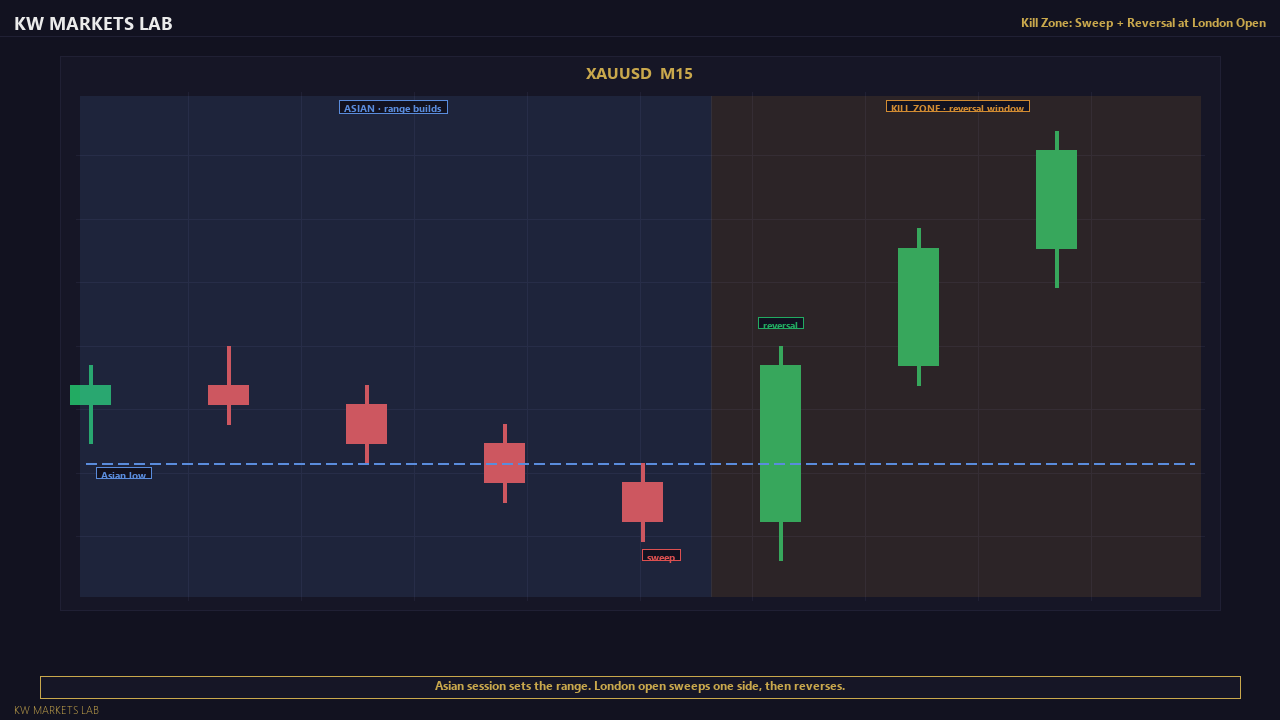
Gold (XAUUSD) has a documented tendency to sweep liquidity at the open of major trading sessions before reversing in the opposite direction. This behaviour is driven by institutional order flow: large players need liquidity to fill positions, and the densest clusters of stop-loss orders sit just beyond the Asian session high and low, prior session extremes, and obvious structural levels.
The kill zone is the 90-minute window surrounding the London open (0700-0830 GMT) and the New York open (1230-1400 GMT). During these windows, gold frequently:
1. Sweeps beyond an obvious level (Asian high/low, prior session high/low)
2. Triggers the stop-loss orders clustered beyond that level
3. Reverses sharply in the opposite direction as the institutional order is filled
The reversal is the trade. You are not trading the sweep — you are trading the reaction after the sweep completes.
Framework Structure
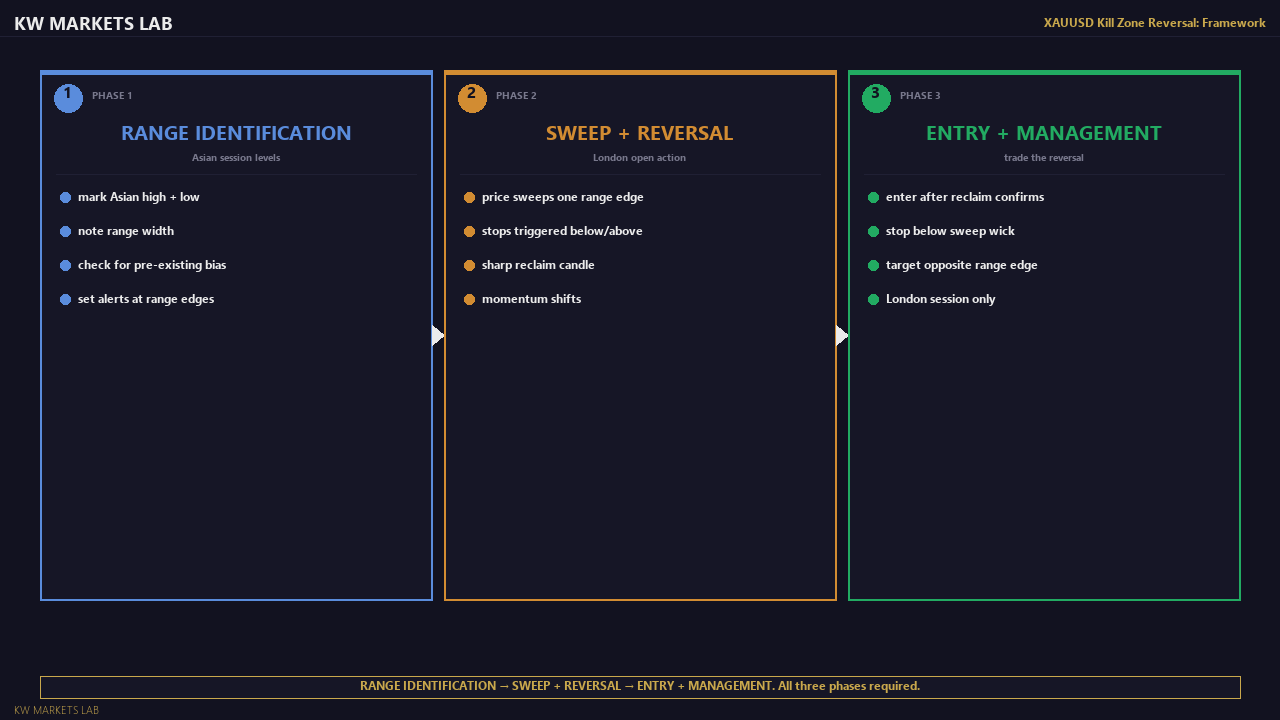
This is a three-condition strategy:
1. Pre-session structure read — Identify the key level that will likely be swept (Asian range boundary, prior session extreme, or obvious structural level)
2. Kill zone sweep — Price moves beyond the identified level during the kill zone window
3. Reversal confirmation — A rejection candle or H1 BOS forms in the opposite direction after the sweep
What Makes This Strategy Gold-Specific
This strategy is designed specifically for XAUUSD because:
- Gold's daily ATR (1500-2500 pips) creates deep wicks that regularly sweep key levels
- Gold's session behaviour is more predictable than most forex pairs — the Asian range → London expansion pattern is consistent
- Gold's pip value structure ($0.10 per pip per 0.01 lot) requires specific position sizing adjustments
- Stop placement must account for gold's wick depth (80-150 pip buffers, not 15-25 pip forex stops)
This strategy can be adapted to other instruments with strong session behaviour, but the specific parameters (stop buffers, timing windows, sizing) are calibrated for XAUUSD.
What This Strategy Is Not
This is not a scalping strategy. The typical hold time is 2-6 hours. This is not a trend-following strategy — it enters against the initial move. This is a reversal strategy with a specific structural context: the reversal is expected because the initial move was a liquidity sweep, not a structural break.
Market Conditions Required
The kill zone reversal only works under specific daily conditions. Before watching for a setup:
- Gold's pre-session move must be less than 1500 pips. If gold has already moved 1500+ pips before the kill zone opens, the session is likely a trend day — sweeps will not reverse, they will extend.
- The Asian range must be at least 500 pips wide on gold. Narrow ranges (under 500 pips) produce shallow sweeps with insufficient liquidity for a clean reversal. The wider the Asian range, the more stop orders are clustered beyond it.
- No high-impact USD data is scheduled within the kill zone window. CPI, FOMC, NFP override session structure completely. Kill zone reversals are session-behaviour patterns — they do not apply during fundamental repricing events.
- The Daily trend should ideally agree with the expected reversal direction. A London kill zone that sweeps the Asian low (setting up a long reversal) in a Daily bullish context is an A-grade setup. The same sweep in a strongly bearish Daily context is C-grade at best.
What Makes This Setup Weak
A weak kill zone reversal has:
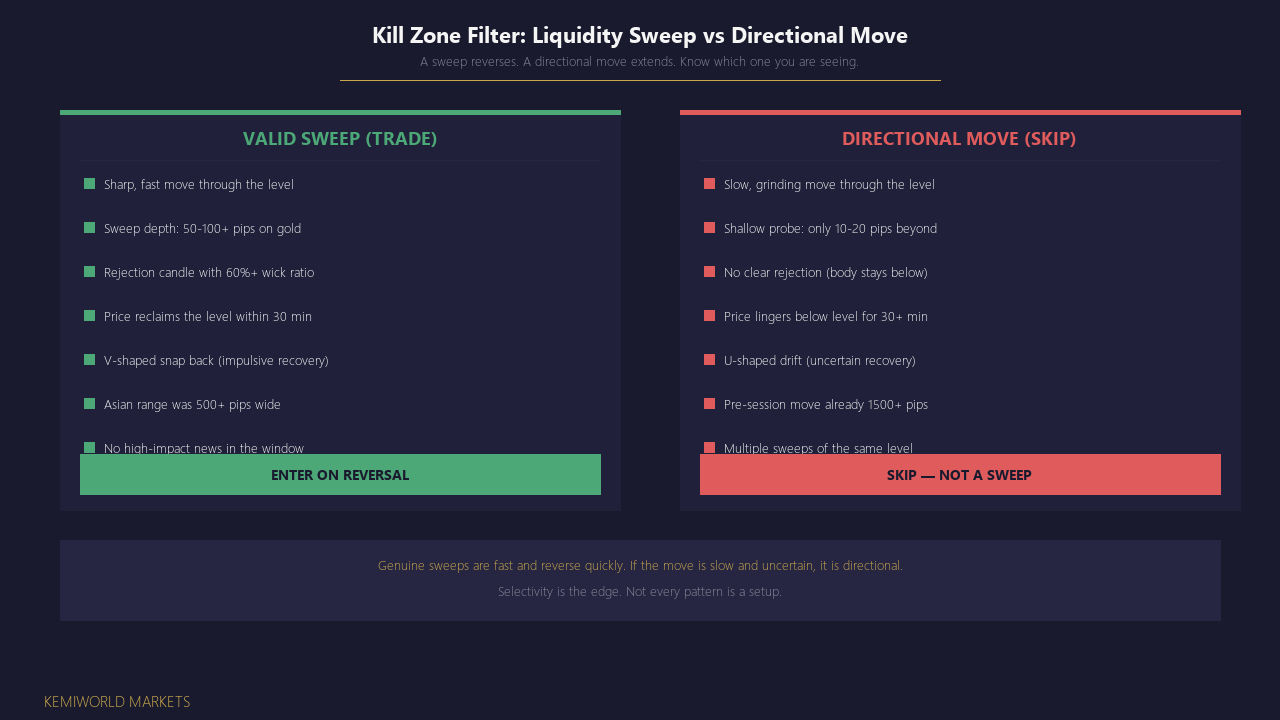
- A shallow sweep — price only exceeds the key level by 10-20 pips on gold. Strong sweeps drive 50-100+ pips beyond the level because they need to trigger deeper stop clusters. Shallow sweeps suggest insufficient institutional interest.
- A slow, grinding move through the level rather than a sharp spike. Kill zone sweeps are fast — they occur within 5-15 minutes. If the move takes 45+ minutes to develop, it may be directional rather than a sweep.
- Multiple sweeps of the same level. One clean sweep + reversal is the pattern. If price sweeps, bounces, then sweeps again deeper, the second move is breaking the level — not sweeping it.
- A rejection candle with a small wick (less than 50% wick-to-range ratio on gold). The deeper the wick into the swept zone, the more aggressive the rejection. Weak, shallow wicks suggest uncertain price action.
Common Beginner Mistake
Beginners enter the moment price touches the Asian boundary during London open — before any sweep occurs. They see price approaching the Asian low and enter long, expecting the kill zone reversal. But the sweep has not happened yet. Price continues through the level, triggering their stop, and then reverses — the classic "stopped out right before the move" experience.
The fix: the entry is AFTER the sweep, not before. You must see price move beyond the key level, form a reversal signal (rejection candle or H1 BOS), and then enter on the reversal. Entering before the sweep means you are in the way of the sweep.
What Experienced Traders Notice
- The correlation between sweep depth and reversal quality. A 100-pip sweep below the Asian low that produces a sharp rejection candle is far stronger than a 30-pip probe. Experienced traders want to see aggressive stop-hunting before entering.
- Whether the sweep absorbed visible stop clusters. If there were equal lows at the Asian boundary (a known liquidity magnet), the sweep of those equal lows is a higher-quality signal because the stops were clearly defined and now absorbed.
- The reaction speed. A genuine kill zone reversal moves fast after the sweep. If price lingers below the swept level for 30+ minutes without reclaiming it, the "sweep" is becoming a structural break. Speed of reclaim matters.
- DXY behaviour during the sweep. If DXY is also sweeping a key level in the opposite direction simultaneously, the gold reversal has dual confirmation. If DXY is trending strongly, the gold sweep may fail.
When to Skip This Trade
- Gold has already made a 2000+ pip move before the kill zone — trend day, not session structure
- The Asian range is narrow and tight (under 500 pips) — insufficient liquidity to sweep
- Multiple sweeps of the same level in the same session — the level is breaking, not being swept
- FOMC, CPI, or NFP is scheduled during the kill zone window
- Friday NY kill zone — end-of-week flows distort session behaviour
- The Daily trend strongly opposes the reversal direction and price is near a Daily supply/demand zone
Entry Conditions
All conditions must be present before entry.
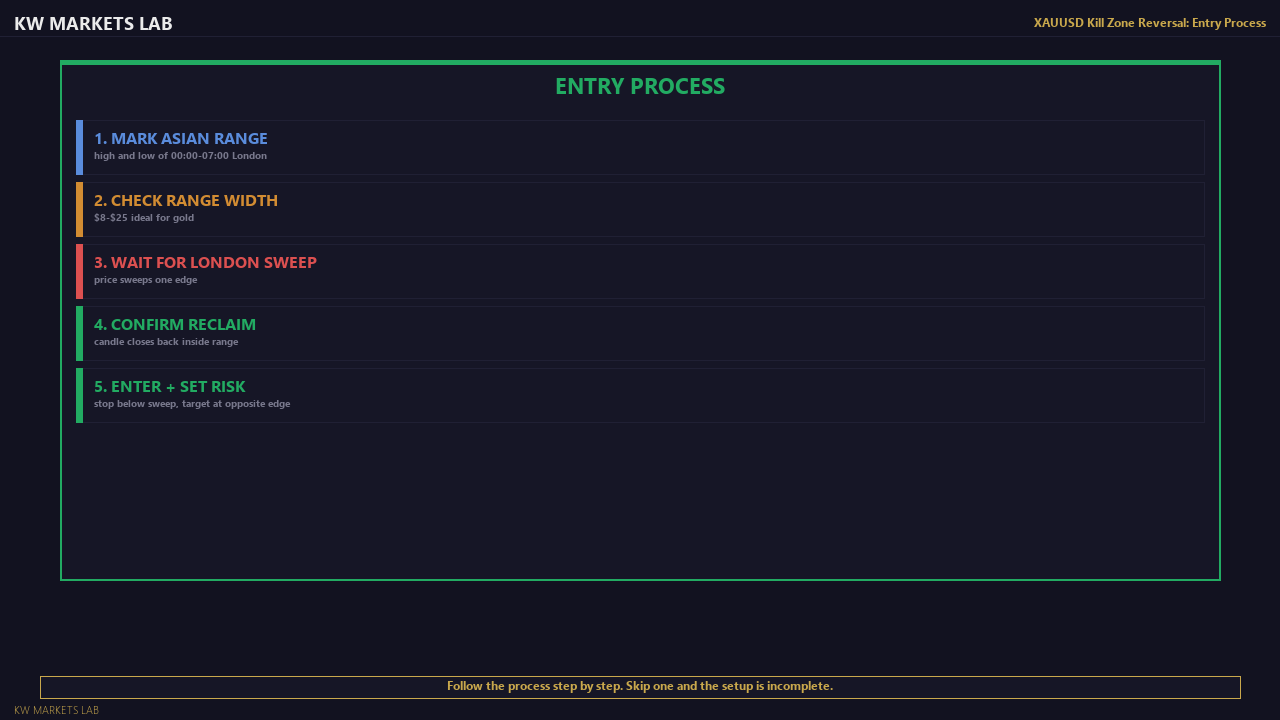
1. Kill Zone Timing Window
The setup must occur during one of two windows:
- London Kill Zone: 0700-0830 GMT
- New York Kill Zone: 1230-1400 GMT
Setups outside these windows are not valid for this strategy. The kill zone timing is not approximate — it is a hard filter.
2. Pre-Session Level Identification
Before the kill zone opens, identify the key level most likely to be swept:
- Asian session high and low (for London kill zone)
- London session high and low (for NY kill zone)
- Prior day high/low if price is near it
- Obvious structural swing point within reach of current price
The level must be clearly defined before the session begins. Do not identify the level after the sweep has occurred — that is hindsight, not analysis.
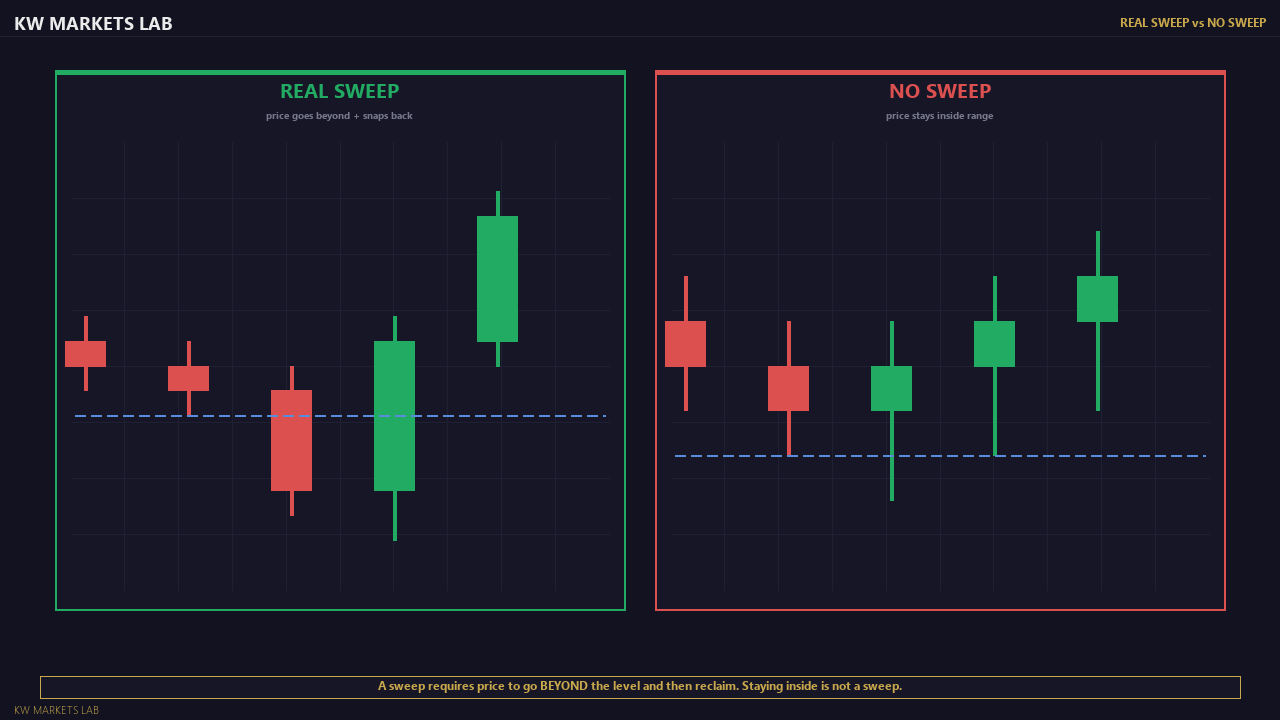
3. Sweep of the Identified Level
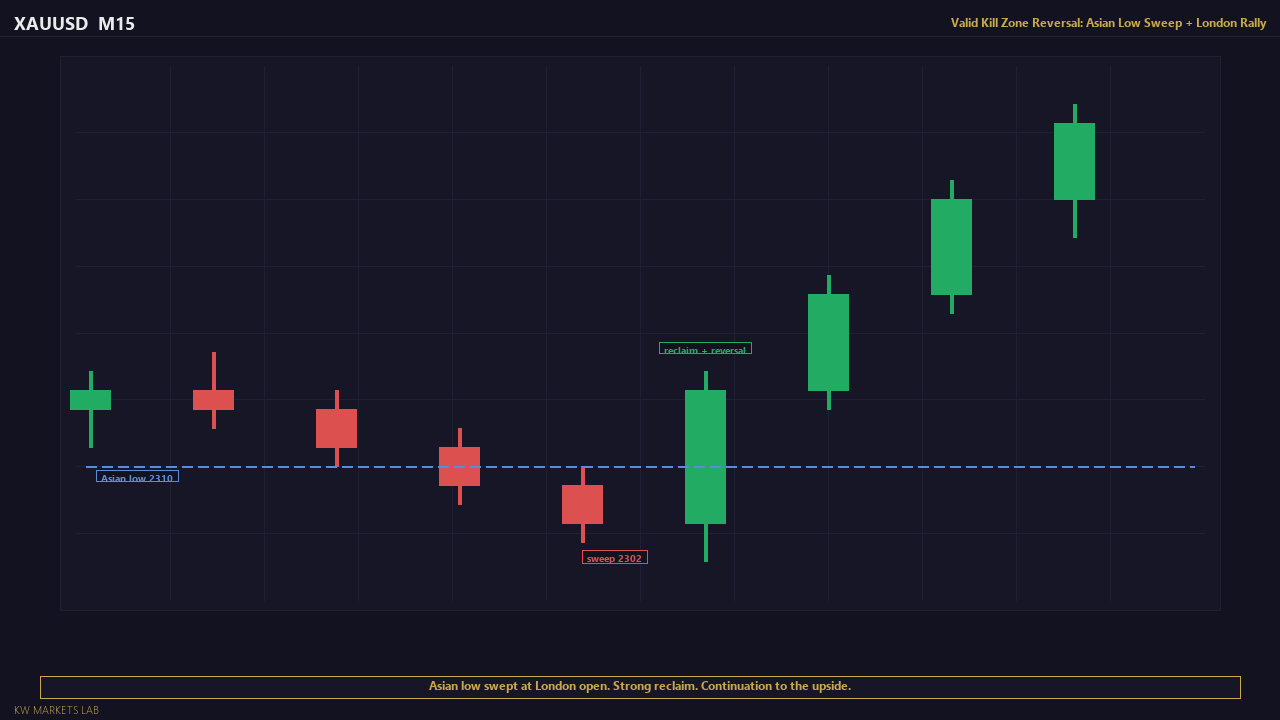
During the kill zone, price must move beyond the identified level. The sweep is characterised by:
- A sharp move through the level (not a gradual grind)
- Price exceeding the level by at least 30-80 pips on gold
- The move occurs within the first 60 minutes of the kill zone
If price does not sweep the level, there is no setup. Do not force a trade.
4. Reversal Confirmation
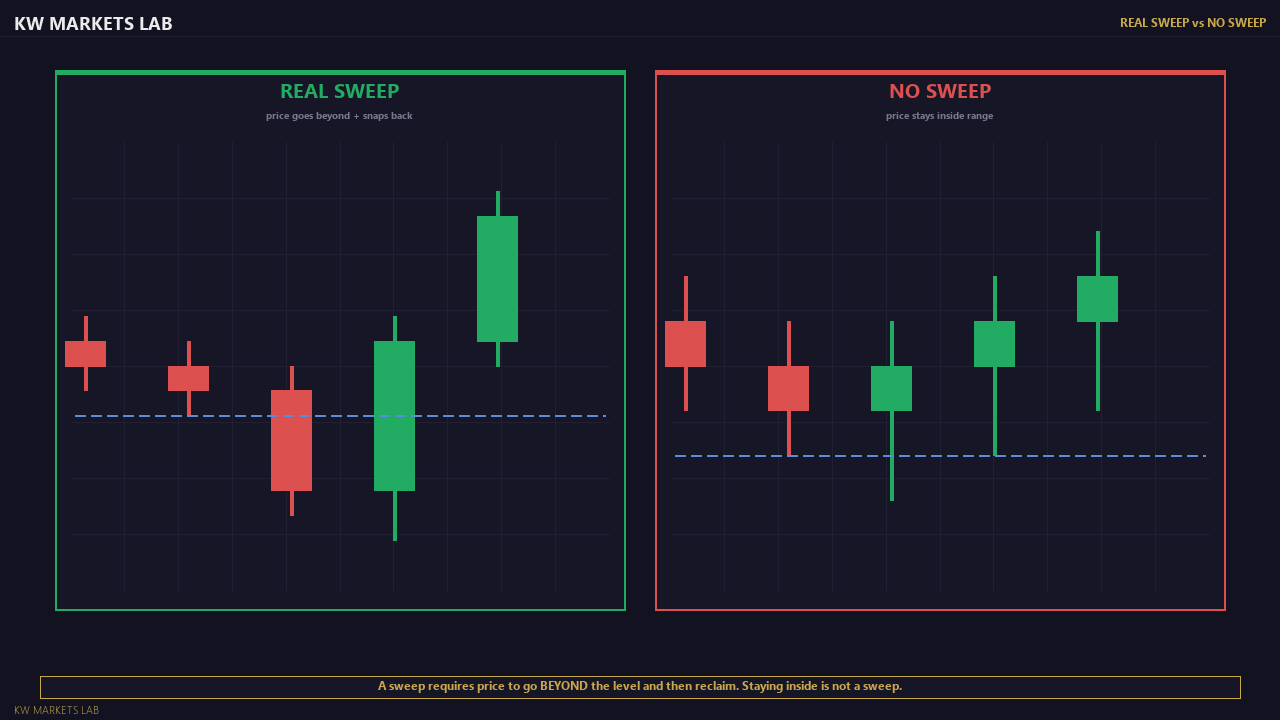
After the sweep, you need confirmation that the move is reversing:
- Rejection candle: A candle with a long wick beyond the level and body closing back inside structure (minimum 60% wick-to-range ratio)
- H1 BOS: A structural break on H1 in the opposite direction to the sweep
- Either confirmation method is valid. Choose one and apply consistently.
5. Entry Placement
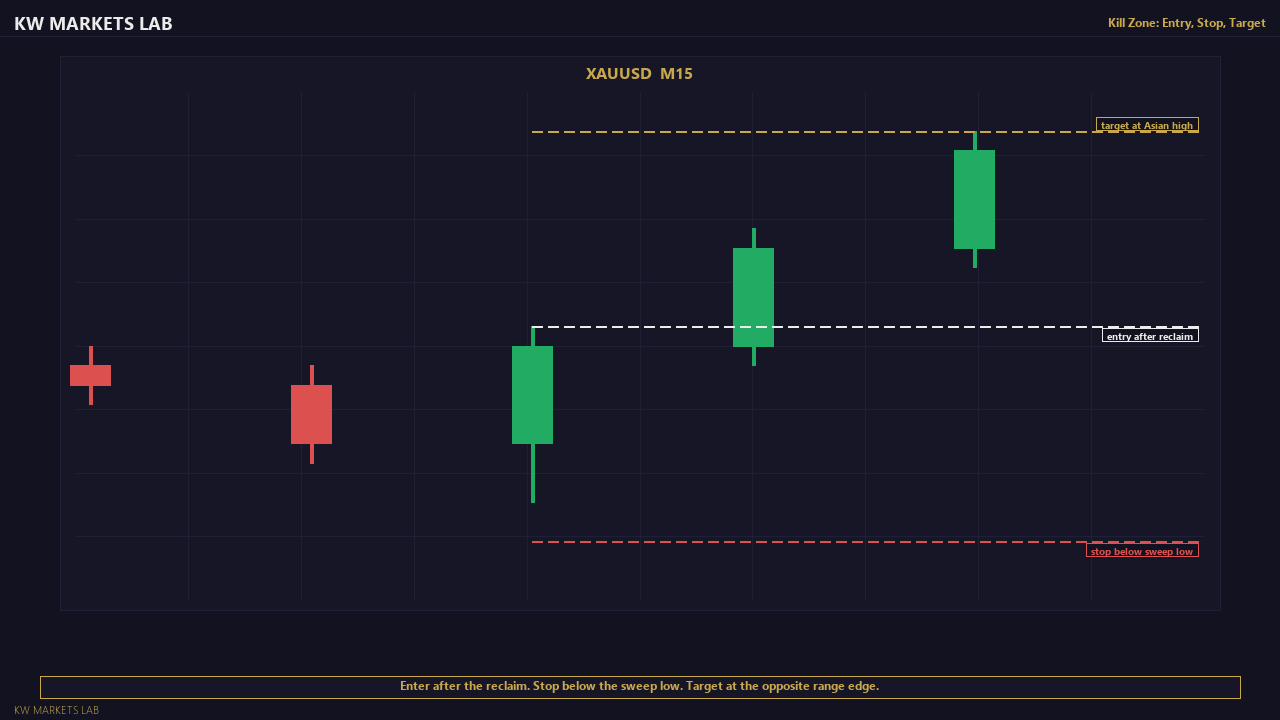
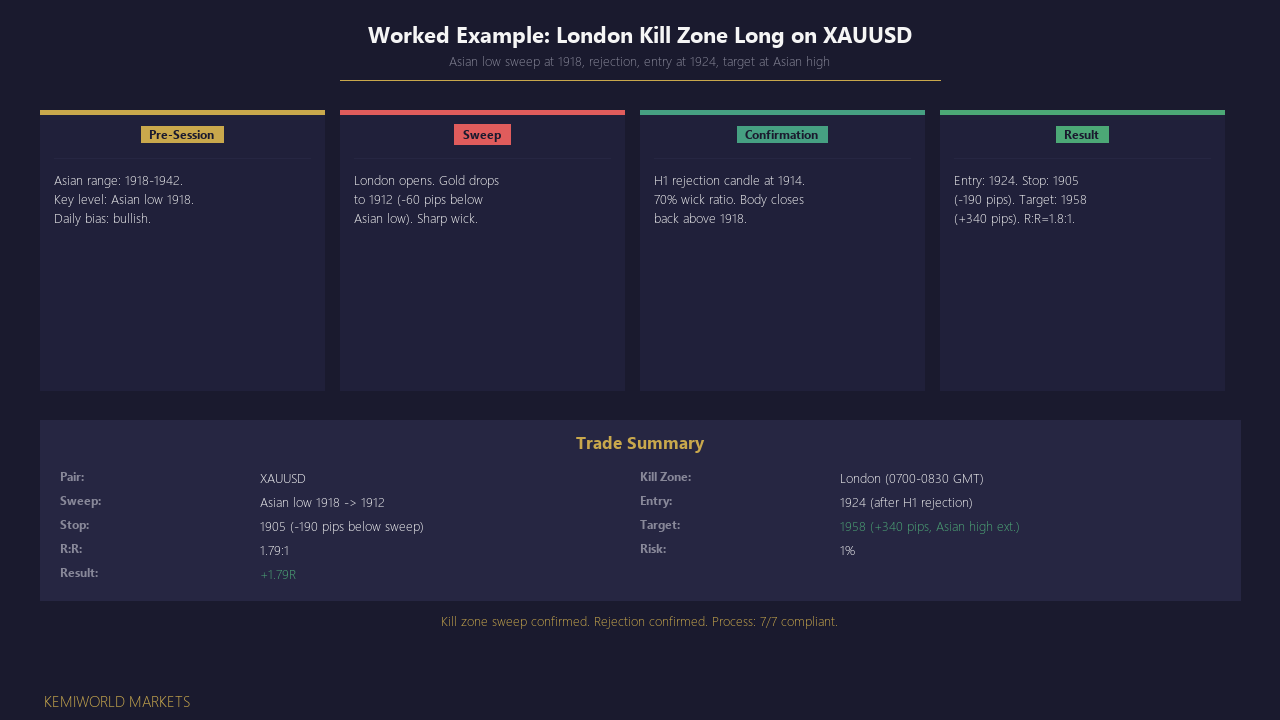
- After rejection candle: enter at the close of the rejection candle
- After H1 BOS: enter on the first pullback to the broken level
- Stop placement: beyond the sweep extreme + 50-80 pip buffer (gold wicks are deep)
6. Position Sizing
Calculate lot size from the stop distance using gold-specific pip values:
- Risk: 1% of account balance
- Lot size = Risk$ / (Stop pips x $0.10 per pip per 0.01 lot x 100)
- Gold stops are wide (100-200+ pips). This means smaller lot sizes. Do not adjust risk % to compensate.
7. Target
- Primary target: the opposite boundary of the pre-session range
- Secondary target: the next significant structural level in the reversal direction
- Minimum R:R requirement: 1.5:1 or better. If the target does not provide 1.5:1, skip the trade.
Failed Setup Example: Kill Zone Trap
London opens. Gold sweeps the Asian low by 40 pips. A small candle forms with a 30% wick ratio — the body is in the lower third, not the upper third. Price recovers 20 pips but then stalls. For the next 45 minutes, price oscillates near the swept level without reclaiming the Asian low.
Why this is not a valid reversal: the rejection candle was weak (30% wick vs required 60%+), the recovery was shallow (20 pips on gold is noise, not conviction), and price failed to reclaim the Asian low within the time window. After 60 minutes without a clean reclaim, this is a failed sweep — the move was directional, not a liquidity event. The setup expires.
Invalidation & Risk Rules
When the setup is invalidated — exit or do not enter.
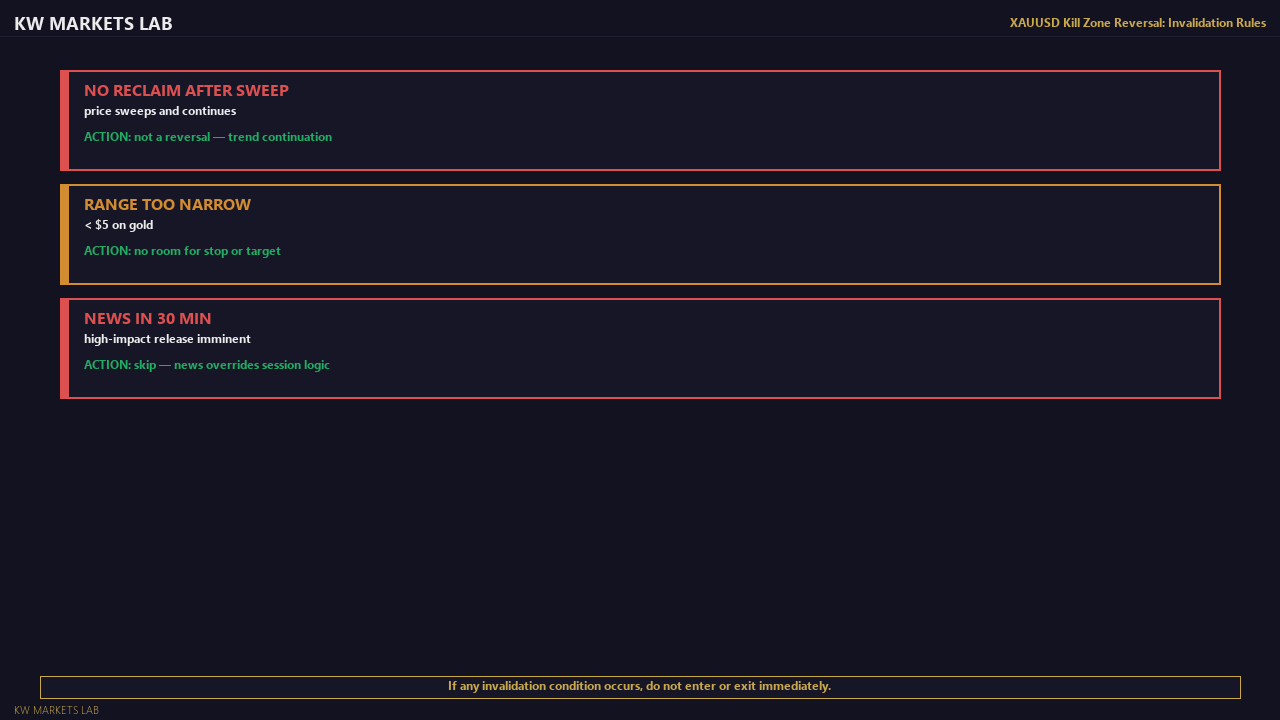
1. Sweep Does Not Reverse Within 60 Minutes
If price sweeps the key level but does not produce a reversal signal within 60 minutes, the move may be a genuine structural break — not a liquidity sweep. Close the watch. The setup has expired.
2. Body Close Beyond the Sweep Level on H1
If an H1 candle body closes beyond the swept level (not just a wick), this confirms a structural break. The sweep was not a liquidity event — it was a real BOS. Do not trade against a confirmed structural break.
3. Kill Zone Window Closes Without a Setup
If the kill zone window ends (0830 GMT for London, 1400 GMT for NY) and no sweep + reversal has formed, there is no trade. Do not extend the window. The session-specific edge disappears outside the kill zone.
4. Multiple Sweeps of the Same Level
If price sweeps the level, pulls back slightly, then sweeps it again deeper, the level is being genuinely broken — not swept for liquidity. One clean sweep + reversal is the pattern. Multiple sweeps degrade the setup quality.
5. High-Impact News Within 30 Minutes
If a high-impact economic release (NFP, CPI, FOMC) is scheduled within 30 minutes of the kill zone, the price behaviour is news-driven — not session-driven. The kill zone reversal pattern does not apply during news events. Skip entirely.
6. Daily Structure Contradicts the Reversal
If the Daily trend is strongly bearish and the London kill zone sweeps the Asian low (suggesting a long reversal), the reversal is against the Daily trend. This does not automatically invalidate the setup, but it reduces the probability. Reduce size or skip if the Daily trend is strongly directional against the reversal.
The "Reversal That Isn't" Trap
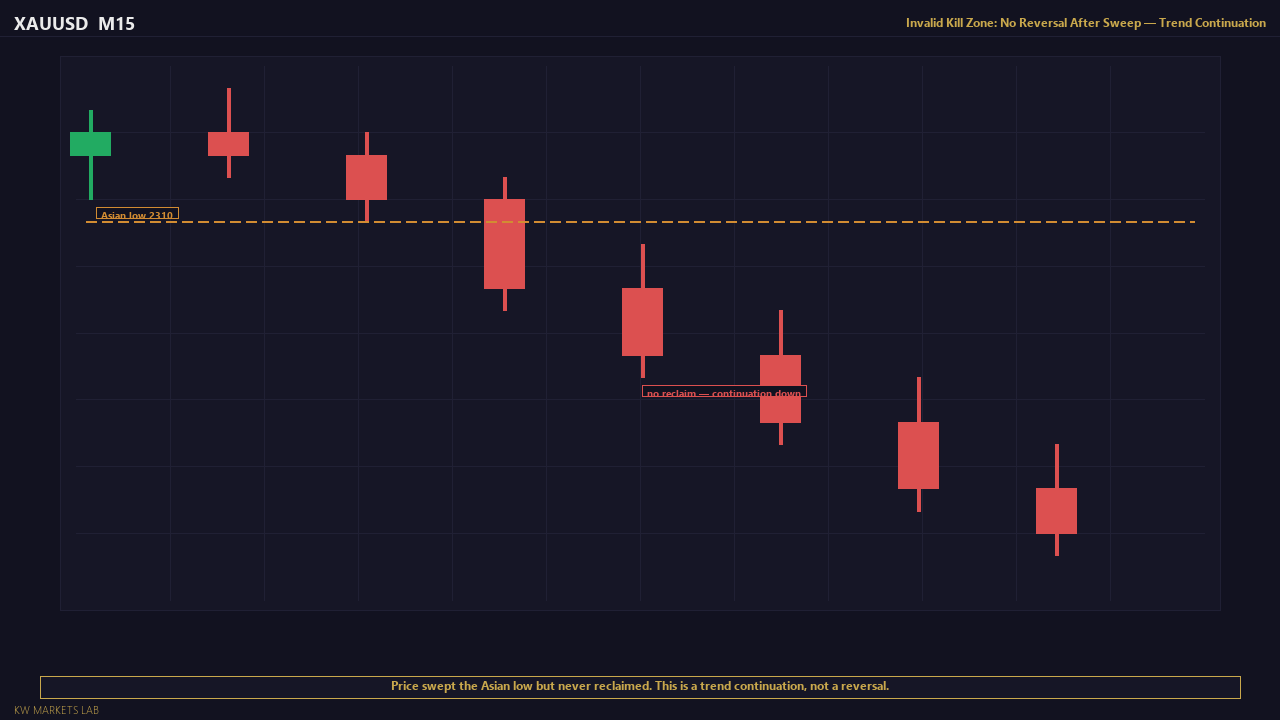
The most costly kill zone mistake: price sweeps the Asian low, produces a wick below, but the "reversal" only retraces 50% of the sweep before collapsing to new lows. Beginners who entered on the partial recovery take a full stop loss.
The distinction: a genuine reversal produces a V-shaped snap back. Within 2-3 candles, price is back above the pre-sweep level and making higher structure. A false reversal produces a U-shaped drift — price slowly crawls back toward the level but lacks the impulsive character of a real reversal. If the bounce from the sweep low looks slow and uncertain, it is not a reversal — it is a pause before continuation.
Rule: if price does not reclaim the swept level within 30 minutes with conviction, the setup is dead.
Where It Works
-
London kill zone on gold after a well-defined Asian range: This is the highest-probability variant. The Asian range establishes clear high/low levels. London sweeps one side and reverses. The wider the Asian range, the more liquidity is clustered, and the cleaner the reversal.
-
NY kill zone when London established a clear directional move: If London moved gold 1500+ pips in one direction, the NY open may sweep the London extreme before reversing. The NY reversal is often a partial retracement of the London move.
-
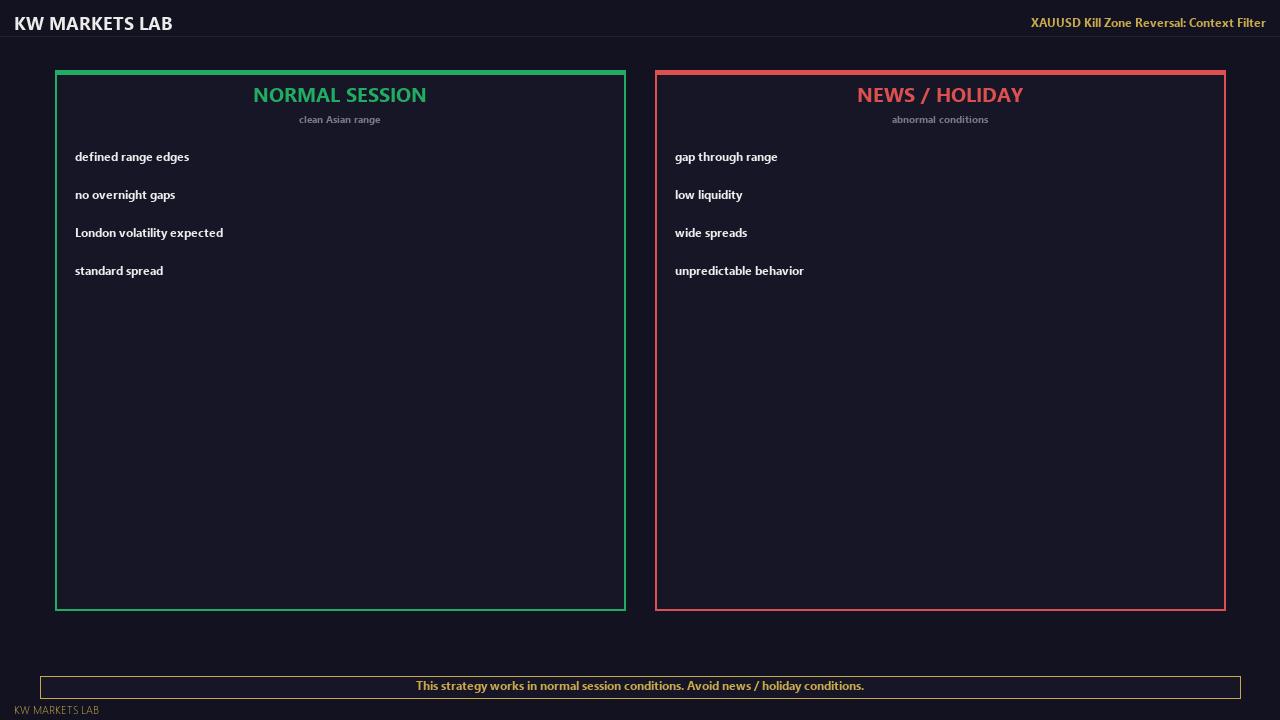
Days with no high-impact news: The kill zone reversal is a session-behaviour pattern. News-driven days override session behaviour. The cleanest setups occur on quiet news days with normal session flow.
-
Gold trading between $50 round numbers: When gold is between two round-number levels (e.g., 1920-1970), the kill zone sweeps tend to target these round numbers. The reversal from a round-number sweep is often the sharpest.
-
When the Daily bias agrees with the reversal direction: If the Daily trend is bullish and the London kill zone sweeps the Asian low (setting up a long reversal), the trade aligns with the higher timeframe. This is the highest-grade variant.
Where It Fails
-
Strong trend days: When a macro catalyst (rate decision, geopolitical event) drives gold in one direction all day, kill zone sweeps do not reverse. The "sweep" is actually the start of a directional move. If gold has already moved 2000+ pips before the kill zone, the reversal probability drops significantly.
-
Very narrow Asian ranges (<500 pips): A narrow Asian range means less liquidity is clustered beyond the boundaries. The sweep is shallow and the reversal has less fuel. These produce weak, grinding reversals rather than clean moves.
-
During high-impact news events: NFP, CPI, and FOMC releases override session behaviour. Gold can move 1000-2000 pips in seconds during these events. Kill zone timing becomes irrelevant when news is the primary driver.
-
Late in the kill zone window: Setups that form in the last 10-15 minutes of the kill zone window have reduced follow-through. The best setups form in the first 30-45 minutes.
-
When multiple pairs show the same setup: If gold AND silver AND DXY all suggest the same reversal, it may be a correlated macro event rather than a session-specific pattern. Correlated setups are not independent — do not treat them as separate trades.
-
Friday kill zones: Friday afternoon (NY kill zone) is affected by end-of-week position squaring. The reversal pattern is less reliable on Fridays because the flow is driven by portfolio management, not session structure.
Known Limitations
-
This is a session-specific strategy with a narrow execution window. Most days will not produce a valid setup. Expect 2-4 setups per week, not 2-4 per day.
-
The distinction between a liquidity sweep and a genuine structural break is a judgement call. The reversal confirmation (rejection candle or H1 BOS) helps, but it is not infallible.
-
Gold's deep wicks mean stops must be wide (100-200+ pips). This produces small lot sizes and requires patience — the trade may take 2-6 hours to reach target.
-
The strategy does not work when gold is in a strong, unidirectional trend day. On days when gold moves 3000+ pips in one direction, kill zone reversals are likely to fail because the move is fundamental, not liquidity-driven.
-
Win rate is moderate (40-50%). Profitability depends on maintaining a positive R:R ratio (1.5:1 minimum). If you cut winners early, the strategy loses its edge.
-
Asian session ranges that are unusually narrow (<500 pips on gold) produce weaker setups because the liquidity clustered beyond the range is smaller.
Visual Examples
Evidence & References
Brooks documents the behaviour of institutional participants during high-volume sessions, noting that the most reliable reversal patterns tend to occur at tested structural levels during periods of maximum liquidity. His analysis of "strong reversals" aligns with the kill zone concept: high-volume sessions produce committed candles that form the basis of reliable entries.
Brooks, A. (2012). Trading Price Action Trends. Wiley Trading.
Michael Huddleston (Inner Circle Trader) has extensively documented the concept of session-based kill zones in publicly available educational content. The London and New York opens are identified as highest-probability windows based on institutional participation. This framework applies that session logic to a structured supply/demand zone methodology. Note: this is educational documentation, not endorsement of any service.
ICT (Inner Circle Trader) public educational content — YouTube and published materials.
Research Notes
Session-based trading and kill zone concepts in practitioner literature.
The kill zone concept originates from the Inner Circle Trader (ICT) methodology, which documents the tendency of institutional traders to seek liquidity at session boundaries. While ICT's specific terminology is proprietary, the underlying concept — that markets sweep liquidity at key levels before reversing — is documented more broadly.
References:
- Dalton, J. (1990). Mind Over Markets. Probus. Market Profile methodology documents the "initial balance" concept (equivalent to the Asian range) and how breakouts from the initial balance predict session direction.
- Steidlmayer, P. (1986). Market Profile. CBOT. Original documentation of session-based price distribution and the significance of opening range behaviour.
- Murphy, J. (1999). Technical Analysis of the Financial Markets. NYIF. Documents support/resistance role reversal and the significance of failed breakouts (analogous to liquidity sweeps that reverse).
- Brooks, A. (2012). Trading Price Action Reversals. Wiley. Documents failed breakout patterns and the tendency of price to reverse after triggering stops beyond key levels.
Important context:
The kill zone reversal is a pattern, not a guaranteed edge. The references describe the structural logic, but your own trade log — tracked over a minimum of 30 setups — is the only valid measure of whether this pattern produces positive expectancy for your execution. Paper-trade before committing capital.
Learn the Full Framework
The concepts behind this strategy are covered in the Foundations course.
Start the Course →Full Documentation
Annotated examples, failure breakdowns, and complete evidence.
View VIP Access →