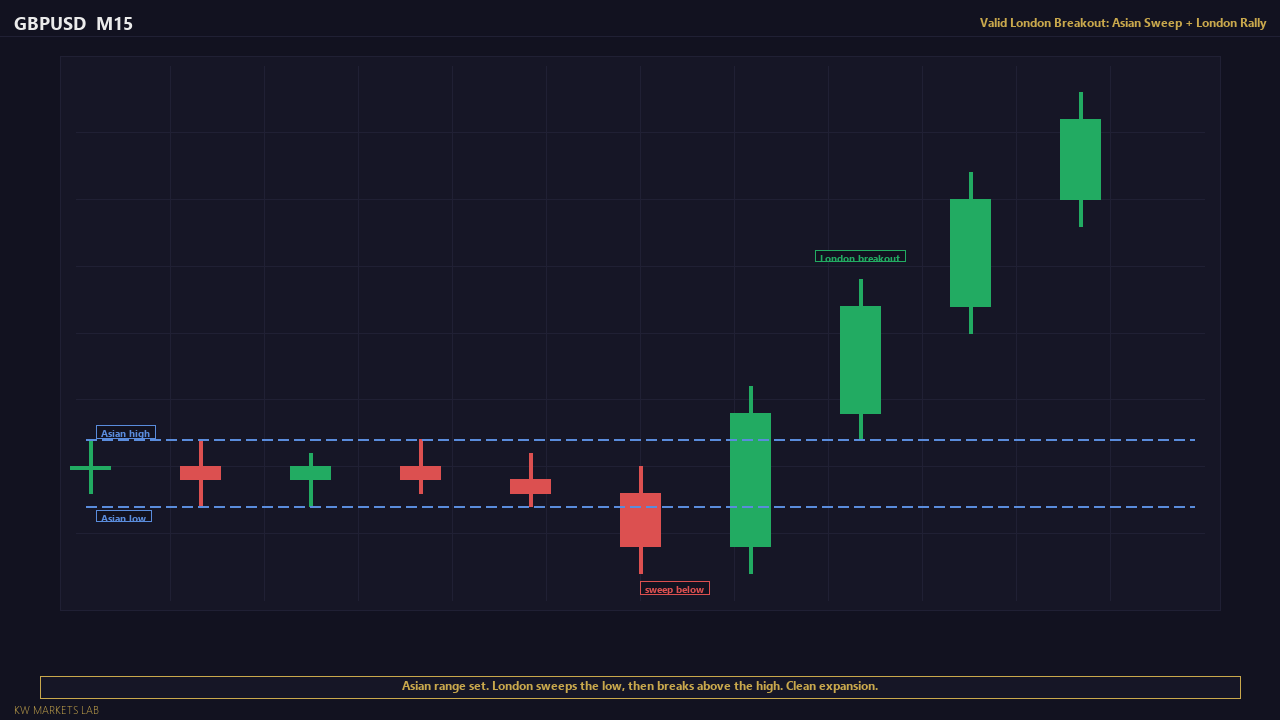
Overview
A session-based breakout framework for major forex pairs (EURUSD, GBPUSD, USDJPY) that captures directional momentum at the London open. Defines the Asian session range, then trades a confirmed breakout of that range during the first 30-90 minutes of the London session.
Before using this strategy:
When to Use This Strategy
- ✓Asian range is clearly defined and between 30-80 pips
- ✓It is Tuesday through Thursday (mid-week)
- ✓The Daily bias aligns with the breakout direction
- ✓No major news event is scheduled at the London open
When NOT to Use It
- ✗Asian range is too narrow (<30 pips) or too wide (>80 pips)
- ✗Monday (gap risk) or Friday afternoon (position squaring)
- ✗BOE/ECB announcement coincides with London open
- ✗The pair has been ranging for weeks on the Daily
Framework Overview
The London Session Breakout is a time-based momentum strategy designed to capture the directional expansion that occurs when the London session opens and breaks the pre-London (Asian) consolidation range. Major forex pairs (EURUSD, GBPUSD, GBPJPY, EURJPY) consistently show increased volatility during the London open, and this strategy systematically exploits that expansion.
Why London Breakouts Work
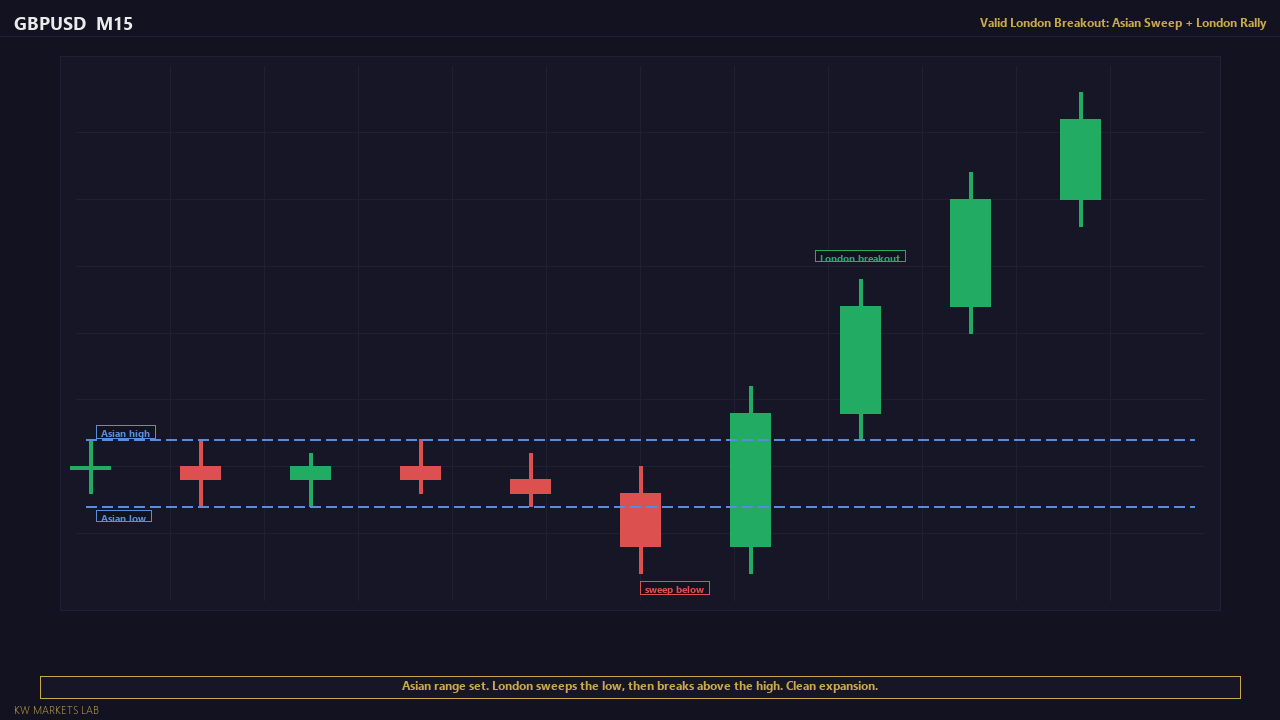
The Asian session (0000-0700 GMT) is typically a period of consolidation for European and USD pairs. Volume is low, ranges are tight, and price oscillates within a narrow band. When London opens (0700 GMT), European institutional participants enter the market, dramatically increasing volume. This volume surge often breaks the Asian range and establishes the direction for the first half of the session.
The breakout is not random. It is driven by the entry of a new participant class (European banks, funds, and dealers) into a market that has been consolidating. The initial direction of the London break frequently becomes the dominant direction for the session.
Framework Structure
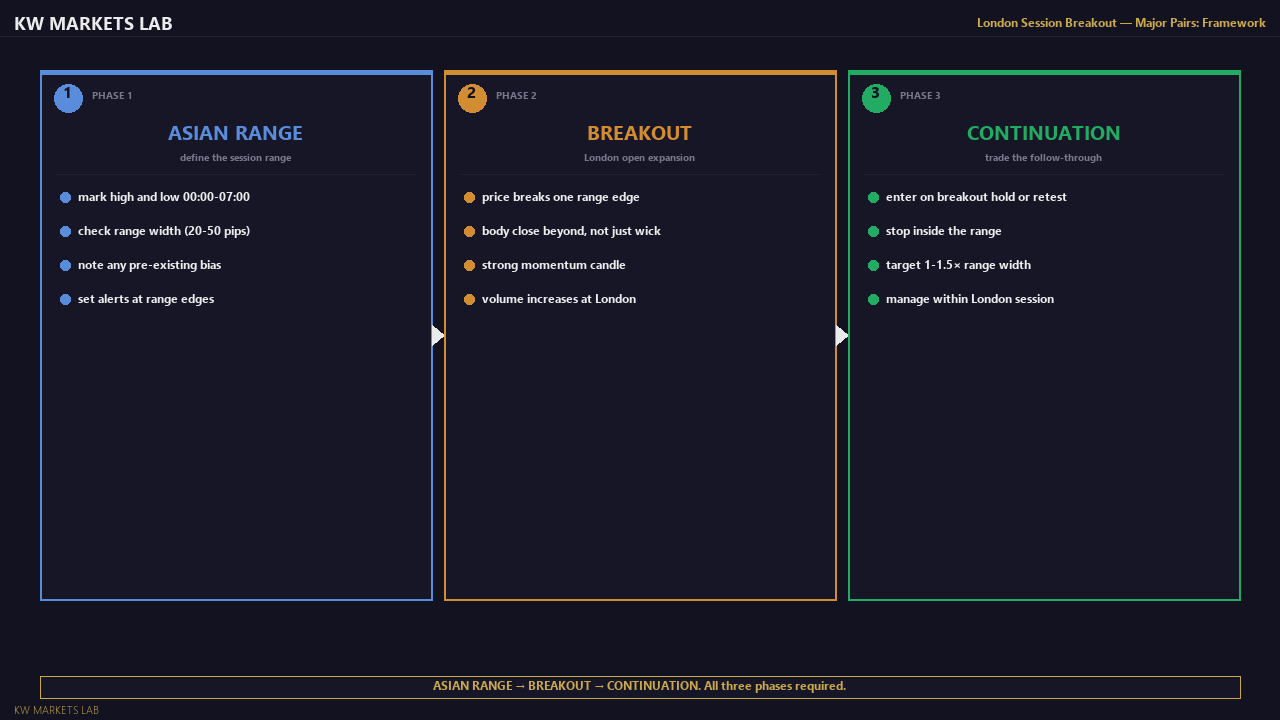
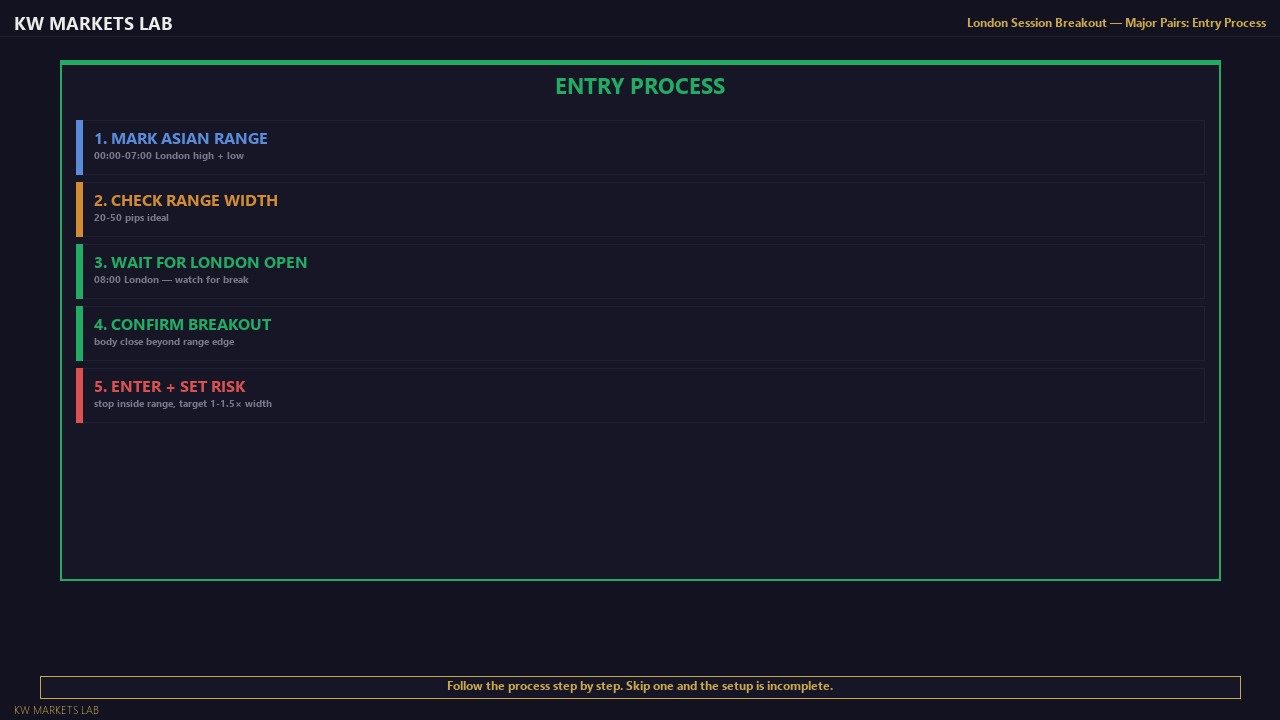
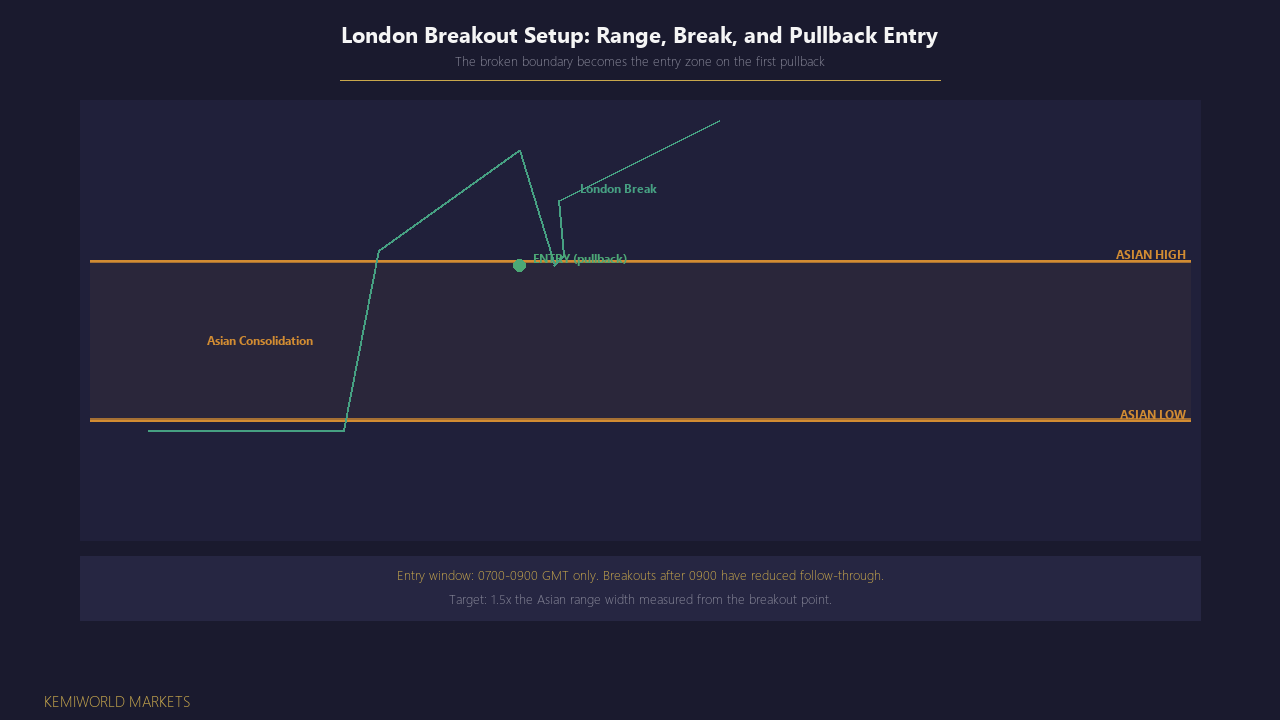
- Mark the Asian session high and low (0000-0700 GMT range)
- Wait for London to break one side of the range (0700-0830 GMT)
- Confirm the breakout with a candle close beyond the range on M30 or H1
- Enter on the first pullback to the broken range boundary
- Stop inside the Asian range. Target: 1.5x the Asian range width
Entry Timing
The optimal entry window is 0700-0900 GMT. Breakouts that occur after 0900 have reduced follow-through because the initial London expansion has already occurred. Do not trade London breakouts after 1000 GMT.
What This Strategy Is Not
This is not a news-trading strategy, though news may coincide with the London open. If a high-impact release is scheduled within 30 minutes of the London open, skip the breakout and wait for post-news stabilisation. This is not an Asian range reversal strategy — you are trading the break, not the fade.
Market Conditions Required
The London breakout strategy has specific pre-conditions that filter out low-quality days:
- The Asian session must have been a genuine consolidation — price oscillating between a defined high and low without directional bias. If the Asian session was trending (making HH/HL through the session), it was not consolidating, and the "range" is misleading.
- The Daily chart must show a directional trend, and the breakout direction must align with it. A London breakout that breaks upward in a Daily bullish trend has significantly higher follow-through than one that breaks against the Daily bias. Always check Daily alignment before the session.
- No high-impact news is scheduled within the first 90 minutes of London open (BOE, ECB, surprise data). News-driven breakouts are fundamentally different from session-driven breakouts — the follow-through is unreliable.
- The Asian range width must be between 30-60 pips for optimal R:R. Below 30 pips: insufficient consolidation energy for a reliable expansion. Above 80 pips: the stop is too wide and the target too distant for practical sizing.
What Makes This Setup Weak
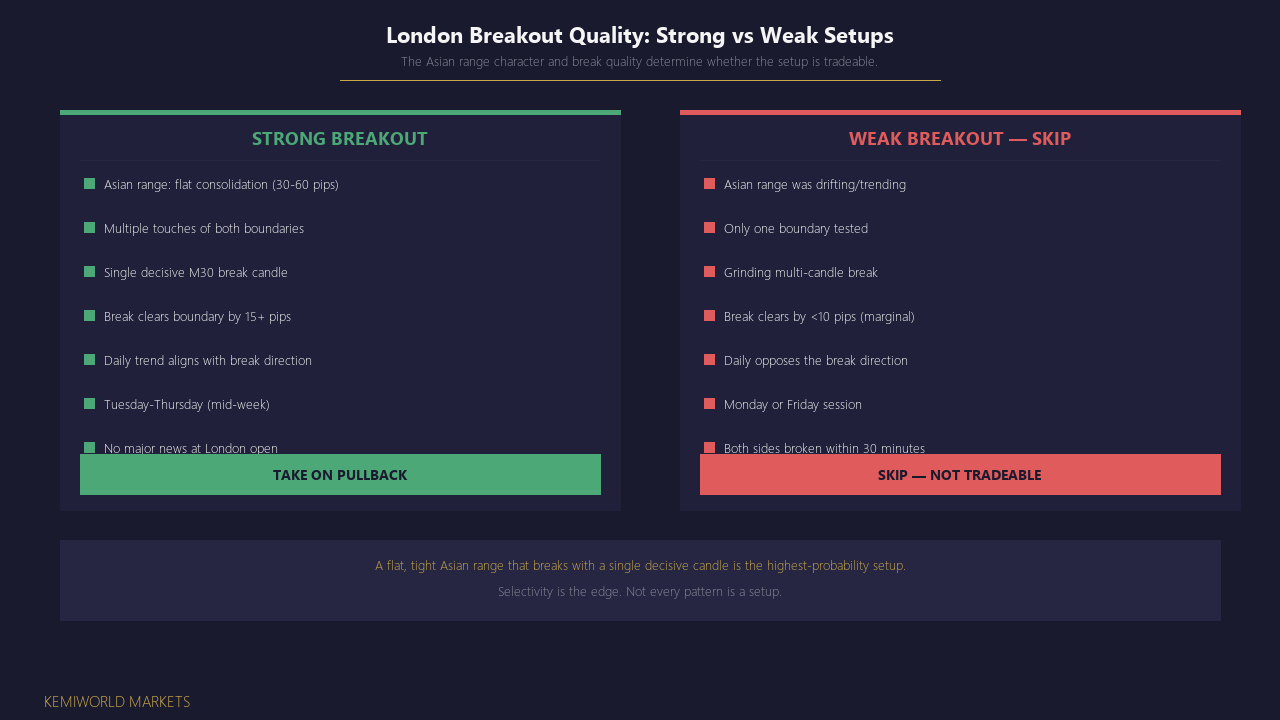
Not every range break is a valid breakout. A weak breakout has:
- A grinding, multi-candle break. The ideal London breakout is a single decisive M30 candle that closes well beyond the range boundary. If it takes 3-4 candles of grinding to clear the boundary, the breakout lacks conviction and false-break probability increases.
- The break occurs before 0700 GMT. Pre-London breaks (during the late Asian overlap) are not driven by London volume. They are often position adjustments that reverse when actual London flow arrives.
- The Asian range was trending, not consolidating. If the range "high" was the last candle's high and price was rising through Asian hours, the "breakout" is just a continuation of Asian momentum — not a fresh London expansion.
- The break occurs on a Monday. Weekend gaps and Monday position adjustments create false ranges. Tuesday-Thursday breakouts are statistically more reliable.
- Both sides of the range break within the first 30 minutes. If price breaks above the Asian high and then reverses to break below the Asian low (or vice versa), the market is chopping — not breaking out. Cancel all orders.
Common Beginner Mistake
The biggest mistake is entering on the initial break candle close without waiting for a pullback. The M30 closes above the Asian high — the beginner enters immediately at the close price. Price then pulls back to the broken boundary (a normal retest) and their tight stop inside the range is triggered. 5 minutes later, price resumes higher and reaches the target without them.
The fix: use the conservative entry method. Wait for the first pullback to the broken boundary. Enter on the retest, not the break. Your fill price is better, your stop is more structurally meaningful, and you avoid the initial volatility spike that shakes out breakout chasers.
What Experienced Traders Notice
- The character of the Asian range. A flat, tight consolidation with multiple touches of both boundaries (a "coil") produces the strongest breakouts. A drifting, one-sided range produces weaker ones.
- Whether the pre-London move (0600-0700 GMT) tested one side of the range. If price probed the Asian low just before London open and was rejected, the London break is more likely to be upward — the downside was tested and held.
- The first 15 minutes of London. Experienced traders watch but do not act during 0700-0715 GMT. The initial move often fakes one direction before the real move develops. The M30 candle close at 0730 is the first reliable signal.
- The relationship between range width and target. A 40-pip range with a 60-pip target (1.5x) gives a clean 2:1 R:R with a 30-pip stop at the range midpoint. If the range is 70 pips, the 105-pip target may run into structural resistance before it is reached.
When to Skip This Trade
- Asian range is below 30 pips (too narrow) or above 80 pips (too wide)
- The Daily trend opposes the breakout direction
- It is Monday (gap distortion) or Friday afternoon (end-of-week squaring)
- BOE, ECB, or other high-impact news is due at or near London open
- Price has already broken both sides of the range — chopping, not breaking out
- The Asian session was trending, not consolidating
- You are trading AUDUSD, NZDUSD, or USDCAD — these pairs respond to Asian/commodity flows, not London expansion
Entry Conditions
All conditions must be confirmed.
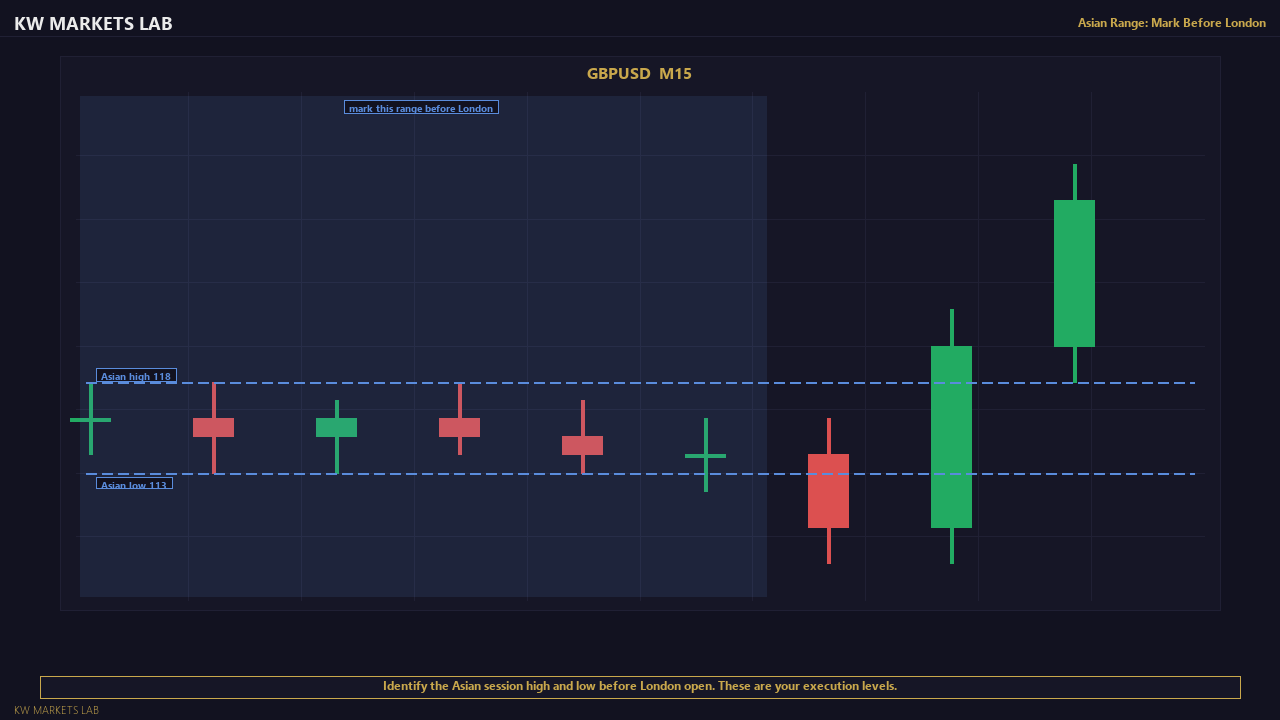
1. Define the Asian Range
Mark the high and low of price action between 0000 and 0700 GMT on the chosen pair. The range must be well-defined — if price has been trending through Asian hours (not consolidating), the breakout setup is less reliable.
2. Minimum Range Width
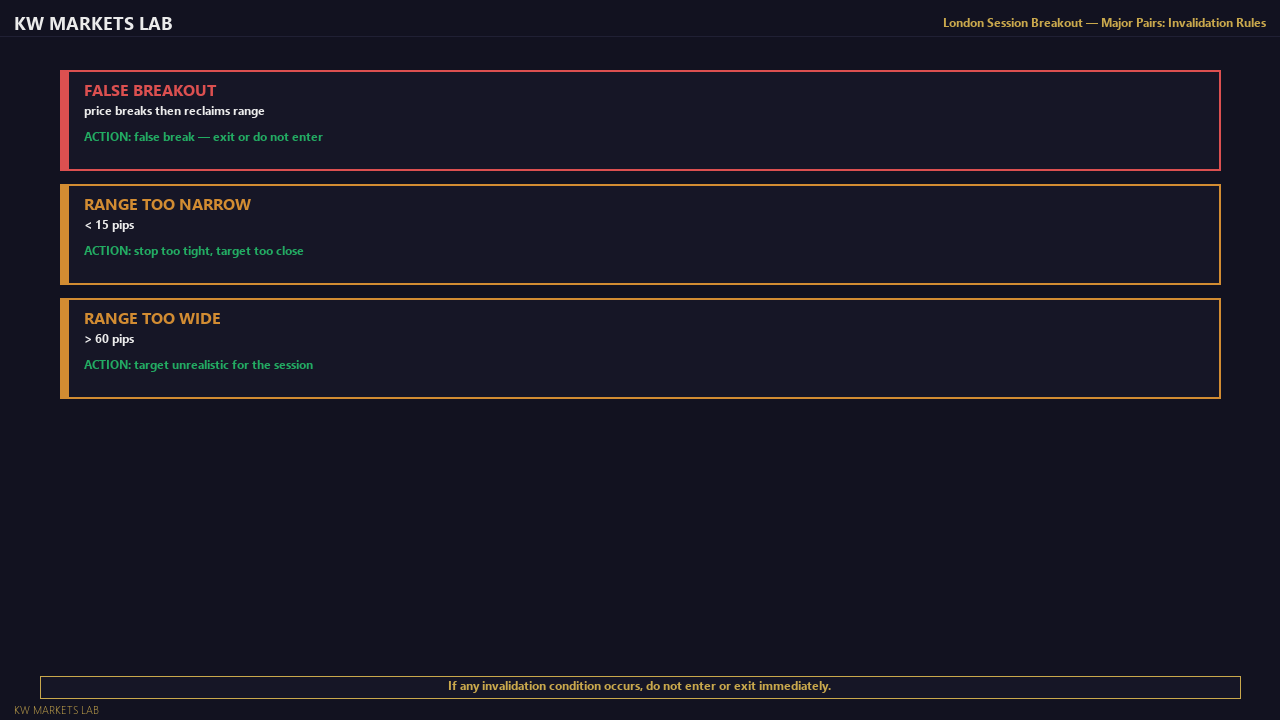
The Asian range must be at least 30 pips (EURUSD/GBPUSD). Ranges narrower than 30 pips may produce false breakouts because the consolidation is too tight — there is not enough coiled energy for a reliable expansion.
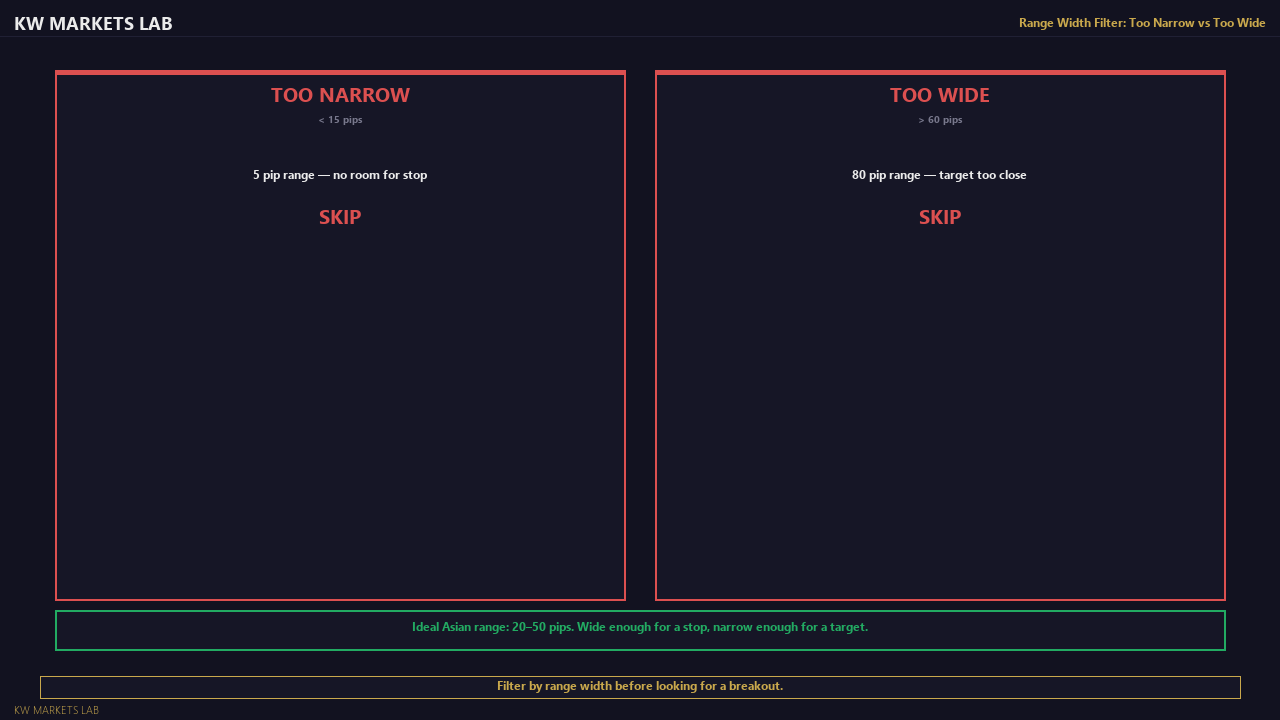
3. Maximum Range Width
If the Asian range exceeds 80 pips, the breakout target becomes too large and the stop too wide for a reasonable R:R. Skip ranges wider than 80 pips.
4. Breakout Confirmation
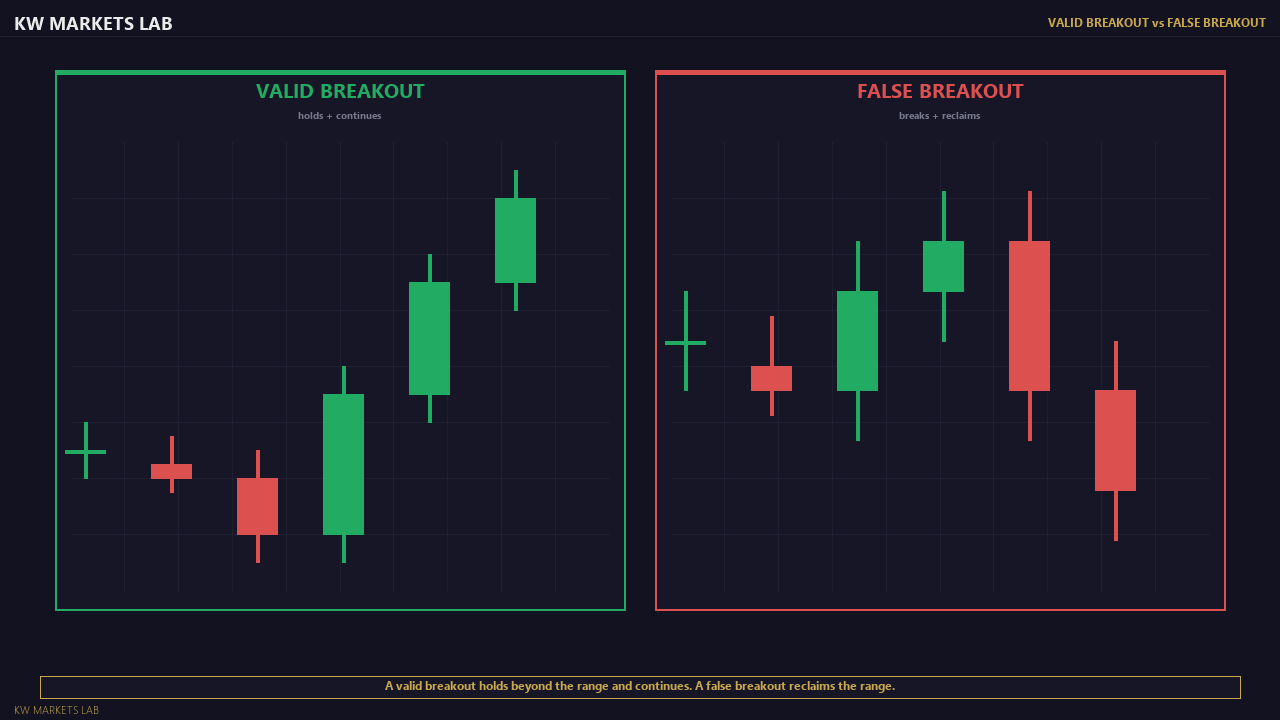
A confirmed breakout requires an M30 candle body closing beyond the Asian range boundary. A wick-only break is not confirmed — it may be a false breakout.
5. Entry Method
Two options:
- Aggressive: Enter on the breakout candle close (higher fill rate, risk of false break)
- Conservative: Wait for the first pullback to the broken boundary (lower fill rate, higher confidence)
The conservative method is recommended for this strategy.
6. Stop Placement
Place the stop inside the Asian range:
- Long breakout: stop below the Asian range midpoint or low (depending on R:R)
- Short breakout: stop above the Asian range midpoint or high
- The stop should be at least 15 pips inside the range
7. Target
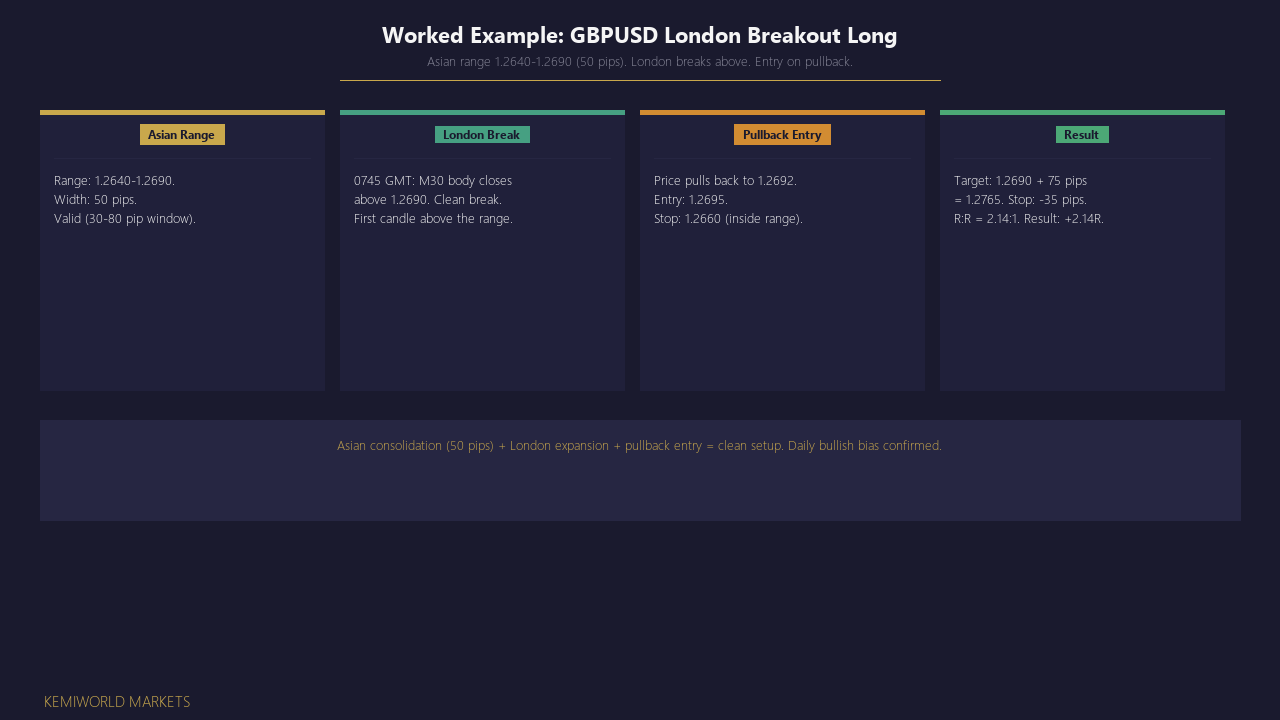
Primary target: 1.5x the Asian range width measured from the breakout point. If the Asian range was 50 pips, the target is 75 pips from the breakout boundary. Secondary target: the next significant structural level.
8. Session Filter
Entry only during 0700-0900 GMT. No entries after 0900 GMT. No entries if a high-impact news event is scheduled within 30 minutes of the London open.
9. Pair Filter
EURUSD, GBPUSD, GBPJPY, EURJPY are the primary pairs. These show the strongest London open expansion. Commodity currencies (AUDUSD, NZDUSD) have weaker London breakout behaviour — avoid.
Failed Setup Example: False London Breakout
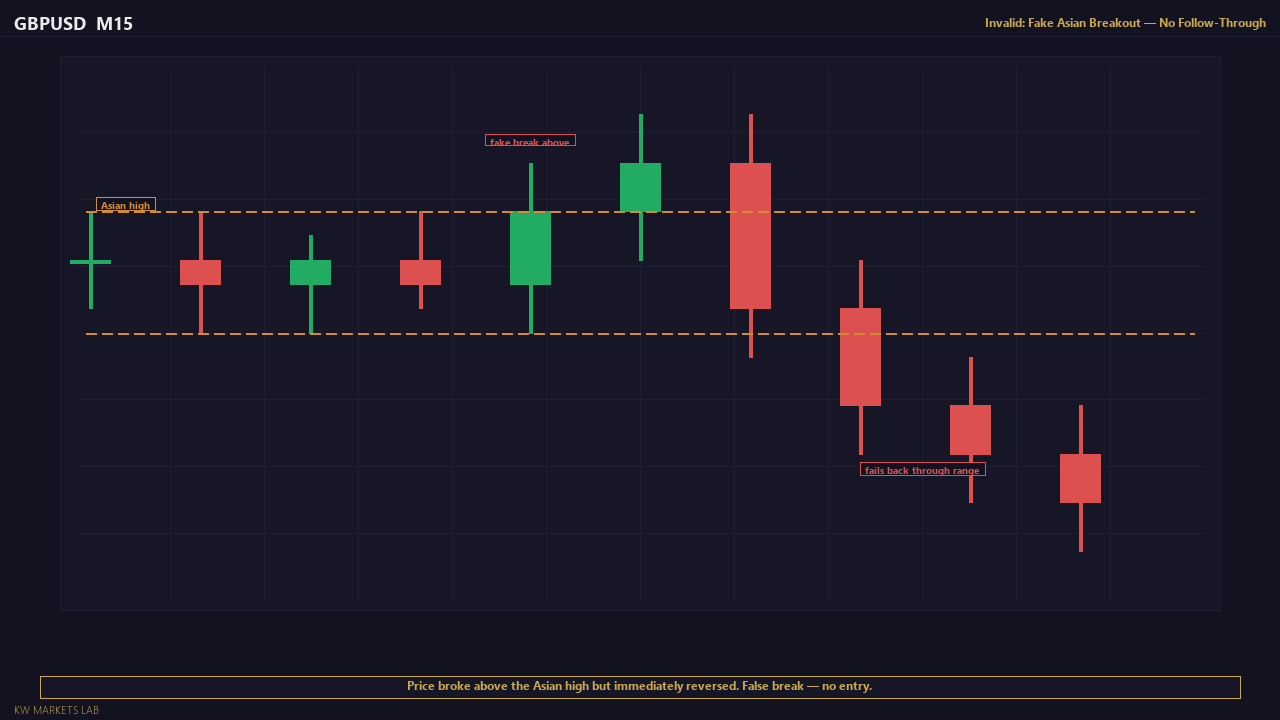
EURUSD Asian range: 1.0830-1.0860 (30 pips). At 0715 GMT, the M30 candle pushes above 1.0860 to 1.0868. A beginner enters long at 1.0868, stop at 1.0845 (inside the range). The next M30 candle opens and immediately drops back below 1.0860, closing at 1.0842. Stop hit at -23 pips.
Why this failed: the "break" was only 8 pips above the range — barely clearing it. The candle at 0715 was within the first 15 minutes of London when fakeouts are common. The entry was on the break itself, not a pullback retest. The range was at the minimum width (30 pips), offering less consolidation energy. And the Daily was ranging, not trending — the breakout lacked higher-timeframe support.
What the conservative trader did: waited for the M30 close at 0730. Saw that the 0730 candle closed back inside the range. Classified it as a false break. No entry. Waited for the real move — which came 45 minutes later as a downside break that reached target.
Invalidation & Risk Rules
When the London breakout setup is invalidated.
1. False Breakout (Body Closes Back Inside Range)
If a candle breaks beyond the range but the next candle's body closes back inside, the breakout has failed. This is a false break. Cancel the trade or close the position if already entered.
2. Breakout Occurs Before 0700 GMT
If price breaks the Asian range before the London session opens, the breakout is not driven by London volume. It may be a late-Asian move or pre-London position adjustment. Do not trade pre-session breakouts.
3. No Breakout by 0900 GMT
If the Asian range has not been broken by 0900 GMT, the session is likely to be a range day. Close the watch. Do not extend the breakout window.
4. Asian Range Is Trending (Not Consolidating)
If Asian price action was directional (trending up or down through the session), the "range" is not a true consolidation. The breakout framework requires a genuine consolidation — a tight, oscillating range — to be valid.
5. High-Impact News at London Open
If NFP (unusual), BOE, ECB, or other high-impact releases coincide with the London open, the breakout is news-driven, not session-driven. Skip.
6. Both Sides Break Quickly
If price breaks above the Asian high and then quickly breaks below the Asian low (or vice versa), the market is chopping. This is not a breakout environment. Cancel all pending orders.
The "Both-Sides Break" Warning
If price breaks above the Asian high within the first 30 minutes, then reverses and breaks below the Asian low — or vice versa — the session is in chop mode. This is not a breakout environment. Both sides have been tested and rejected. The correct action is to cancel all pending orders and close the watch for the day. Do not try to trade the "second break" — it is just as likely to reverse.
This pattern occurs most commonly on high-impact news days (data released at 0700 GMT), Mondays (gap adjustments), and pairs that are in a tight multi-week range on the Daily. If the Daily structure shows 3+ weeks of ranging, London breakouts on that pair are unreliable until the range resolves.
Where It Works
-
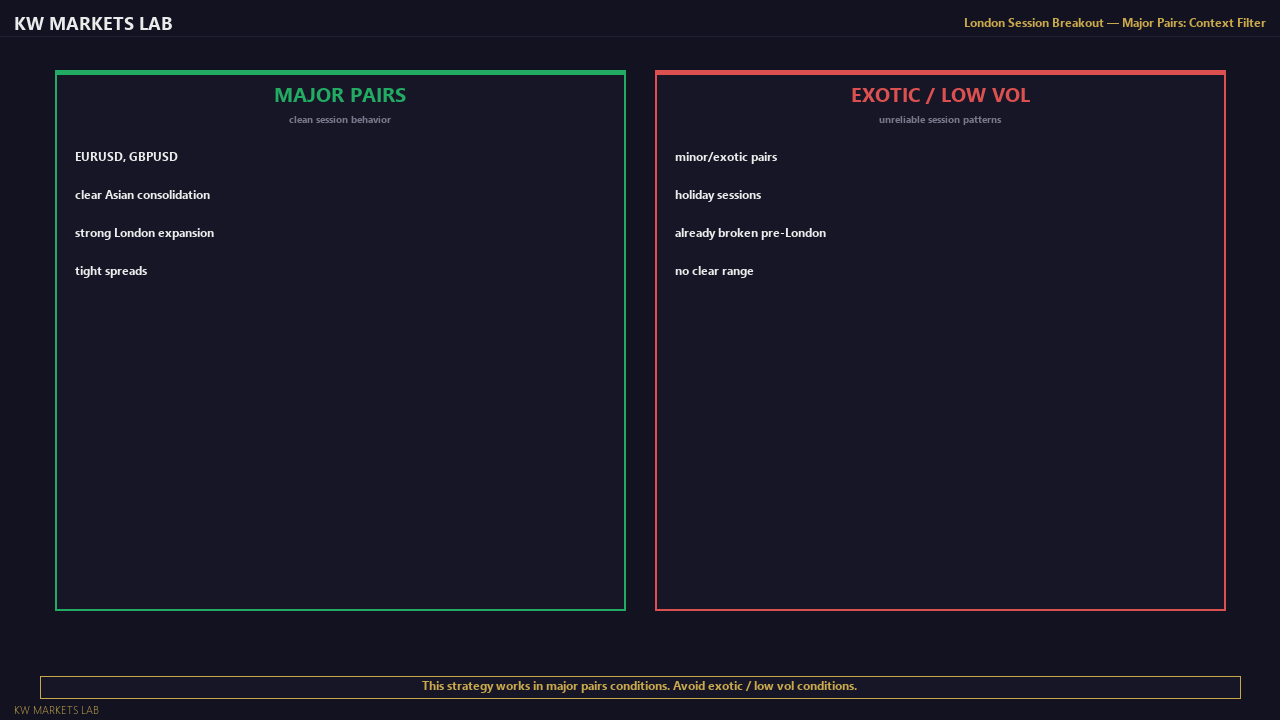
GBPUSD and EURUSD during trending macro phases: These pairs show the strongest London breakout tendency when a clear macro trend is in place.
-
Asian ranges between 30-60 pips: This is the sweet spot — enough consolidation energy for a clean expansion, not so wide that the target becomes impractical.
-
Tuesday through Thursday: Mid-week days produce the most reliable breakouts. Monday has gap risk, Friday has end-of-week positioning.
-
When the Daily bias aligns with the breakout direction: A London breakout that breaks in the direction of the Daily trend has significantly higher follow-through.
-
Post-consolidation weeks: After multi-day tight ranges on the Daily, the first London breakout often initiates the new directional phase.
Where It Fails
-
Choppy, range-bound pairs: When a pair has been ranging on the Daily for weeks, London breakouts tend to be false — the range boundary acts as a magnet pulling price back.
-
Major news at London open: BOE, ECB announcements, or surprise data releases produce erratic breakouts that do not follow session behaviour.
-
Narrow Asian ranges (<30 pips): Too little consolidation energy. The breakout is often weak and fails to reach the target.
-
Wide Asian ranges (>80 pips): The stop and target become too wide for practical position sizing at standard risk levels.
-
AUDUSD, NZDUSD, USDCAD: These pairs are driven by Asian/commodity flows, not London volume. London breakout behaviour is weaker.
-
Summer low-volume periods (July-August): Reduced institutional participation means weaker breakout tendency.
Known Limitations
-
Not every day produces a valid breakout. Some days the Asian range is too wide, too narrow, or not well-defined. Expect valid setups 3-4 days per week.
-
False breakouts are common — approximately 30-40% of range breaks reverse. The pullback entry method reduces this risk but does not eliminate it.
-
The strategy is time-bound. If you cannot watch the 0700-0900 GMT window, you cannot trade this strategy. It is not suitable for traders in time zones where this window is inconvenient.
-
Transaction costs are relevant on tight ranges. A 30-pip range with a 15-pip stop and 45-pip target on a pair with a 2-pip spread means spread consumes 4.4% of the target.
-
Monday London opens are less reliable — weekend gap adjustments can distort the Asian range.
-
The strategy requires discipline to skip days when conditions are not met. If you trade every day regardless of range quality, win rate drops significantly.
Visual Examples
Evidence & References
The Bank for International Settlements publishes turnover data by trading centre every three years. London consistently accounts for approximately 37-43% of global daily forex turnover, making it the highest-volume session by a significant margin. This provides the liquidity context for session-based breakout strategies.
Bank for International Settlements. Triennial Central Bank Survey (2022). BIS.org.
Nial Fuller has extensively documented the Asian range breakout methodology in publicly available educational content, including the concept of using the Asian session consolidation as the breakout reference and the London open as the timing window. The framework presented here applies the same session logic with an H4 directional filter.
Fuller, N. Learn to Trade the Market — public educational articles. LearnToTradeTheMarket.com.
Research Notes
Session-based trading research and references.
The concept of session breakouts is rooted in the observation that trading volume — and therefore price movement — is concentrated during specific time windows corresponding to major financial centre openings.
References:
- Dalton, J. (1990). Mind Over Markets. Initial balance and range extension concepts directly support the London breakout framework.
- Steidlmayer, P. (1986). Market Profile. Documents the opening range concept and its statistical tendency to define session direction.
- Kathy Lien (2008). Day Trading and Swing Trading the Currency Market. Wiley. Specifically documents the London/European session breakout as a practitioner strategy.
- Brooks, A. (2012). Trading Price Action Trading Ranges. Breakout mechanics and failure analysis applicable to session range breakouts.
Validation: Track 30+ London breakout attempts across EURUSD and GBPUSD. Record Asian range width, breakout direction vs Daily bias, and outcome. Expect win rate of 50-60% with positive R:R.
Learn the Full Framework
The concepts behind this strategy are covered in the Foundations course.
Start the Course →Full Documentation
Annotated examples, failure breakdowns, and complete evidence.
View VIP Access →