Overview
A two-timeframe framework specific to XAUUSD that establishes directional bias exclusively from the Daily chart, then drops to H1 to find a precise entry signal. Designed for traders who want a systematic approach to Gold without over-optimising to lower timeframe noise.
Before using this strategy:
When to Use This Strategy
- ✓Daily gold structure shows clear HH/HL or LH/LL
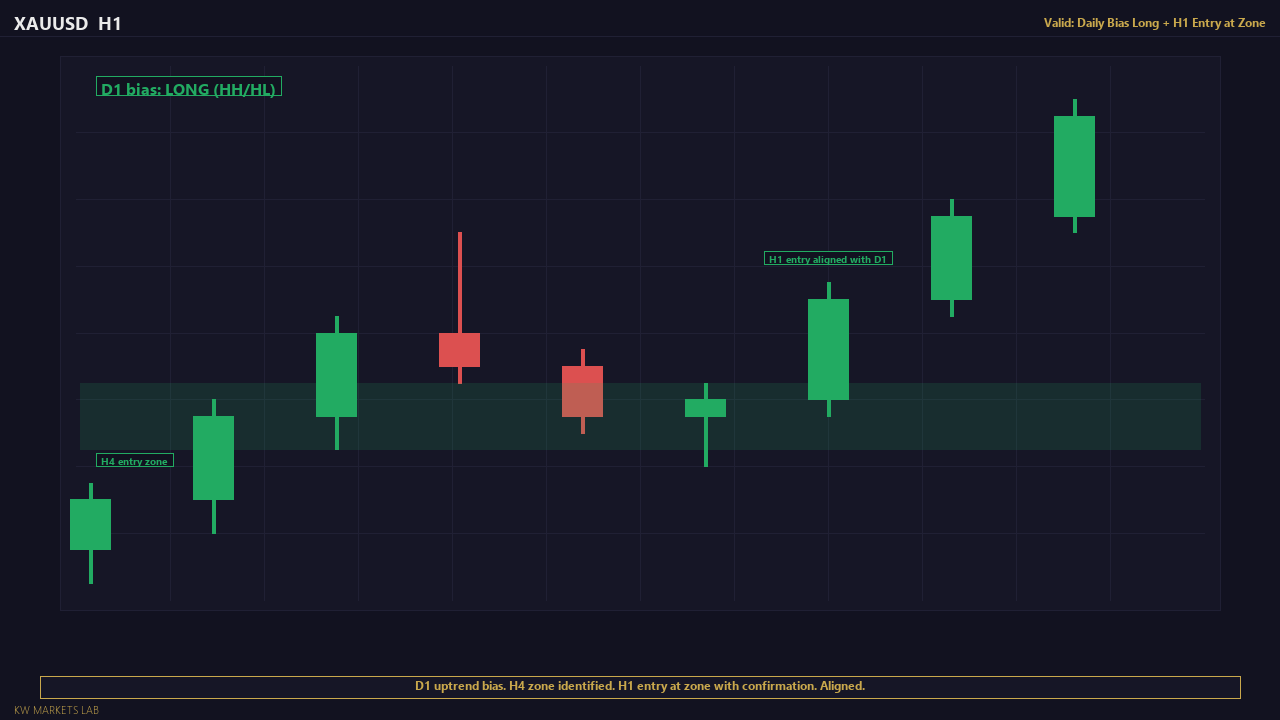
- ✓H4 is in a correction phase pulling back toward a Daily zone
- ✓A fresh Daily demand/supply zone is within reach of current price
- ✓London or New York session is about to open
When NOT to Use It
- ✗Daily structure is ranging or ambiguous
- ✗H4 is still in impulse (not yet correcting toward a zone)
- ✗The zone has already been tested twice (absorbed)
- ✗FOMC or CPI is scheduled within the next 30 minutes
Framework Overview
The XAUUSD Daily Bias & H1 Entry Framework is a complete trading system for gold that uses the Daily chart to establish directional bias and the H1 chart for precision entry timing. This framework combines the macro perspective of the Daily chart with the tactical execution capability of the H1 chart.
Why Two Timeframes
Gold's volatility requires a wider lens for context and a narrower lens for execution. The Daily chart shows you the trend — where institutional participants are positioned and where the next significant move is likely to come from. The H1 chart shows you the micro-structure within that trend — the pullbacks, the consolidation, and the specific moments where entry risk is minimised.
Trading gold on the Daily alone produces entries with stops too wide for practical position sizing. Trading gold on the H1 alone produces entries without directional conviction. The two-timeframe cascade solves both problems.
Framework Structure
-
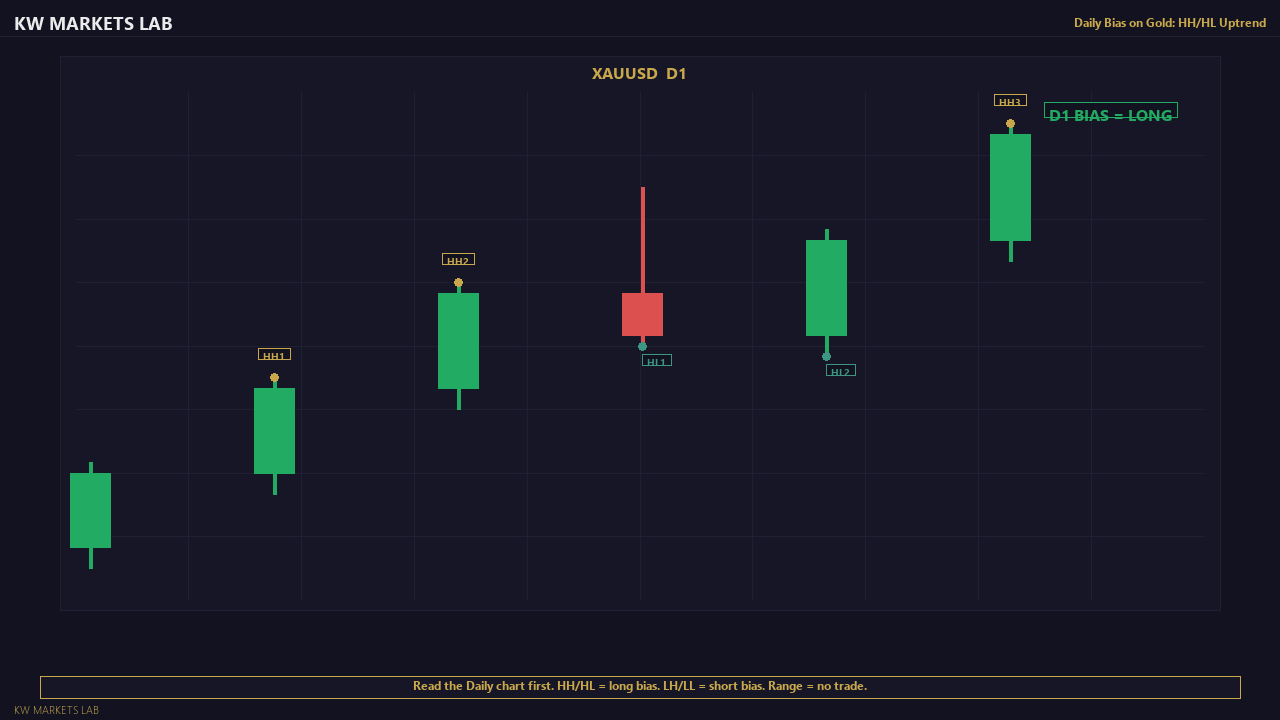
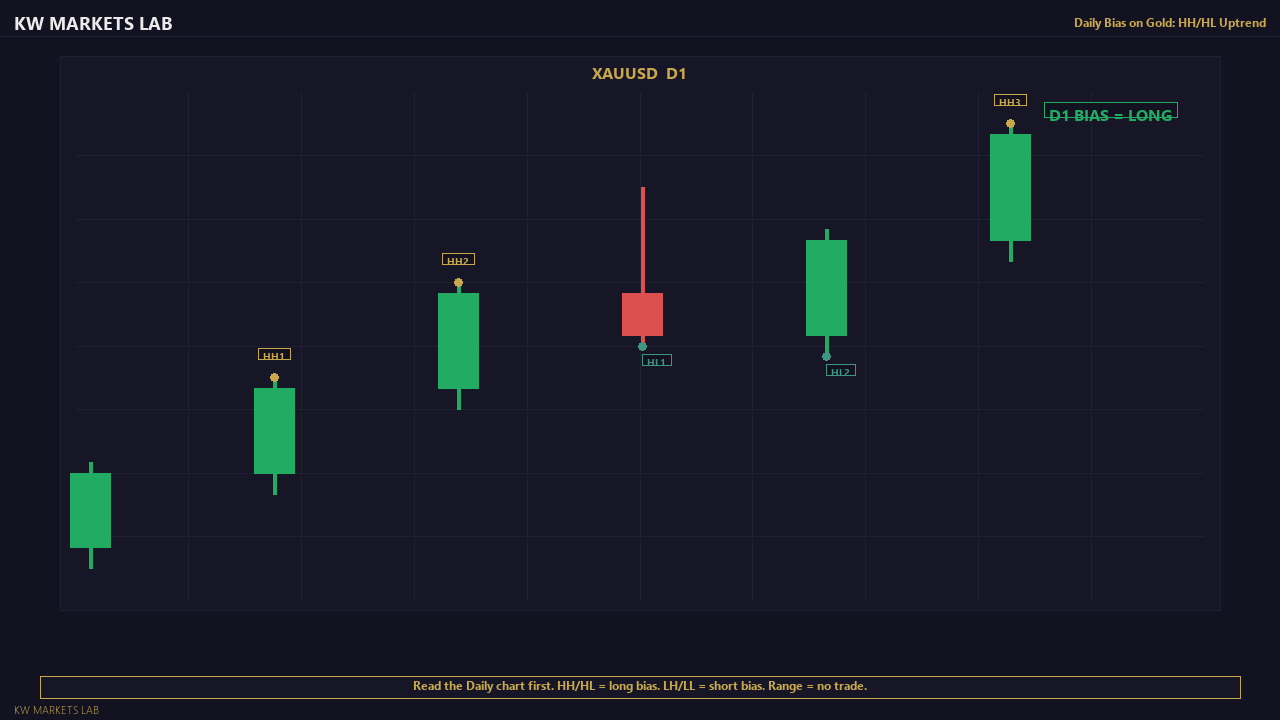
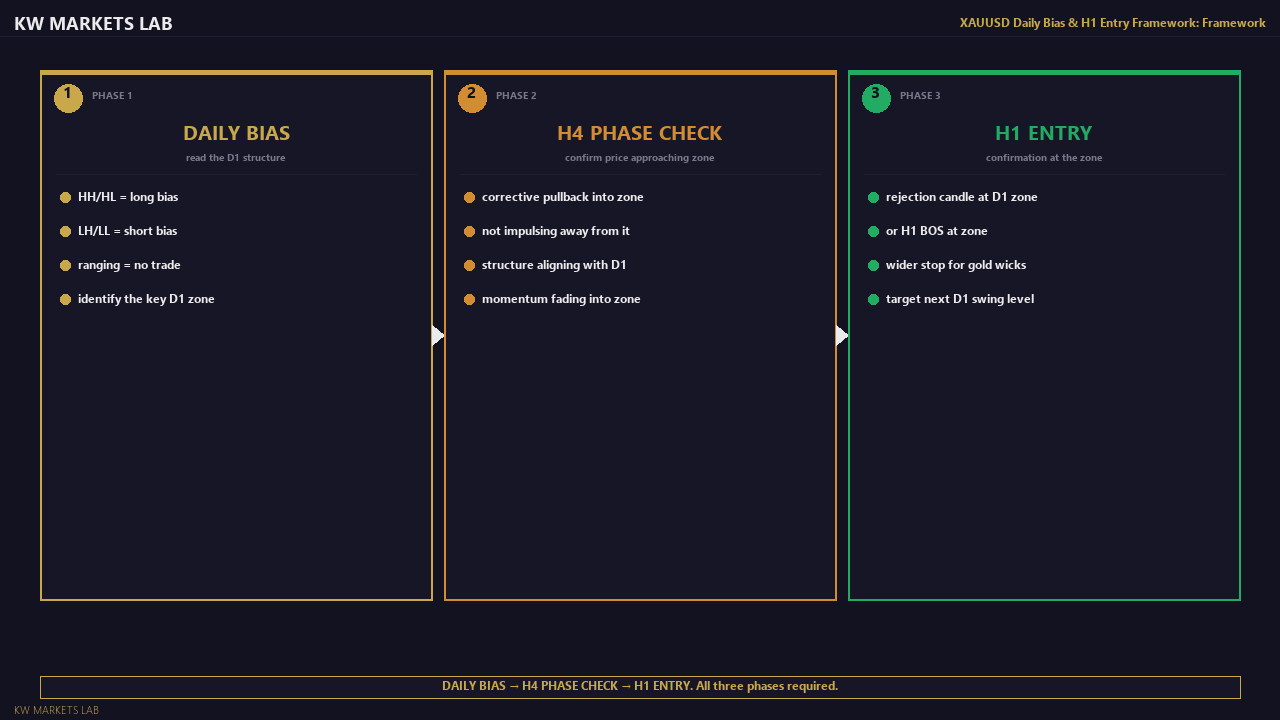
Daily Analysis (2-3 minutes): Identify the structural state (HH/HL or LH/LL). Mark the most recent significant demand and supply zones. Define the directional bias and the invalidation level. Write a one-sentence bias statement.
-
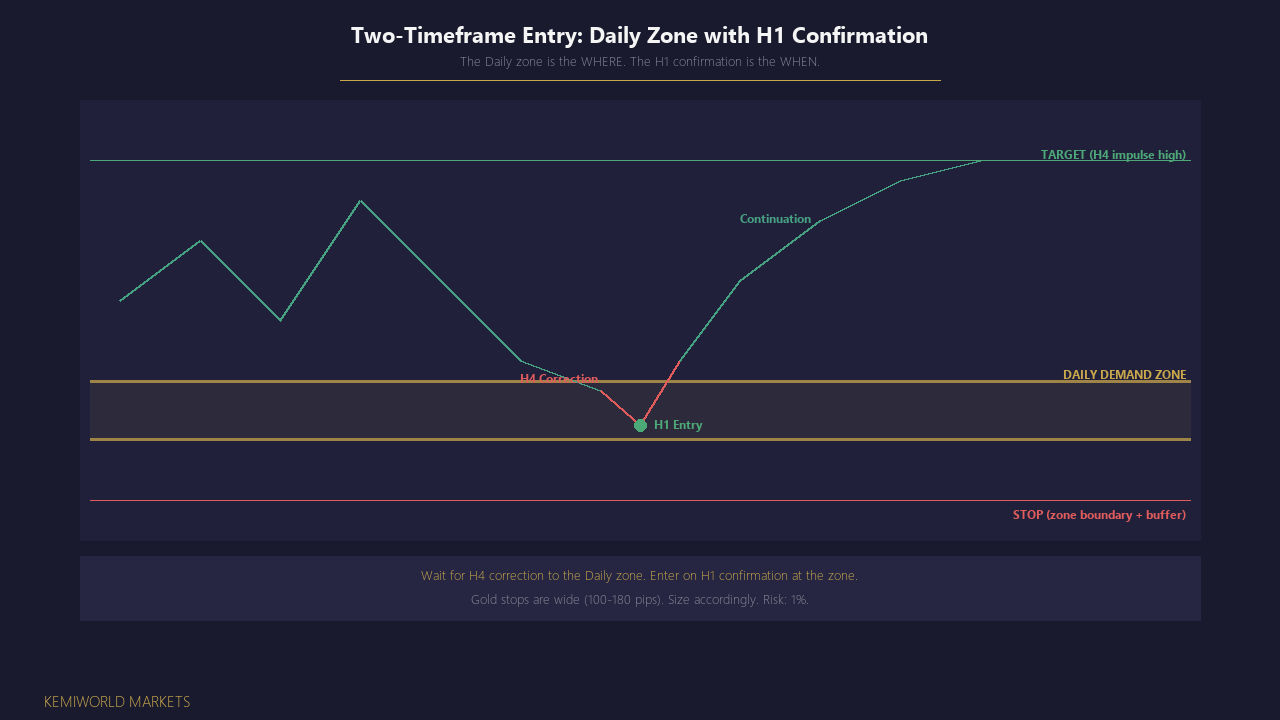
H4 Context (1-2 minutes): Identify the current H4 phase — is price in impulse (trending strongly) or correction (pulling back toward a Daily zone)? If price is in impulse, wait. If price is in correction toward a Daily zone, activate the H1 watch.
-
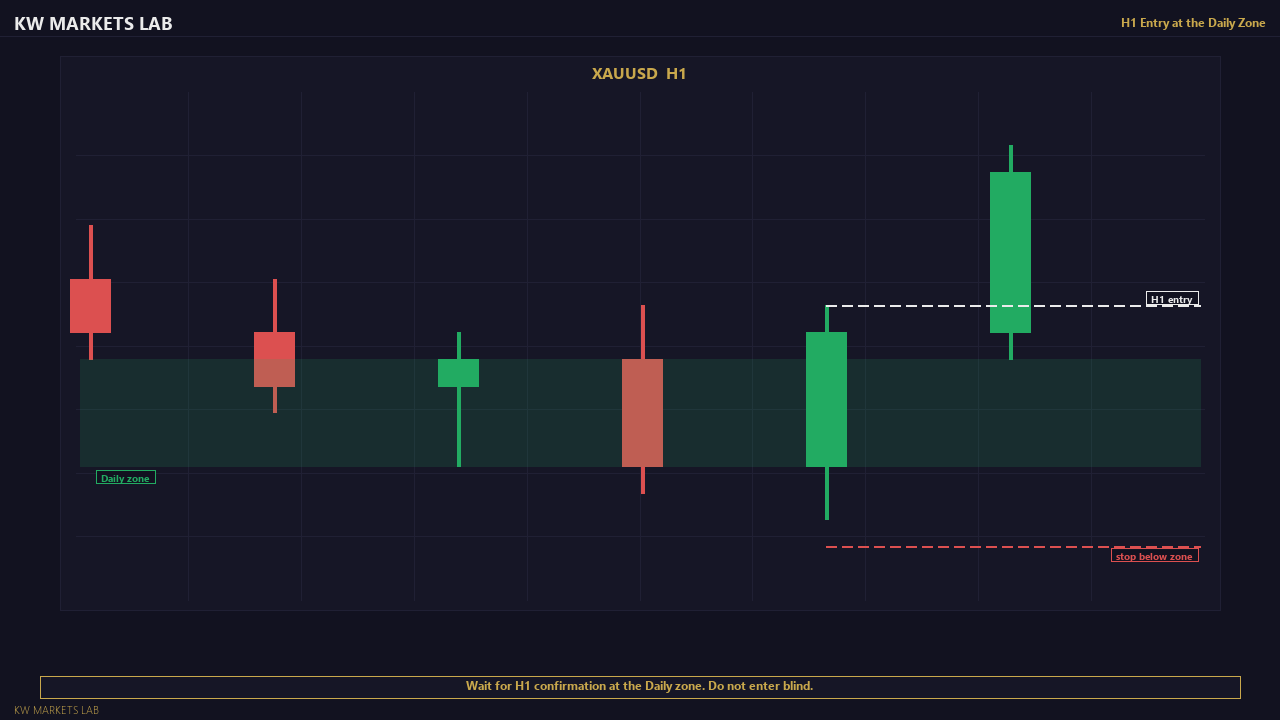
H1 Entry (active watch): When price reaches the Daily zone, switch to H1. Watch for: H1 BOS in the direction of the Daily bias, or a rejection candle at the zone boundary. Enter on confirmation with stop beyond the zone.
Gold-Specific Adjustments
All parameters are calibrated for XAUUSD:
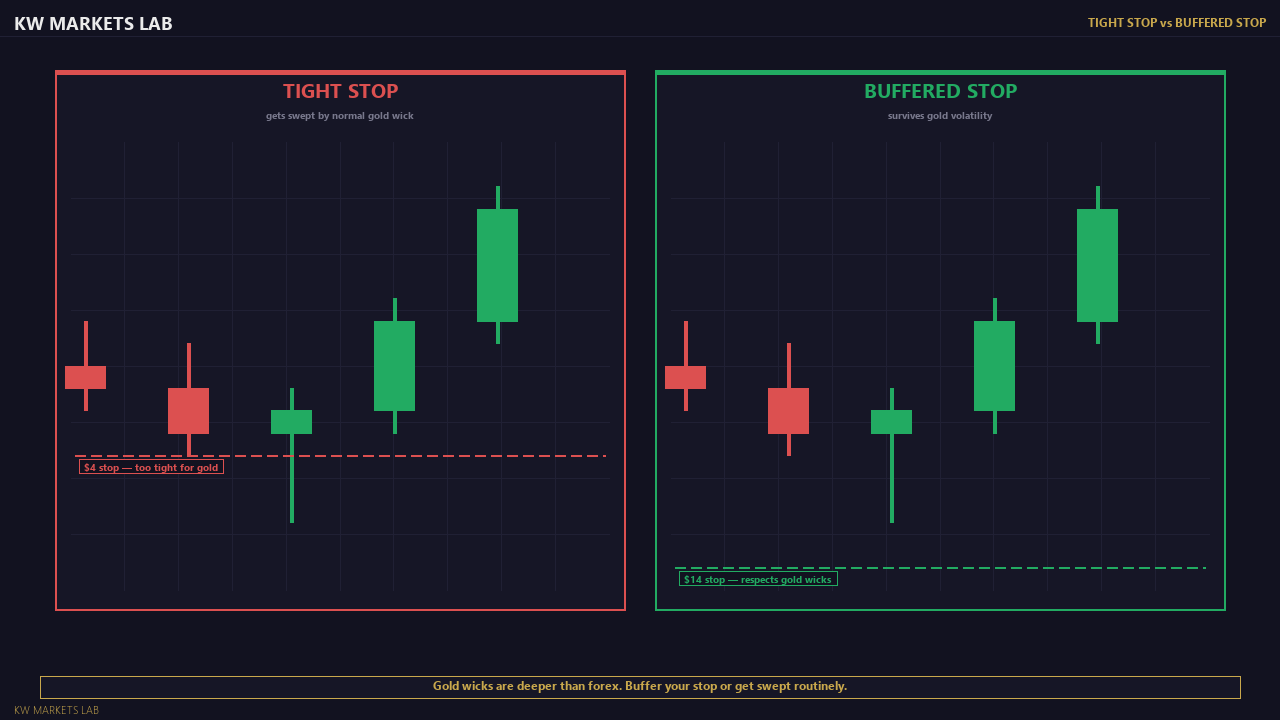
- H1 stop placement: 80-120 pips below/above the zone (gold wicks are deep)
- Position sizing: use gold-specific pip value ($0.10 per pip per 0.01 lot)
- Session preference: London open and NY open produce the best H1 entries
- Avoid Asian session entries on gold (low volume, wide spreads, false signals)
What This Strategy Produces
A typical trading week produces 2-4 valid setups on XAUUSD. Each setup has:
- A clear Daily directional bias
- A defined H1 entry with specific stop and target
- R:R ratio of 1.5:1 to 3:1 depending on zone depth and target distance
- Hold time of 4-12 hours (intraday to overnight)
What This Strategy Is Not
This is not a scalping framework. It requires patience — sometimes waiting 2-3 days for price to reach a Daily zone. It is not a counter-trend strategy — entries are always in the direction of the Daily bias. And it is not a set-and-forget system — the H1 entry requires active monitoring during the kill zones.
Market Conditions Required
This framework requires:
- A clear Daily trend on gold (HH/HL or LH/LL with at least 2 completed swing pairs). If the Daily is ranging, this framework produces no setups — do not force a bias.
- A defined Daily demand or supply zone within reach. "Within reach" means current price is correcting toward the zone, not already deep inside it or past it. Set alerts rather than watching continuously.
- Normal gold volatility (Daily ATR 1500-2500 pips). In very low volatility (ATR under 1000), zones are less reactive. In very high volatility (ATR over 3000), the framework's stop parameters may be insufficient.
- The H4 must be in a corrective phase — pulling back toward the zone. If H4 is in impulse (strongly trending away from the zone), the correction has not started yet. Wait.
What Makes This Setup Weak
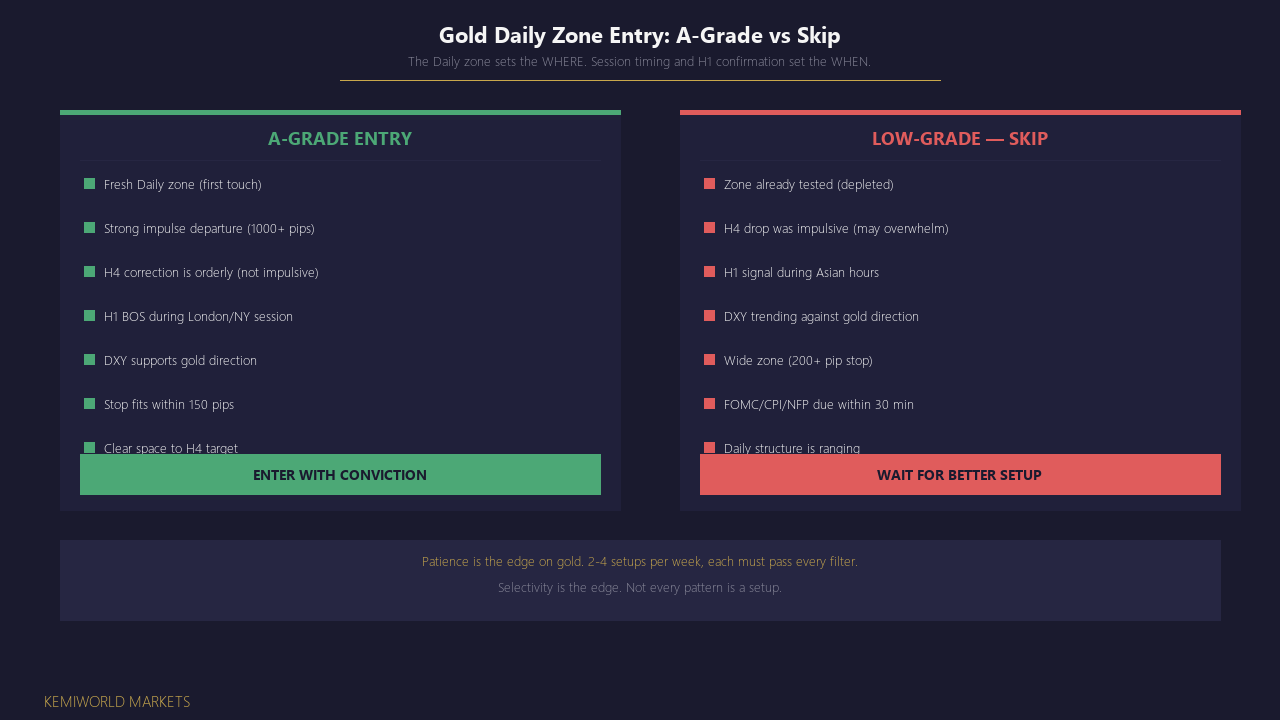
- The Daily zone has been tested before. Fresh (first-touch) zones with strong impulse departures (1000+ pips) are the highest probability. Retested zones are depleted.
- The H1 confirmation occurs during Asian session (0000-0700 GMT). Gold's Asian session has thin volume and wide spreads. H1 BOS signals during Asian have poor follow-through. Wait for London or NY.
- The Daily zone is wide (more than 200 pips). Wide zones produce wide stops (200+ pips), resulting in very small lot sizes and poor R:R unless the target is exceptionally distant.
- DXY is trending strongly in the direction that opposes the gold trade. Gold is inversely correlated with USD. If DXY is impulsively rallying and your gold setup is a long, the macro headwind significantly reduces probability.
Common Beginner Mistake
Entering before the H4 correction reaches the Daily zone. Beginners see the Daily bias is bullish and enter long at any price, anywhere on the chart. But the entry is specifically at the Daily zone — not just "somewhere in the bullish trend." The Daily zone is where the institutional orders sit. Entering above the zone means entering without the institutional support that makes the trade work.
The second mistake: using forex-sized stops on gold. A 25-pip stop on gold will be hit by normal intraday noise within minutes. Gold requires 80-150+ pip stops due to its wick depth and ATR. Adjust lot size accordingly — wider stop = smaller lots = same 1% risk.
What Experienced Traders Notice
- Whether the H4 correction is orderly or impulsive. An orderly, slow pullback toward the zone (controlled selling) is ideal. A fast, impulsive drop toward the zone suggests panic — which may overwhelm the demand at the zone.
- The DXY correlation. When DXY is also approaching a key level in the opposite direction, the gold trade has dual confirmation. When DXY is trending strongly against the gold direction, reduce size or skip.
- How many H4 candles the correction has taken. A correction that reaches the zone in 3-5 H4 candles is fresh and timely. One that takes 15+ candles is extended and may overshoot the zone entirely.
- The time of day. The best H1 entries on gold occur during the first 90 minutes of London open (0700-0830 GMT) and the first 90 minutes of NY open (1300-1430 GMT). Entries outside these windows have lower follow-through.
When to Skip This Trade
- Daily structure is ranging or ambiguous
- The zone has been tested twice (orders absorbed)
- H4 is still in impulse — the correction toward the zone has not begun
- The H1 confirmation forms during Asian hours
- FOMC, CPI, or NFP is due within 30 minutes
- DXY is trending strongly against the gold direction
- The zone is too wide for a reasonable R:R (200+ pips on gold)
Entry Conditions
All conditions must be confirmed.
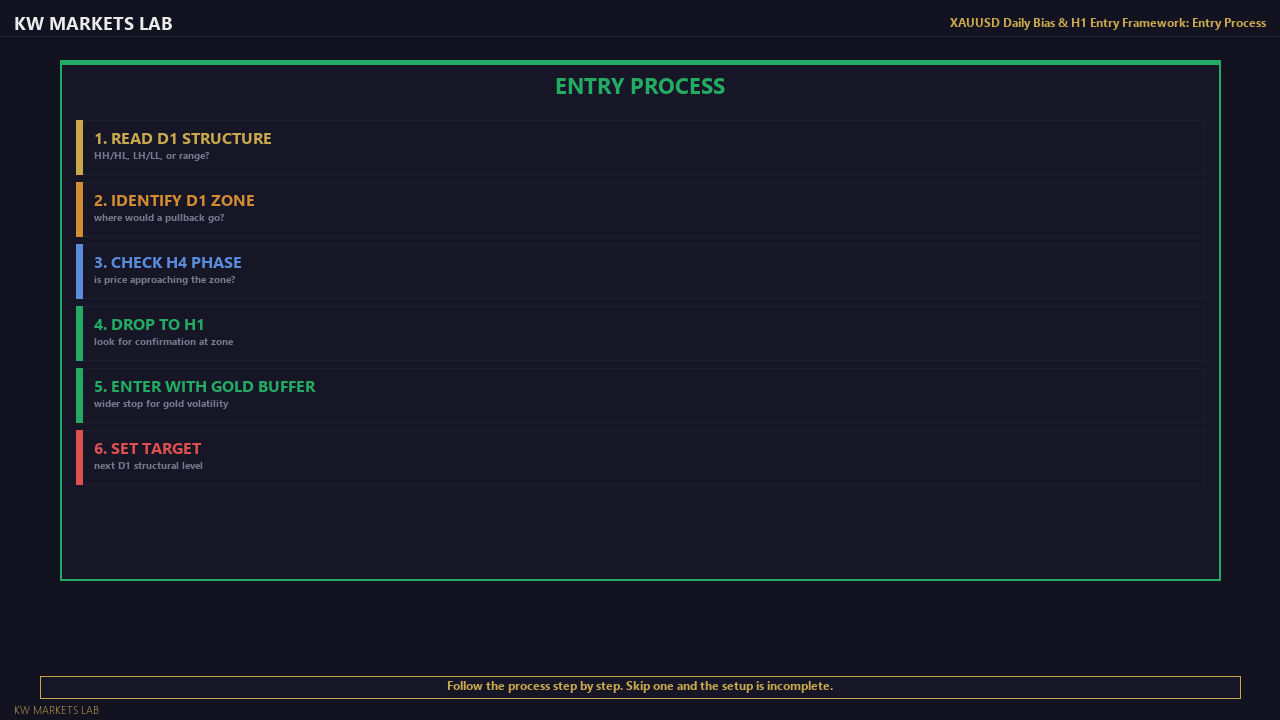
1. Daily Structural State Defined
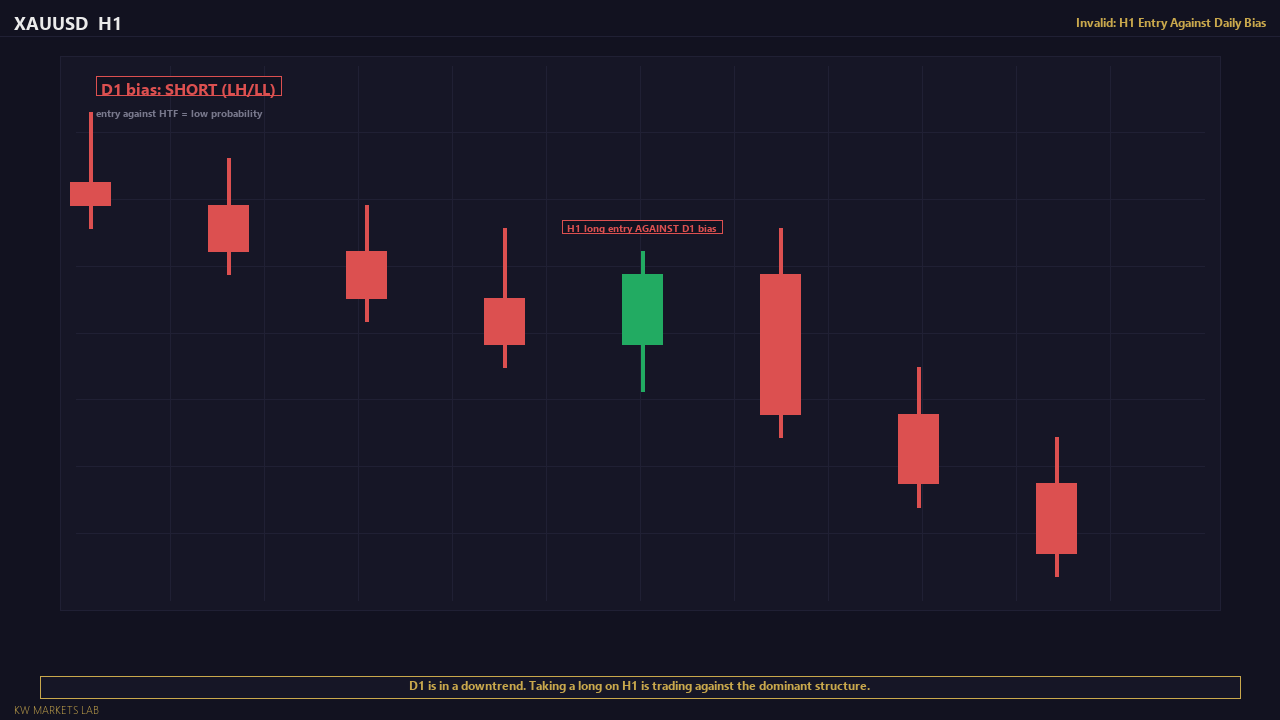
The Daily chart must show clear trending structure. HH/HL = bullish bias (look for longs only). LH/LL = bearish bias (look for shorts only). Ranging Daily = no trades under this framework.
2. Daily Zone Identified
For longs: identify the most recent Daily demand zone (origin of the last significant rally). For shorts: identify the most recent Daily supply zone. The zone must be significant — a zone that produced a 500+ pip move on gold.
3. H4 Phase Check
The H4 must be in a corrective phase — pulling back toward the Daily zone. If the H4 is in impulse (strongly trending away from the zone), wait. Entries are made during the correction, not during the impulse.
4. Price Reaches the Daily Zone
Wait for price to arrive at or near the Daily demand/supply zone. "Near" means within 100-150 pips on gold. Set alerts rather than watching continuously.
5. H1 Confirmation at the Zone
When price reaches the zone, watch the H1 chart for:
- H1 BOS in the direction of the Daily bias (strongest confirmation)
- Rejection candle at the zone boundary (moderate confirmation)
- The confirmation must occur during London or NY session hours
6. Entry Placement
Enter after H1 confirmation. Stop placement: beyond the far boundary of the Daily zone + 50-80 pip buffer. On gold, this typically means a 100-180 pip stop.
7. Position Sizing
Lot size = (Account x 1%) / (Stop pips x $0.10 per pip per 0.01 lot x 100). Gold stops are wide — expect small lot sizes. Do not increase risk percentage to compensate.
8. Target
Primary target: the H4 swing that marked the start of the correction (the most recent H4 impulse high for longs). Secondary target: the next significant Daily level. Minimum R:R: 1.5:1.
9. Management
At 1:1 R: move stop to breakeven. At primary target: close 50-60% of position. Trail remaining position behind H1 structural levels.
Failed Setup Example
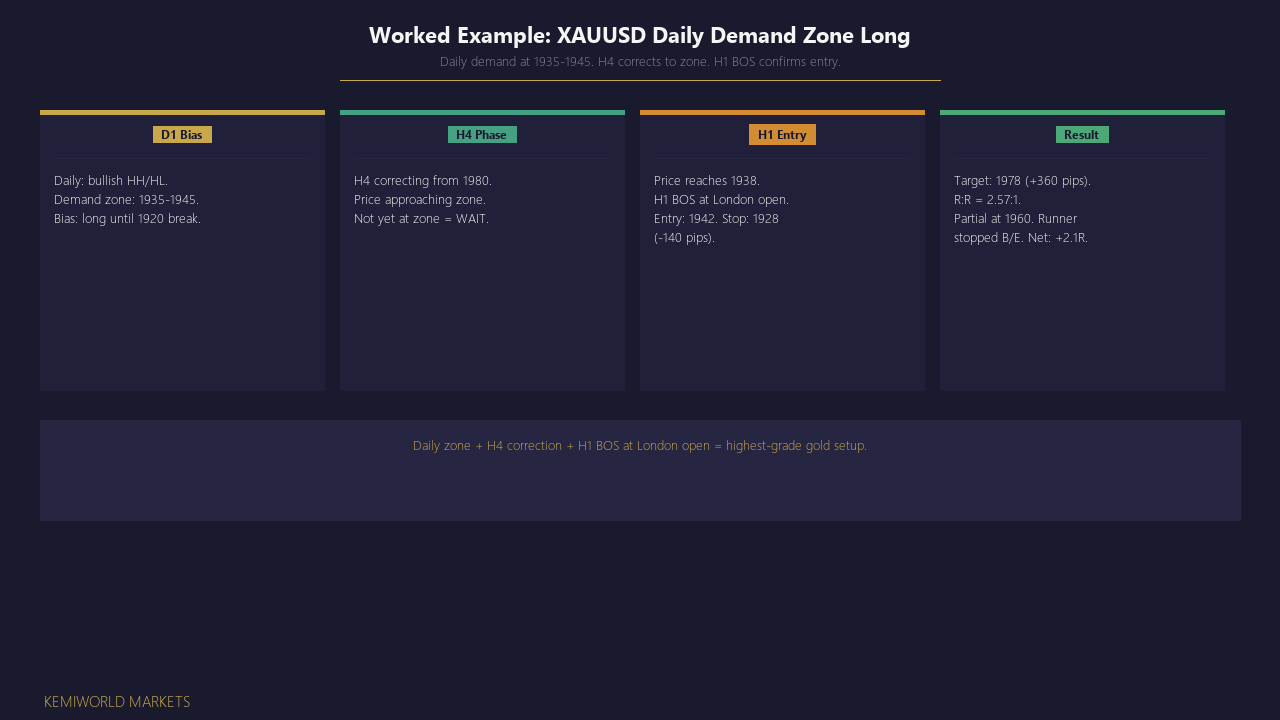
Daily gold is bullish. Demand zone at 1940-1950. H4 is impulsively dropping from 1985 with large bearish candles. Price reaches 1942 and a small H1 candle forms at 0300 GMT (Asian session). A beginner enters long.
Why this fails: the H4 drop was impulsive, not corrective — aggressive selling may overwhelm the demand zone. The H1 "confirmation" occurred at 0300 GMT during Asian thin volume — unreliable. The candle was small and indecisive (not a clear rejection or BOS). The correct action: wait for London open, see if the zone holds with a strong H1 BOS during the London kill zone, then enter. If the zone breaks during London, the setup is dead.
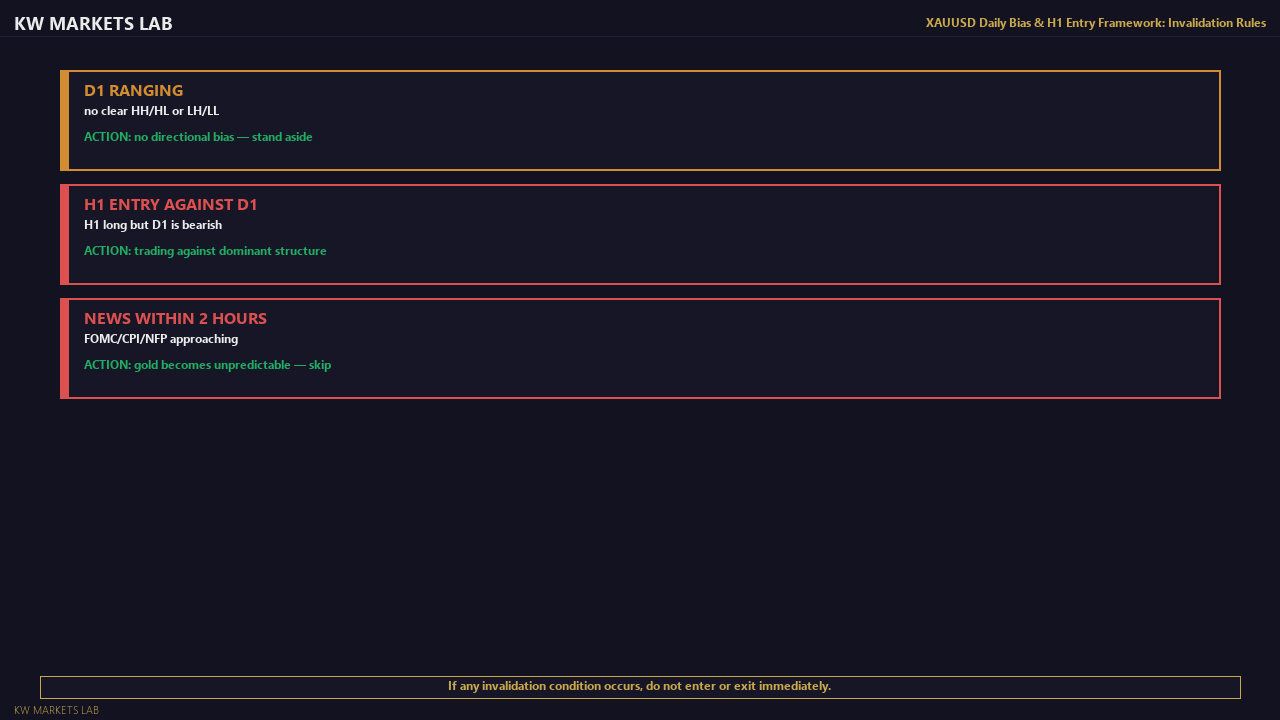
Invalidation & Risk Rules
When the Daily bias / H1 entry setup is invalidated.
1. Daily Structure Breaks (CHoCH)
If the Daily chart produces a Change of Character (LL in bullish structure, HH in bearish), the bias is no longer valid. Cancel all pending entries and reassess.
2. Price Does Not Reach the Daily Zone
If price reverses before reaching the identified zone, there is no entry. Do not enter at an intermediate level — the setup requires price at the Daily zone.
3. No H1 Confirmation After 3 H1 Candles in the Zone
If price enters the Daily zone but the H1 does not produce a BOS or rejection within 3 candles (3 hours), the zone may be absorbing rather than rejecting. The setup degrades significantly.
4. H1 Confirmation During Asian Session
If the H1 BOS or rejection occurs during Asian hours (0000-0700 GMT), the confirmation is low-quality due to thin volume. Wait for London or NY session confirmation.
5. High-Impact News Within 30 Minutes
If a gold-sensitive release (US CPI, FOMC, NFP, Fed speeches) is scheduled within 30 minutes, the H1 confirmation may be noise. Wait for post-news stabilisation.
6. Zone Has Been Tested Before
Fresh Daily zones (first touch) are the highest probability. A zone that has already been tested and held is weaker. A zone tested twice is invalid.
The "Zone Will Hold Because Daily Is Bullish" Trap
Beginners assume that because the Daily trend is bullish, every pullback to a demand zone must bounce. But Daily zones can break even in bullish trends — especially when the zone is retested, the correction is impulsive, or a fundamental event shifts the macro context.
The sign a zone is failing on gold: price enters the zone, spends 2+ H1 candles inside it without producing a clear rejection wick, and the bodies are closing deeper into the zone. This is absorption — the institutional orders are being consumed. After 3 H1 candles inside the zone without rejection, cancel the entry.
Where It Works
-
Gold in a clear Daily trend: When the Daily shows clean HH/HL or LH/LL, the framework's bias filter produces high-quality directional entries.
-
London and NY kill zone entries: The best H1 confirmations occur during the first 90 minutes of London and NY sessions. Session timing dramatically improves entry quality.
-
Fresh Daily demand/supply zones: First-touch zones that produced large impulses (1000+ pips) are the highest-probability entry locations.
-
When DXY trend agrees: Gold is inversely correlated with USD. When the DXY trend supports the gold bias (weak DXY for gold longs), the framework performs best.
-
Moderate volatility periods: When gold's daily ATR is 1500-2500 pips, the framework's parameters are well-calibrated. In very low or very high volatility, adjust expectations.
Where It Fails
-
Ranging Daily structure: Without a clear trend on the Daily, the framework produces ambiguous signals. Do not force a bias in ranging conditions.
-
Strong one-direction days: When gold rallies or drops 2500+ pips in a single session without pulling back, the framework produces no entries because price never reaches a zone.
-
During and immediately after FOMC/CPI: These events can reverse Daily structure in a single candle. Wait 2-3 Daily candles after a major event before re-establishing the framework.
-
When DXY is directionless: If DXY is ranging, gold often chops without clean trending structure. The framework requires directional conviction.
-
Asian session entries: Even if H1 BOS forms during Asian hours, the follow-through is unreliable. Session filter is non-negotiable on gold.
-
After 3+ consecutive Daily impulses: Late-trend zones have lower probability. Each successive zone in the trend direction is weaker than the last.
Known Limitations
-
The framework requires patience. Price may take 2-5 days to reach a Daily zone. If you need daily activity, this framework will under-deliver on frequency.
-
Gold's wide stops (100-180 pips) produce small lot sizes. Account growth is slower but risk is well-managed.
-
The Daily zone identification is subjective. Different traders may mark slightly different zones. Consistency in your method is more important than finding the "perfect" zone.
-
The strategy does not work on strong trend days when gold moves 2000+ pips without pulling back to any zone. These days are missed — not failed analysis.
-
The H1 confirmation requires active monitoring during London and NY open. If you cannot watch during these windows, the framework is impractical.
-
Gold-specific risk events (FOMC, CPI, NFP) can invalidate zones by gapping through them. Consider reducing exposure before known high-impact events.
Visual Examples
Evidence & References
The World Gold Council publishes regular research on gold price drivers. Key findings relevant to this framework: gold exhibits a persistent negative correlation with the US dollar index; gold price is significantly influenced by US real yields; the London and New York sessions account for the majority of daily volume and directional price movement.
World Gold Council. Gold Market Research and Outlook. Gold.org (various publications).
Kleinman documents gold's behavioural characteristics as a commodity-currency hybrid: responding to both technical levels and macro fundamentals. The dual nature of XAUUSD — reacting to price action patterns while also being fundamentally driven — is well-established in commodity trading education.
Kleinman, G. (2013). Trading Commodities and Financial Futures (4th ed.). FT Press.
Research Notes
Multi-timeframe analysis and gold-specific trading research.
The two-timeframe framework (Daily context + lower-timeframe entry) is a foundational concept in professional trading, documented extensively in both academic and practitioner literature.
References:
- Elder, A. (1993). Trading for a Living. Wiley. Introduces the triple-screen trading system — a multi-timeframe framework that uses higher timeframes for direction and lower for entry.
- Murphy, J. (1999). Technical Analysis of the Financial Markets. Multi-timeframe analysis methodology.
- Brooks, A. (2012). Trading Price Action Trends. Wiley. Higher-timeframe context as a filter for lower-timeframe entries.
- Nison, S. (1991). Japanese Candlestick Charting Techniques. Rejection candle patterns (hammer, shooting star) as confirmation signals at key levels.
Gold-specific context:
Gold's correlation with USD, real interest rates, and risk sentiment adds macro overlay to the technical framework. The references above provide the technical methodology; the gold-specific parameters (stop buffers, session windows, pip value) are calibrated from practitioner experience on XAUUSD specifically.
Validation: Paper-trade 30+ setups on gold using this framework. Track: zone quality, H1 confirmation type, session timing, and R:R outcome. Expect 2-4 setups per week with 40-55% win rate.
Learn the Full Framework
The concepts behind this strategy are covered in the Foundations course.
Start the Course →Full Documentation
Annotated examples, failure breakdowns, and complete evidence.
View VIP Access →